

.jpeg)
In the world of design, some systems remain quietly essential — working behind the scenes to keep our buildings safe, healthy, and sustainable. One of these unsung heroes is the Sewage Treatment Plant (STP).
For architects and engineers, STPs are not just about compliance — they are about designing with responsibility. In an era where every drop of water counts, understanding the logic, location, and integration of an STP can define whether a project is sustainable in the truest sense.
“Architecture doesn’t end at the façade — it extends underground, where systems sustain what we design above.”
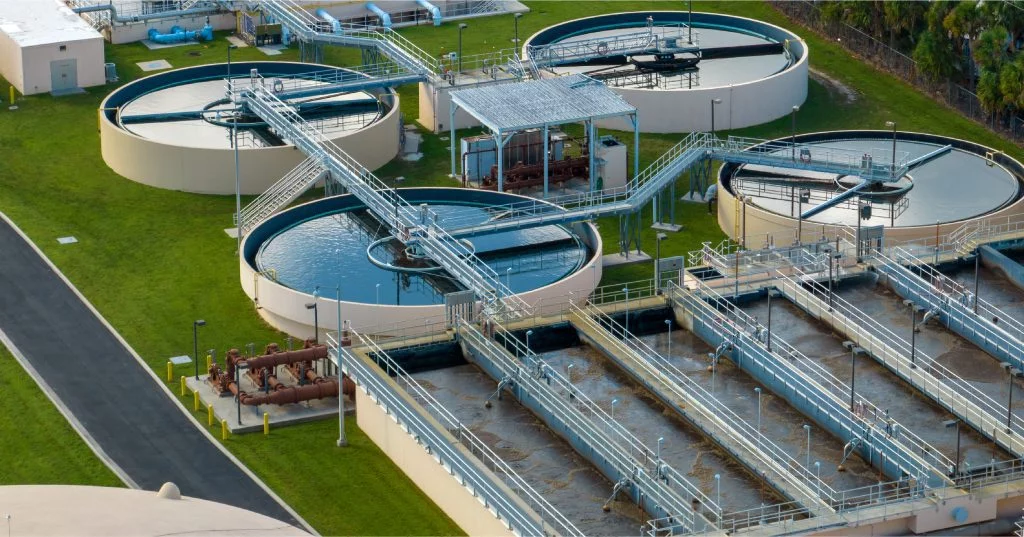
What Is an STP and Why Do We Need It?
An STP (Sewage Treatment Plant) is a system that treats wastewater from toilets, kitchens, and wash areas before releasing or reusing it. In urban India, most municipalities now mandate STPs for residential complexes, institutions, hotels, and commercial developments generating over a threshold volume of wastewater (usually >20,000 litres/day).
Without proper treatment, raw sewage contaminates soil and water bodies — leading to diseases and ecological imbalance. STPs help recycle water for flushing, landscaping, or HVAC systems, cutting dependence on freshwater sources.
Did You Know? Treated STP water can reduce fresh water demand in large housing projects by up to 40%.
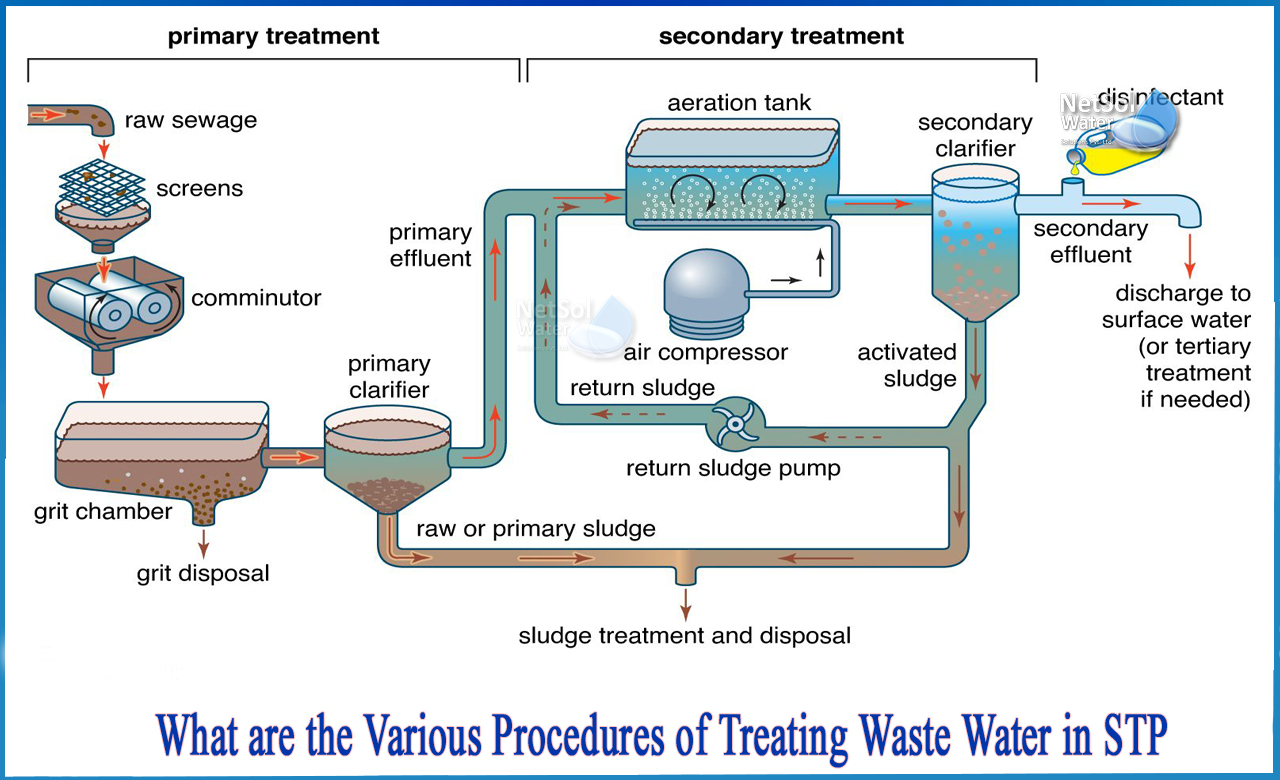
How Does an STP Work? The Process Simplified
Every STP follows the same fundamental treatment stages — though technology and scale may differ.
(A) Primary Treatment
- Removes physical impurities (sand, plastic, grit) through screening and sedimentation.
- The heavier solids settle as sludge.
(B) Secondary Treatment
- Biological process where microorganisms break down organic matter.
- Systems like Activated Sludge Process (ASP) or Moving Bed Biofilm Reactor (MBBR) are common.
(C) Tertiary Treatment
- Final filtration and disinfection using UV or chlorination.
- Water becomes safe for reuse — though not for drinking.
Understanding each stage helps in planning spatial and service needs — tanks, aeration units, and drying beds all need specific zones, ventilation, and maintenance access.

Where Does an STP Fit in Building Design?
Architecturally, the STP isn’t just a technical box to be placed anywhere on site — its location, access, and integration matter deeply.
Key Design Considerations
| Aspect | Design Implication |
| Location | Place STPs at the lowest contour of the site — gravity-fed pipelines save energy and reduce maintenance. |
| Access | Ensure vehicular access for sludge removal trucks (at least once every few months). |
| Odour Control | Provide natural ventilation shafts and consider odour-proof manholes. |
| Noise | Buffer the blower and motor rooms acoustically or through planting. |
| Integration | In landscape-heavy sites, STPs can be subtly integrated under podiums or behind green berms. |
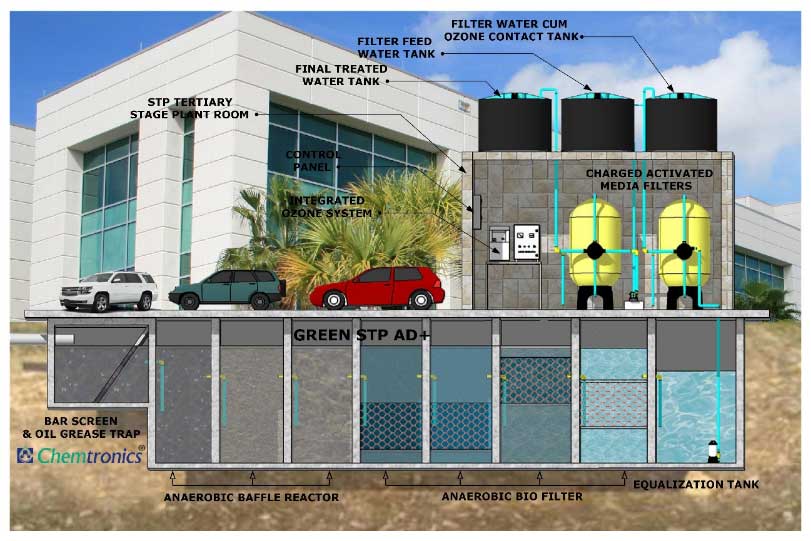
Design is not just about adding systems — it’s about making them disappear beautifully.
STPs as Part of the Sustainable Water Cycle
An STP doesn’t exist in isolation. It’s part of a closed water management loop in buildings:
Water Supply → Usage → Treatment → Reuse → Recharge.
Architects can amplify sustainability by linking the STP to:
- Greywater reuse for flushing or HVAC make-up.
- Rainwater harvesting systems to recharge groundwater.
- Bioswales and percolation trenches for overflow management.
Example: In an institutional campus, STP-treated water often irrigates lawns through a subsurface drip system, ensuring no standing water or odour. When designed holistically, an STP becomes an invisible engine of sustainability.
Case Study: Auroville, Tamil Nadu – Decentralised Wastewater Treatment (DEWATS) Image Alt Text: Auroville’s natural treatment ponds lined with vegetation showing root-zone treatment of wastewater. Caption: Auroville’s DEWATS model shows how wastewater can be treated naturally through bio-filtration, creating a zero-energy, ecological alternative to mechanical STPs.
Why it’s innovative:
- Uses constructed wetlands instead of energy-intensive blowers.
- Blends with the landscape — functioning as both ecology and infrastructure.
Common Mistakes to Avoid
- Ignoring STP in early site zoning: retrofitting is costly and often compromises design quality.
- Undersized treatment units: always calculate using peak occupancy loads.
- No provision for sludge removal access: leads to long-term maintenance failure.
- Poor ventilation and odour management.
- Mixing stormwater and sewage lines — a frequent coordination error in student and professional drawings alike.
A well-coordinated STP layout reflects how seriously a designer understands system-based architecture.
The Future: Smart & Decentralised STPs
Emerging technologies are reshaping how we treat wastewater in the built environment:
- Modular prefabricated STPs for rapid installation in housing complexes.
- IoT-based monitoring for flow, pH, and dissolved oxygen control.
- Decentralised systems (DEWATS) for small clusters of houses or urban blocks.
These shifts align perfectly with the AECO industry’s move towards sustainable infrastructure and integrated design thinking.
Tomorrow’s architect isn’t just a designer — they are a systems thinker. Knowing where your water goes is knowing how your building lives.
Learning to Integrate STPs as a Designer
For architecture students and young professionals, understanding how to read STP drawings, coordinate shafts and pipelines, and visualise service areas in 3D is becoming as essential as knowing structure or HVAC.
💡 You might want to read next: 👉 “Plumbing Case Studies: What to Involve and Avoid in Complex Projects.”
Stay tuned for Kaarwan’s upcoming MEP Design Course — designed for Architects and Civil Engineers to learn service coordination, system layouts, and sustainable design integration.
The mark of a thoughtful architect lies in how they handle the unseen — water, waste, and systems that make architecture truly alive.
Understanding Sewage Treatment Plants (STPs) is no longer optional. It’s a step toward designing buildings that don’t just stand beautifully — they function responsibly.
FAQs
Q1: What is the main purpose of an STP in a building?
To treat sewage and wastewater, making it reusable or safe for discharge into the environment.
Q2: Can STP-treated water be reused for drinking?
No. It can be reused for non-potable purposes like flushing, irrigation, and HVAC cooling.
Q3: How do architects contribute to STP design?
By ensuring proper site placement, accessibility, ventilation, and integration with landscape and drainage systems.




.png)