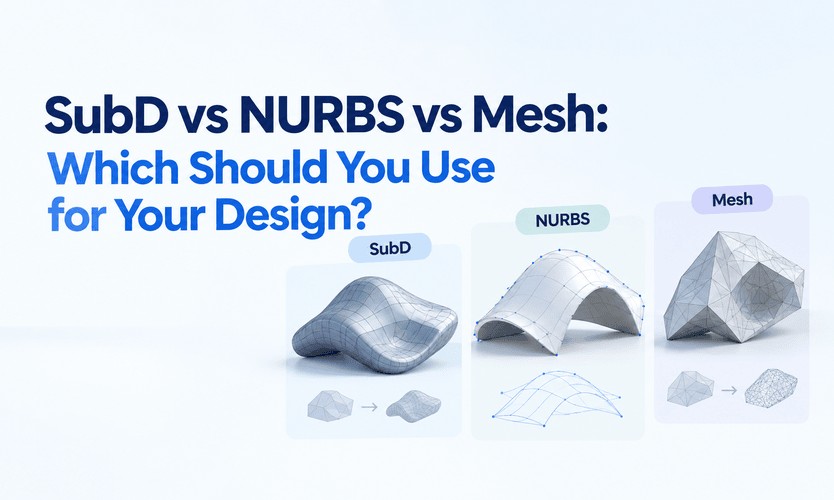
SubD vs NURBS vs mesh comes down to one question: what does this model need to do once it leaves your screen?
NURBS gives you precise, fabrication-ready surfaces. Mesh suits freeform work and anything headed for a 3D printer. SubD lets you push and pull organic forms fast, and in Rhino it can still be converted to NURBS when you need exact geometry.
Most students just use whichever type they learned first, even when it's the wrong tool for the job. This guide gives you a decision table to match your project (a curved façade, a piece of furniture, a printed model) to the right geometry type, and shows you how to move between all three.
One thing worth knowing: this is also how Kaarwan's Rhino & Grasshopper Certification is sequenced. Students work through NURBS and surface continuity first, then move on to advanced SubD modeling.
What Each Geometry Type Actually Is
All three describe a surface. They just describe it differently, and that difference decides everything else.
NURBS surfaces are defined by maths: a degree, control points, knots and an evaluation rule. Nothing is approximated. The surface simply is the equation.
A mesh is a net of vertices, edges and flat faces. It looks smooth only because there are enough tiny facets that your eye gives up counting.
SubD sits between the two. You edit a low-poly control cage, and a subdivision algorithm (Catmull-Clark, published back in 1978) rounds it into a smooth form. In Rhino, SubD is its own geometry type, described as measurable and manufacturable, and it can be converted to NURBS or mesh when you need to.
That last bit trips people up. You'll read plenty of articles claiming SubD is "just a mesh". In Rhino, it isn't quite that simple.
Want all three geometry types hands-on? Kaarwan's Rhino & Grasshopper Certification with Job Support takes you from NURBS and surface continuity to advanced SubD modeling.
NURBS: Best For
NURBS is best for anything that will be cut, moulded, milled or documented to a tolerance.
Think of a curved façade with panels that all have to fit together, or a roof that needs to be rationalised before it's built. NURBS lets you control continuity between surfaces: G0 (they touch), G1 (they share a tangent) and G2 (curvature flows across the seam too). For a façade that catches light, that difference is visible from the street. It also exports cleanly to STEP and IGES, which is what most CNC workshops and fabricators want.
The catch? It's slower. You're building surfaces from curves, thinking about span counts, and sometimes fighting a trim that won't behave. That's normal, and it's the price of precision. If you're new to this, our breakdown of how NURBS work in Rhino is a good place to start.
In studio: if your model is going into Revit for documentation, NURBS-based geometry is what you'll want. Our guide to Rhino Inside Revit shows how that handoff works.
Mesh: Best For
Mesh is best for 3D printing, scan data and quick visual work where exact surface maths don't matter.
Most desktop printers want STL or OBJ files, and both are mesh formats. If your final output is a printed model for a jury, mesh is the format that gets it there. Scans work the same way: point-cloud and scan data arrives as a mesh, and you model over it.
This matters more in India now than it did a few years ago. One IMARC Group estimate put India's 3D printing market at USD 860.4 million in 2025, growing at about 21% a year towards 2034. (Market reports vary a lot in their numbers, so treat that as a direction, not gospel.) And it isn't just desktop printers. In August 2023, Bengaluru got India's first 3D-printed post office at Cambridge Layout, a 1,021 sq ft building built by L&T with structural validation from IIT Madras. A robot deposited concrete layer by layer from a digital model, in about 45 days. Different scale from your studio printer, same idea: digital model in, layers out.
The limit is precision. A mesh can't hold a truly smooth curve or a clean edit history. Want to see how mesh geometry works inside Grasshopper? Our guide on 3D printing with Grasshopper covers mesh quality and export.
Also Read: Rhino Basics: Learning the Interface and Initial Modeling Skills
SubD: Best For
SubD is best for organic, iterative forms like furniture, product design and freeform massing.
Say you're designing a lounge chair for your thesis, or a lamp with a soft, pebble-like body. With NURBS you'd be planning surface patches before you've even decided on the shape. With SubD you grab a face, pull it, and see the form change in real time. That cage-based editing is why Rhino SubD modeling is so quick for exploration. You can also add creases when you want a sharp edge somewhere in an otherwise soft form.
So when do you use SubD in Rhino? When you're still finding the form and haven't locked the dimensions. Once the shape settles, you can convert it and carry on with precision tools.
In studio: start a SubD from a simple box or a primitive, keep the cage as light as you can, and add divisions only where you need control. Heavy cages fight you.
Decision Table: Match Your Project to the Right Geometry Type
Here's the short version. Find your project, take the pick.
| Your project | Best pick | Why |
| Curved façade with panels | NURBS | Controlled continuity, clean panelling, STEP/IGES export |
| Furniture or product concept | SubD | Fast, organic iteration, convertible to NURBS later |
| 3D-printed model or prototype | Mesh | STL/OBJ is what printers read |
| Working from scan data | Mesh | Scans arrive as meshes; model over them |
| Freeform concept massing | SubD | Quick form-finding without surface planning |
| CNC or fabrication drawings | NURBS | Exact surfaces and solids |
| Quick render or visual study | Mesh or SubD | Precision matters less than speed |
If a project sits between two rows, that's usually a sign you'll use two types in sequence. Which brings us to the good part.
Converting Between Types in Rhino
You don't have to commit to one. Rhino gives you a set of commands to move between all three:
- ToSubD turns a mesh or NURBS surface into a SubD.
- ToNURBS turns a SubD into NURBS patches.
- Mesh turns a SubD into a high-poly mesh.
- ExtractControlPolygon pulls out the low-poly cage.
- QuadRemesh converts a mesh or NURBS into a quad mesh, which you can then turn into a SubD.
The direction matters. SubD to NURBS is the smooth path. Mesh to NURBS in Rhino is the hard one, because a mesh has no surface maths to inherit. The usual route is QuadRemesh into SubD, then ToNURBS. It works, but check the result before you send it anywhere. If you're heading for fabrication, our piece on optimizing files for parametric fabrication helps with what to do next.
A typical sequence: sketch the form in SubD, convert to NURBS to refine and document, then export a mesh for printing. Three types, one project, each doing what it's good at.
Want to work with SubD, NURBS, and mesh models confidently? Kaarwan’s Rhino & Grasshopper Certification with Job Support helps you master everything from precise surfaces to advanced parametric and organic modeling.
Three Things to Take Away
NURBS when the model has to be built to a tolerance. Mesh when it's going to a printer or starts as a scan. SubD when you're still finding the form. And you don't have to pick one for life. Most real projects move through two or three types, and knowing when to switch is the skill.
FAQs
Can you convert mesh to NURBS in Rhino?
Yes, but not in one clean click. Because a mesh is made of flat facets, the usual route is QuadRemesh into a SubD, then ToNURBS. Expect to check and tidy the result before using it for fabrication.
Is SubD modeling harder to learn than NURBS?
Usually easier to start. You edit a cage by pushing and pulling, which feels closer to sculpting. NURBS asks you to think in curves, spans and continuity, so it has a steeper curve but rewards you with precision.
Which is better for 3D printing, mesh or NURBS?
Mesh, because printers read STL and OBJ files. But starting from NURBS gives you more control when you convert, since you decide how fine the mesh gets. Check that your mesh is watertight before you print.
Do architects use SubD modeling?
Yes, mostly in early design: freeform massing, soft furniture, pavilion studies. Once the form is fixed, many convert to NURBS for detailing and fabrication.