

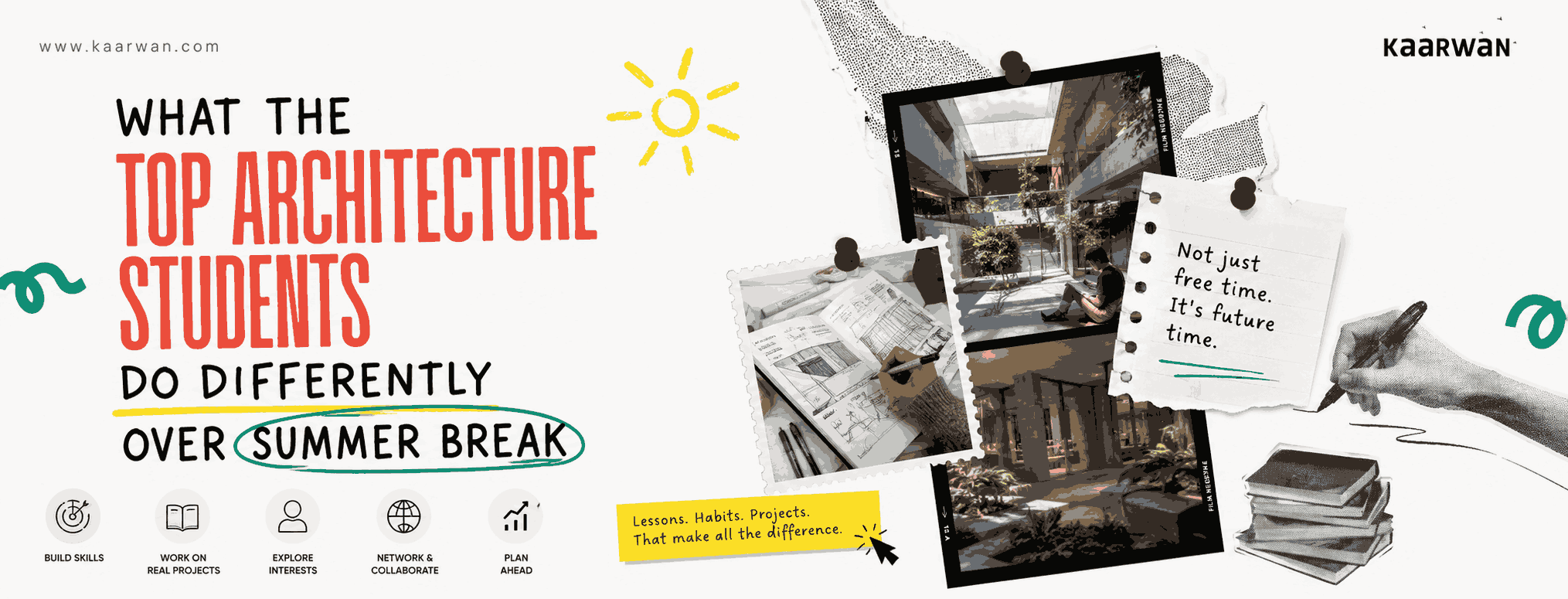
There's a particular kind of student who comes back to college in August and just seems different.
Not louder. Not necessarily more confident. Just clearer. The kind of clarity that shows up in their work, in the way they talk about their ideas, and in the fact that they already know what they want to do next. Ask them about their summer, and they don't fumble for an answer — they tell you exactly what they worked on, what they figured out, and where they're headed next.
The gap between that student and everyone else rarely comes down to talent. It almost always comes down to how they spent their summer.
Two months is a long time. Long enough to build something real, learn something deeply, and think about the questions that the semester never leaves room for. Most students let it pass in a comfortable blur. The ones who don't — they're the ones you notice when September rolls around.
Here's what we've seen the best architecture students do differently — and what's worth borrowing before this summer slips away. It is the time to make the best and unbiased decisions for your career because we all know that time flies by, and without the right skills, you can become dispensable too.
1. They Build Something Nobody Asked For
During the semester, everything is a reaction. Briefs, deadlines, feedback loops, studio crits that run until midnight. There's very little room to just make something on your own terms.
Summer changes that — but only if you let it.
The students who come back ahead are almost always the ones who picked a personal project early in the break and actually saw it through. Not a polished one — a real one. A pavilion design developed well past the concept stage, with sections, material logic, and structural thinking worked through properly. A housing typology study for a site in their own city, informed by actual observation rather than Google Maps. A detailed adaptive reuse proposal for a building they've walked past a hundred times and always been curious about.
The point isn't to produce a final presentation board. It's to push a single idea further than a semester deadline ever allows. To sit with a design problem long enough to hit the difficult questions — the ones that come after the first good sketch, when the real thinking has to begin.
That depth is what separates a portfolio that gets noticed from one that just gets filed. Reviewers and employers can tell the difference between work that was made under pressure and work that was made with genuine curiosity. Summer is one of the rare times you get to produce the second kind.
2. They Go Deep on One Tool Instead of Skimming Five
There's always that person in the studio whose Rhino work just flows — whose forms are resolved, whose drawings are clean, who doesn't spend the first hour of every session fighting the software. Or the student whose Lumion renders carry an atmosphere that most people's work never quite reaches.
That fluency rarely comes from class time alone. It comes from a summer where they made a decision to go deep on one thing instead of scratching the surface of everything.
Right now, the tools worth committing to are the ones reshaping how architecture is actually being practised. Parametric modelling in Grasshopper is no longer a niche skill — it's becoming a baseline expectation in serious design studios. Computational workflows that connect geometry to performance data are changing how early-stage design decisions get made. Rendering pipelines in Lumion and Enscape have made it possible to communicate atmosphere and materiality at a speed and quality that would have taken weeks just a few years ago.
And it doesn't have to be cutting-edge to be valuable. Getting genuinely fluent in Revit documentation workflows, or building real command-line confidence in AutoCAD, can set you apart in a professional environment faster than most students expect. Firms spend real time training new hires on basics that a committed summer could have already covered.
Pick the tool that aligns with where you want to go. Spend the summer inside it — not through tutorials alone, but through an actual project that forces you to solve real problems with it. The difference between knowing a software and having spent 200 hours inside it shows in every line you draw.
3. They Visit Spaces as They Mean It
Not just travel — observe. There's a real difference between the two, and the best architecture students understand it intuitively.
They treat summer like a self-guided field study. They visit a built work and spend genuine time in it — not just photographing the facade for Instagram, but actually sitting inside it. Noticing how a double-height volume shifts the feeling of a room. How a jaali screen filters light differently at 9 am versus 4 pm. How the transition between a public street and a semi-private courtyard is handled at the ground plane, and what that does to how people move through it.
They sketch the section perspectives on site. They photograph material junctions, weathering patterns, and the way two different materials meet at an edge. They notice when something doesn't work — when a beautifully designed space is consistently avoided by the people it was made for — and they think about why.
These observations don't always feed directly into the next project. But they accumulate into something more valuable than any single reference — a trained instinct for how space actually works, as opposed to how it looks in a render.
Your own city has more to teach you than you've given it credit for. A Doshi building, a well-considered colonial-era civic structure, a brutalist institutional complex from the 1970s that everyone dismisses but nobody has actually studied — if you're willing to slow down and look carefully, there's a detailed study in every one of them. You don't need to travel far. You need to look closer.
4. They Ask the Questions the Semester Never Leaves Room For
This one is the quietest shift. It doesn't produce anything you can put in a portfolio. But it tends to matter the most — often more than anything else on this list.
What kind of architect do you actually want to be? Are you drawn toward design research, toward computational and parametric work, toward urban-scale thinking, toward interiors and experience design? What pulls your attention when there's no brief to follow, no grade attached, and nobody watching?
These aren't easy questions, and the semester is genuinely too loud to hear the answers in. There's always a deadline, always a submission, always someone else's opinion to process. Summer is one of the only times the noise drops enough to actually think.
The students who navigate third year, thesis topics, and internship applications with real confidence are almost always the ones who used a summer — at some point — to sit with these questions properly. Not to arrive at a perfectly packaged answer, but to get honest about what excites them and what doesn't. To notice where their energy naturally goes when nobody is directing it.
That self-knowledge compounds. It shapes the projects you choose, the skills you invest in, and the opportunities you pursue. It's the difference between a final year that feels purposeful and one that feels like you're just getting through it.
To Sum It Up
Summer is long enough for that kind of honesty. Most students don't use it that way—the ones who do come back with something no classroom can give them.
If this is the summer you want to use intentionally — to build real fluency in tools like Grasshopper, Lumion, or Revit, to finally work on something that genuinely moves your portfolio forward, or to get clearer on what kind of architect you're becoming — Kaarwan is built for exactly that.
Our courses are designed for architecture students who want to use their time well, not just fill it. Whether you're looking to go deep on a specific tool, build a project with real guidance behind it, or just figure out your next step with some clarity — this is a good time to start.
Explore what we're offering this summer →
The semester will be back before you know it. Might as well meet it ready.
FAQs
1. How can architecture students use the summer productively?
By building projects, learning skills, and exploring career interests.
2. Why are personal projects important?
They showcase creativity, initiative, and problem-solving skills.
3. Which software should architecture students learn?
Revit, Grasshopper, Rhino, Lumion, Enscape, or AutoCAD.
4. Should I learn one tool or many?
Mastering one tool is usually more valuable.
5. How do site visits help architecture students?
They improve understanding of real-world spaces and design.
6. Can summer projects improve my portfolio?
Yes, they add depth and demonstrate commitment.
7. How should I prepare for architecture internships?
Build technical skills and strengthen your portfolio.
8. How can I find my specialisation in architecture?
Explore different fields and follow your interests.
9. Are online architecture courses worth it?
Yes, they help build practical, industry-relevant skills.
10. Why is summer important for career growth?
It provides time to learn, experiment, and plan ahead.


.png)