

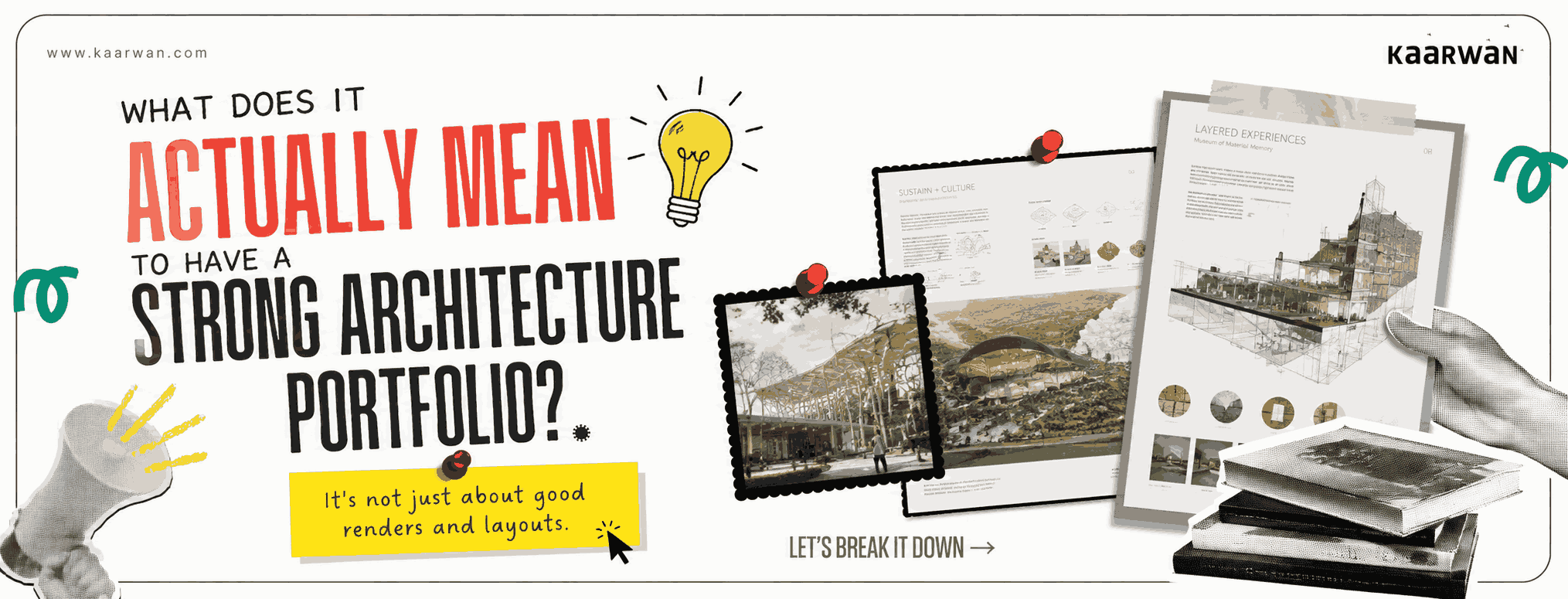
Open any architecture student's portfolio, and you'll find the same things.
A clean cover page. A competition entry that placed. A housing project from the third year with beautifully rendered perspectives. A section drawing that took four days. Everything presented with care, everything laid out with intention — and somehow, none of it quite landing the way it should.
This is the quiet frustration of architecture portfolios. Students spend months building them, agonise over every page, and still walk out of reviews with the same feedback — "It's good, but it doesn't tell me who you are."
That feedback sounds vague. It isn't. It's pointing to something very specific — and understanding what it actually means is the difference between a portfolio that gets you in the room and one that gets filed away.
A Portfolio Is Not an Archive. It's an Argument.
The most common mistake architecture students make is treating their portfolio like a record of everything they've done. Every project, every semester, every submission — documented faithfully, presented chronologically, and handed over like evidence.
But nobody reviewing a portfolio wants evidence. They want a point of view.
A strong portfolio is curated, not comprehensive. It's making a claim — "This is how I think. This is what I care about. This is the kind of architect I am becoming." Every project inside it should be there because it advances that claim, not because it represents a semester of work you're proud of.
The hardest part of building a portfolio isn't the design — it's the editing. Cutting a project you loved because it doesn't fit the story you're telling. Choosing three images of a building instead of twelve because three is what it takes to communicate, and twelve is what it takes to feel safe. That ruthlessness is what separates a portfolio with a point of view from one that's just a gallery.
The Process Matters as Much as the Outcome.
Here's something most students don't realise until someone tells them directly — the reviewer isn't just looking at the final render. They're looking for evidence of thinking.
How did you arrive at this form? What did you try before this? Where did the design break down, and how did you respond to it? A portfolio that shows only resolved, polished outcomes tells the reviewer very little. A portfolio that shows the journey — the early sketches, the failed scheme, the pivot, the resolution — tells them everything they need to know about how you work under pressure.
This doesn't mean filling pages with messy process work. It means choosing one or two moments in each project where the thinking is visible. A sketch that captures the moment the idea crystallised. A diagram that explains a decision that the render alone could never communicate. A section that shows not just what was built but why.
The students whose portfolios consistently get noticed are the ones who make their thinking legible — not just their taste.
Presentation Is a Design Problem. Treat It Like One.
The layout of your portfolio is itself a piece of design work. And it's being evaluated as one, whether you intend it to be or not.
Inconsistent margins, clashing typefaces, images that haven't been colour-corrected to match — these aren't minor issues. They signal to a reviewer that the same student who couldn't resolve a layout problem is about to hand them a set of construction drawings. Attention to detail in the portfolio is read as evidence of attention to detail in practice.
This doesn't mean your portfolio needs to be a visual spectacle. Some of the strongest student portfolios are the most restrained — a consistent grid, one typeface, images that breathe. Restraint is a design decision. Clutter is the absence of one.
What your portfolio should never be is a template downloaded from Behance and filled in. Reviewers see hundreds of those. A portfolio that looks like a hundred others is already telling the reviewer something — that the person who made it doesn't yet trust their own judgment enough to make original decisions. And in architecture, judgment is everything.
What You Leave Out Is as Important as What You Put In.
There's a version of this you've probably heard before — "quality over quantity." But it goes deeper than that.
Leaving out a weak project isn't just about protecting the overall quality. It's about protecting the narrative. One project that doesn't fit the story you're telling creates doubt about all the ones that do. The reviewer starts wondering whether the strong work was intentional or incidental.
Be honest about what your best work actually is. Not your most technically complex. Not your most recent. Your most you — the project where your thinking was clearest, your instincts were most trusting, and the outcome felt inevitable rather than laboured. That project should anchor the portfolio. Everything else should be chosen in relation to it.
To Sum It Up
If you don't yet have a project that feels like that — a project that genuinely represents who you are as a designer — then that's not a portfolio problem.
That's a signal. This is exactly the right time to go make that project.
Summer is long enough to build something you're genuinely proud of. Something that asks a real question and answers it with real design thinking. Something that gives your portfolio a centre of gravity it's been waiting for.
Explore Kaarwan's summer courses →
The portfolio is the story of your architectural mind. Make sure it's telling the right one.
FAQs
1. How many projects should be in an architecture student's portfolio?
Aim for 4–8 strong projects that showcase a range of skills rather than including every project you've completed.
2. Should I include college projects in my architecture portfolio?
Yes. Well-presented academic projects can effectively demonstrate your design thinking, technical skills, and creative process.
3. What software should I use to design my portfolio layout?
Most architecture students use Adobe InDesign, but tools like Canva, Figma, and PowerPoint can also work for clean, professional layouts.
4. Does an architecture portfolio need a physical version?
Not always. A digital PDF is usually sufficient, though a printed portfolio can be useful for interviews, juries, or networking events.
5. How long should an architecture portfolio be?
Keep it concise—10–20 pages is ideal for students, focusing on quality over quantity.
6. Should I include hand sketches in my architecture portfolio?
Absolutely. Hand sketches showcase your observational skills, design process, and ability to communicate ideas quickly.
7. What's the ideal portfolio format — PDF, website, or printed?
A PDF portfolio is the industry standard, while a website can strengthen your online presence, and a printed version serves specific presentation needs.
8. How do I present unbuilt or conceptual projects convincingly?
Use strong visuals, clear diagrams, and a compelling narrative to explain the project's intent, process, and potential impact.
9. Should my portfolio have a consistent visual theme?
Yes. Consistent typography, colours, layouts, and graphic styles help create a polished and professional impression.
10. How do I make my portfolio stand out from other architecture students?
Focus on storytelling, showcase your design process, highlight unique strengths, and curate only your best work.




.png)