

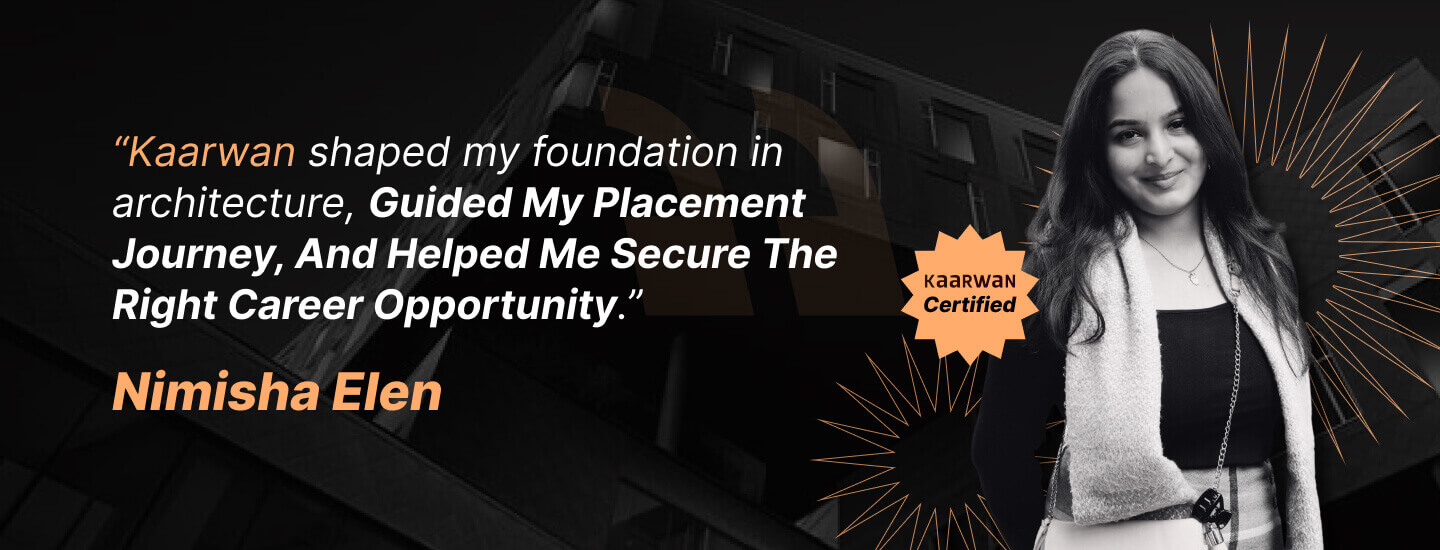
Nimisha didn’t enter the world of online learning with certainty. She didn’t come with a grand plan or a fixed roadmap.
She began with a quiet, very human question:
“Am I actually becoming the designer I want to be?”
It was the kind of question many young architects ask themselves in the late hours —after a tough critique, a confusing site analysis class, or a moment when software feels like an unsolvable puzzle.
And that question became the starting point of Nimisha’s journey.
What Made Nimisha Take Her First Course—and Then Five More?
Nimisha ’s journey didn’t accelerate overnight. It grew in moments. Steady. Practical. Personal.
Her first course at Kaarwan wasn’t taken out of impulse. It was taken out of need:
- The need to understand design beyond theory
- The need to bridge the gap between college learning and real practice
- the need to feel steady in a field that demands clarity
And somewhere between understanding Vastu principles and decoding her first site analysis exercise, something shifted.
Not dramatically. Not like a movie montage. But with a simple thought, she later shared:
“It broadened my curve of knowledge.”
It was enough to make learning feel meaningful again.
How Vastu, Site Analysis & UI-UX Changed the Way Nimisha Thinks
Every course Nimisha chose opened a different door for her. She wasn’t collecting certificates—she was collecting clarity.
Courses like:
- Vastu Compliant Design
- Climate & Site Analysis
- UI/UX for Designers
- Photoshop for Sheet Presentation
…didn’t just add skills. They changed the way she saw design.
Concepts that once felt scattered began connecting. Assignments started revealing patterns. Design decisions suddenly came with logic.
And for Nimisha, that quiet internal shift mattered more than anything else. Because clarity is what young designers crave the most—and rarely find easily.
The Courses That Demanded More—and How Nimisha Rose to Them
Short courses lit the spark. But long, intensive ones reshaped her identity.
BIM. Revit. Parametric Modelling. These weren’t casual add-ons. They required time, patience, repetition, and honesty.
Nimisha often re-watched lessons, stayed up late fixing small modelling errors, and returned to assignments even when she didn’t get them right the first time.
But instead of wearing her down, the process gave her momentum.
She said something that stayed with us:
“Fun assignments and regular discussions made me want to rework myself. It never felt tough.”
That line says so much about who Nimisha is— committed, curious, unafraid of slow progress.
Her Only Honest Discomfort—And Why It Matters
Nimisha wasn’t blindly positive.
Her experience with the Parametric Modelling course wasn’t ideal. She described it as feeling “like attending lectures,” not like being held through the complexity of Grasshopper.
And her honesty matters. Because young architects rarely say this out loud:
Some tools feel intimidating. Some courses feel heavy. Some spaces feel too technical and not nurturing enough.
Nimisha’s feedback shines a light on what learners genuinely need: warmth, clarity, and an environment where complexity doesn’t feel suffocating.
Her honesty makes her story real—not polished.
The One Request That Shows Who Nimisha Really Is
At the end of her feedback, Nimisha shared something unexpectedly thoughtful:
“There should be more classes on how to lead a corporate life—from college to office.”
This wasn’t a request for more content. It was a plea many young designers silently hold:
- “How do I behave in my first office?”
- “What do I say in meetings?”
- “How do I communicate with seniors?”
- “What does professionalism even look like?”
Nimisha gave voice to a need that’s rarely addressed in architecture education. And that shows her depth—not just as a learner, but as someone thinking about the journey beyond the classroom.
Nimisha’s Growth Is Quiet but Powerful—And It’s Entirely Hers
What stands out about Nimisha’s journey isn’t the number of courses she completed. It’s the way she showed up for herself.
- She chose clarity over confusion.
- She chose honesty over comfort.
- She chose patience over quick wins.
- She chose growth—even when it felt slow.
And slowly, steadily, she became more confident. More informed. More grounded. This isn’t a story about a platform. It’s a story about a young designer who kept investing in herself because she believed she could be better.
And she is.
If you want to experience the same, register here.




.png)