

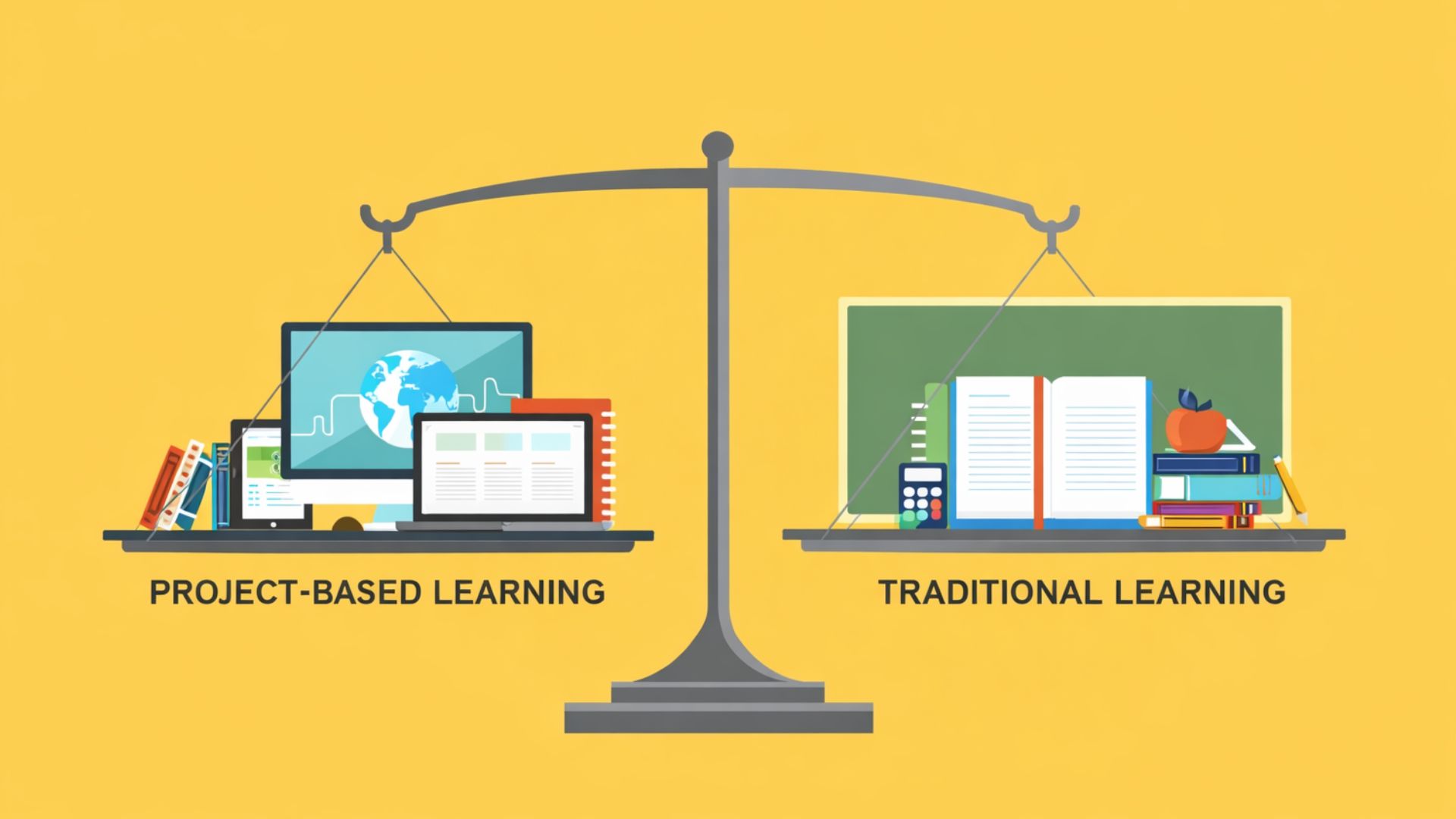
For years, education in the AEC industry has been following the same pattern. Watch lectures. Take notes. Pass exams. Repeat.
In 2025, that pattern started to break, but in 2026, it has completely transformed.
Project-based learning is no longer just a preferred approach; it is the primary method through which employers, learners, and institutions derive educational value. Supported by AI tools, stackable credentials, and a hiring market that has formally moved to skills-first evaluation, the case for PBL has never been stronger or better evidenced.
This is not a fad. It is a structural correction that is growing by the second.
Let's explore why project-based learning continues to outpace traditional courses in 2026 — and what's new since we last discussed it.
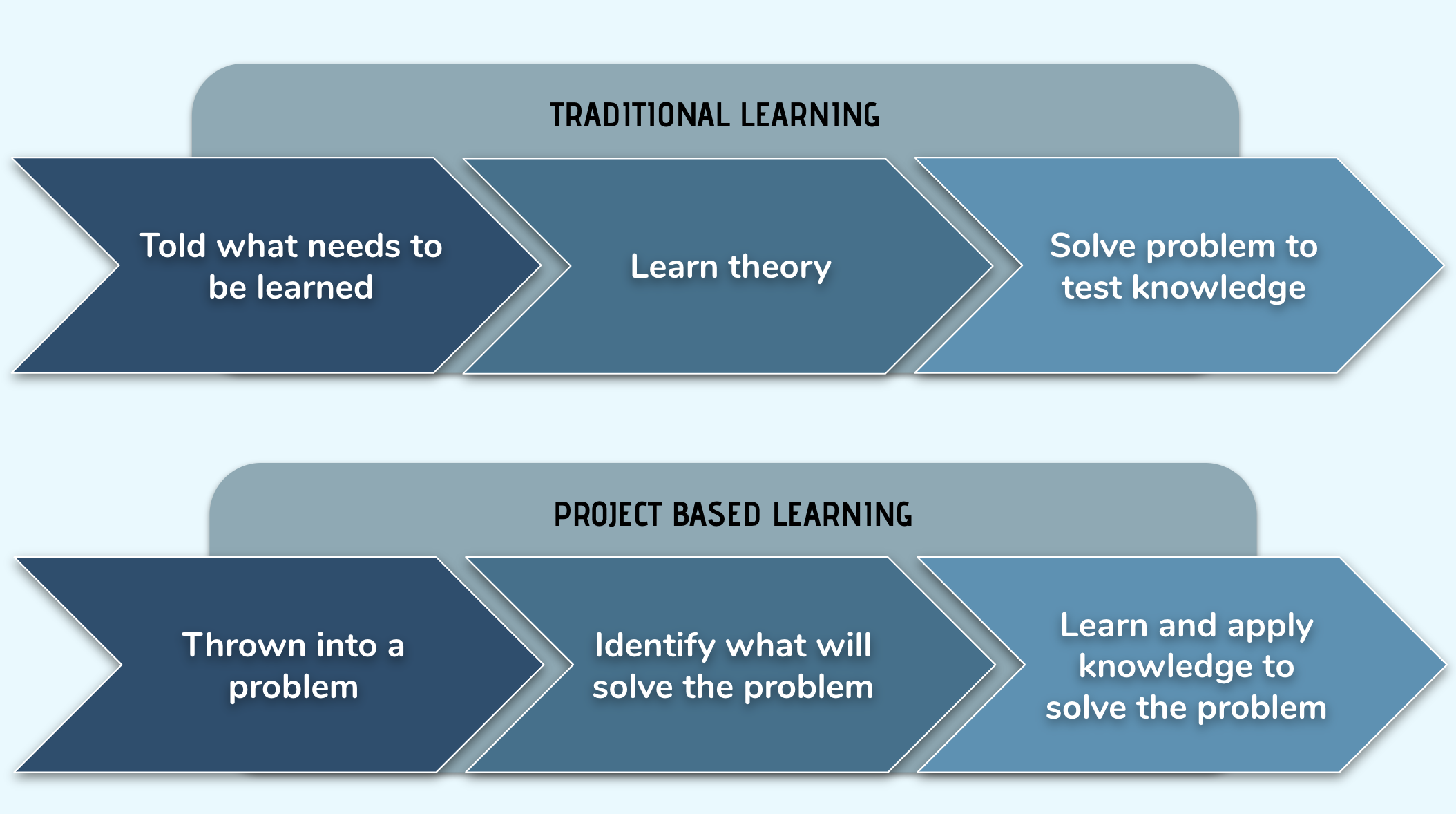
The Problem With Traditional Courses (That No One Wanted to Admit)
Traditional courses were not faulty by design. They were built for a world where jobs evolved slowly, degrees guaranteed careers, and theory mattered more than what was practical and what could be executed.
Here’s what shifted:
- US job postings looking for a 4-year degree dropped 33% between 2019 and 2025.
- 81% of employers are now hiring based on skills — up from just 56% four years ago.
- 89% of students are actively choosing stackable, short-form credential courses and paths over traditional degrees.
- The ROI breakeven for a micro-credential holder is 14 months. For a traditional university graduate, it is 3–5 years.
Standing next to ideologies that speak about less time and more outcome, students felt conflicted spending months memorising theories they never used. Graduates had certificates but struggled with real tasks. AI is becoming another wave of revolution, making the pace of change so fast that a four-year curriculum can be declared obsolete before graduation day.
Employers kept asking the same question: 'Great resume. But can they actually do the job?'
That gap became impossible to ignore, and project-based learning stepped in to close it.
What Project-Based Learning Did Differently
Project-based learning has actually flipped the entire system.
Instead of asking students to memorise everything in theory, it asked them to build in real-time. Instead of grades being the goal, outcomes were prioritised.
- You did not just learn web development; you shipped a website.
- You did not study marketing theory; you launched a campaign and analysed results.
- You did not 'complete a course’; instead, you walked away with proof of skill and built something real.
That shift changed everything.
Learning by Doing Beats Learning by Listening
One of the biggest reasons Project Based Learning tipped the scales was quite simple: people learn better when they do.
Hands-on learning allowed students to make mistakes, solve problems under pressure, and think practically instead of memorising answers. Every mistake moved the project one step ahead. That kind of learning sticks — and research confirms it.
Research Insight
An 800% rise in global PBL research publications occurred between 2014 and 2023, with the fastest growth in STEM, engineering, and computer science education — the exact fields employers cite as highest-need. (Frontiers in Education, 2025)
Real-World Projects Replaced Hypothetical Assignments
Traditional courses loved all the theoretical “ifs” and “buts”. Questions like 'If this company existed, what would you do?' Would often stand against project-based learning, and posed a better approach: 'Here's the problem. Fix it.'
In 2026, the ‘real world' has been re-established. Students now work on projects that use actual industry tools like AI platforms, VR environments, and live data systems. Deadlines, constraints, and client feedback are all valid
The emergence of AI-powered simulations and immersive learning environments means that even learners who cannot access a physical lab or studio can now work on authentic, high-stakes project scenarios. By the time learners are done with their course, they are not ‘job-ready,’ they’re already doing the job.
How AI Is Supercharging Project-Based Learning in 2026
If 2025 was the year of project-based learning, it sure has proved its value, and now 2026 has brought the wave of powerful acceleration and artificial intelligence.
AI has become the infrastructure beneath modern learning. It handles what mentors cannot do at scale, and not only does it deliver, it does so 24/7.
- Adaptive learning platforms now personalise project complexity, pacing, and feedback in real time. 71% of higher education institutions deploy these platforms in 2026 (up from 34% in 2023).
- Tools like Microsoft Copilot for Education, Khanmigo, and Sana Labs act as AI co-mentors that assist in guiding students through problems rather than giving them answers.
- AI-powered test tools identify skill gaps before a project stalls, nudging learners toward the right resources at exactly the right moment.
- VR and AR environments powered by AI allow students to carry on working on realistic project scenarios — from engineering simulations to marketing campaigns — without any physical infrastructure constraints.
Critically, AI is not replacing any human mentor. The most effective 2026 learning models pair AI-driven personalisation with human guidance and real community. The data shows that students who feel dependent on AI feel less like a human connection. This can be perceived as a signal that the best implementations keep humans at the centre.
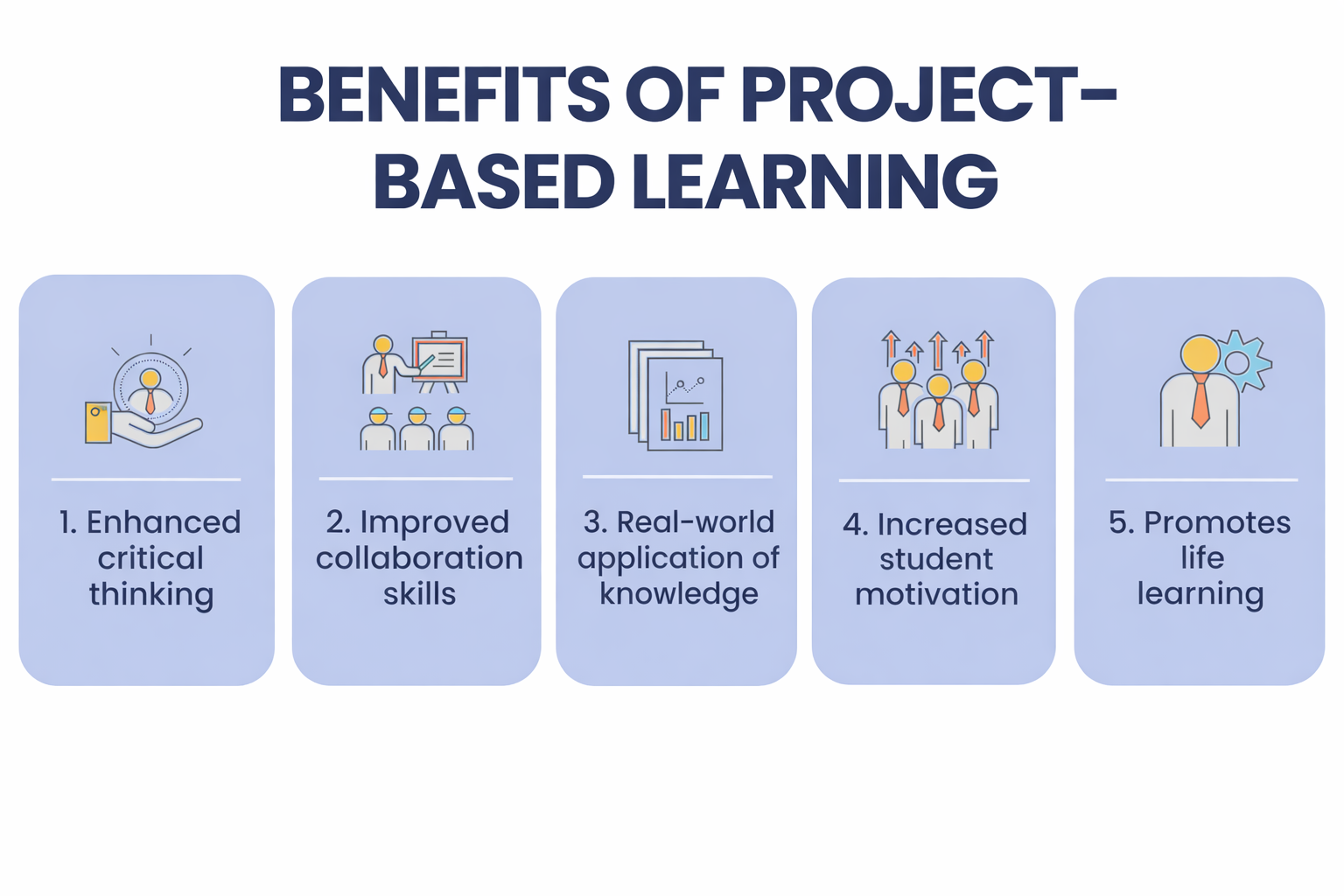
Micro-Credentials: The Natural Home of Project-Based Learning
In 2026, we need to also talk about Project-Based Learning as a credentialing pathway and how it helps in developing not just textbook knowledge, but skills as well.
Micro-credentials are short, competency-based qualifications that provide verifiable proof of specific skills. These can further help in justifying project-based education. By definition, they need learners to demonstrate capability through projects, and not simply exams.
- Google Career Certificates, Microsoft Azure certifications, and AWS credentials now bear more weight with many tech recruiters than generic business degrees.
- Bootcamp graduates report placement rates of 70–80% within six months, with approximately a third lacking a 4-year degree.
- 77% of students now ask for degrees that include industry micro-credentials as integrated parts.
- Short-term credentials at US community colleges started rising by 27% between 2017 and 2024.
The degree is not dead, but its relevance is. In 2026, it is one option among many, and for learners who want to move swiftly and prove skills quickly, they must enter the workforce on their own timeline. Micro-credentials backed by project-based portfolios are the most clear path.
Employers Started Valuing Proof Over Paper — and the Numbers Now Prove It
In 2025, we said employers were 'quietly' drifting away from degree requirements. In 2026, there is nothing like it.
- 81% of employers use skills-based hiring as of 2026 — up from 56% in 2022.
- 65% of employers have adopted skills-based hiring for entry-level roles (US hiring survey, 2026).
- GPA screening has plummeted: 73% of employers used GPA as a filter in 2019; just 42% do today.
- Google, IBM, Apple, Accenture, Bank of America, Delta, and Walmart have all formally removed or reduced degree requirements.
What employers want instead: portfolios, case studies, live projects, demonstrable impact, and AI literacy. A candidate who has completed five strong, real-world projects now outcompetes someone with a perfect academic record in most industries.
Skill-based education is finally fully aligned with how hiring actually works — and project-based learning delivers exactly that evidence.
| What Employers No Longer Prioritise | What Employers Now Require |
| 4-year degree as a baseline filter | Demonstrated skills and portfolio |
| GPA as a screening metric | Skills assessments and work samples |
| Theoretical knowledge from coursework | Proof of solving real problems |
| Time spent in education | AI literacy + adaptability + execution |
Motivation Went Up. Dropouts Went Down.
Traditional courses relied on discipline. Project-based learning relied on curiosity.
When students worked on meaningful projects, motivation stopped being a problem. They stayed longer, engaged more, and finished what they started — because they could see progress. Not months away. Every week.
Small wins, visible milestones, and the satisfaction of building something real kept learners invested in ways that lecture-and-test models simply cannot replicate.
The Modern Education System Needs Speed — And AI Provides It
Traditional courses moved too slowly. By the time a syllabus was updated, the industry had already changed. In 2026, the pace has only accelerated.
The explosion of generative AI has rendered static four-year curricula obsolete faster than they can be updated. Project-based learning adapts faster because projects evolve with tools, trends, and market needs.
In 2026, AI platforms will make this agility even sharper. Adaptive learning systems update content recommendations based on real-time employer data and emerging skill demands — meaning a learner in a PBL program today is working on challenges that reflect what the market needs right now, not what mattered five years ago.
That agility is what makes project-based learning future-proof.
It Was Never About Replacing Teachers — And AI Won't Change That
This was not a teacher problem in 2025. It is not a teacher problem in 2026. It was, and remains, a structural problem.
In project-based learning, instructors become mentors. They guide, challenge, and give feedback when it matters most. That human connection made learning feel personal — not automated, not distant.
In 2026, AI plays a supporting role in that structure. It handles the repetitive feedback loops, tracks progress, and flags where a student needs help. But the mentorship, context, inspiration, and human connection remain irreplaceable — and the data backs this up. Students who feel over-reliant on AI tools consistently report feeling less connected to their learning community.
The future is educators and AI working together — not one replacing the other.
So, Why Does Project-Based Learning Keep Winning in 2026?
Because it respects reality — and in 2026, reality has only strengthened its case.
- Careers are built on skills, not exams — and 81% of employers have formally adopted this view.
- Learning sticks when it is applied — and research shows 800% growth in academic validation of PBL effectiveness.
- Employers trust proof more than promises — portfolios and work samples now outrank GPA and degrees.
- AI has made personalised, project-based learning scalable in ways that were impossible in 2022.
- Micro-credentials have made this pathway faster, cheaper, and more directly connected to employment than ever.
- Hybrid and immersive environments have removed the geographic and logistical barriers to quality PBL.
Project-based learning outperforms traditional courses because it prepares people for the actual world of work — and that world has changed more in the last two years than in the previous decade.
Final Thoughts
Education did not fail. It evolved.
Project-based learning was not a shortcut. It was a smarter path — and in 2026, it has grown smarter still. AI, micro-credentials, immersive technology, and a job market that formally rewards skills over pedigree have all converged to make project-based learning not just the best option, but the default expectation.
In a world that rewards action, adaptability, and execution, learning by doing is no longer just better. It is essential, and you can begin your journey today, here.
FAQs
1. What is project-based learning?
Project-based learning is a method where students learn by working on real projects instead of only studying theory or taking exams.
2. Why did project-based learning outperform traditional courses in 2025?
It focused on practical skills, real-world projects, and job-ready outcomes rather than memorization.
3. How is project-based learning different from traditional learning?
Project-based learning emphasizes hands-on learning, while traditional courses rely mainly on lectures and exams.
4. Is project-based learning better than traditional courses?
For skill development and career readiness, project-based learning proved more effective than traditional courses.
5. Do employers prefer project-based learning?
Many employers now prefer candidates with portfolios and real-world experience over theoretical knowledge.
6. What skills do students gain from project-based learning?
Students gain problem-solving, critical thinking, collaboration, and practical job skills.
7. Is project-based learning suitable for beginners?
Yes. Beginners benefit from learning by doing and improving through real projects.
8. Can project-based learning replace traditional education?
It doesn’t replace it completely but strongly enhances modern education systems.
9. What industries benefit most from project-based learning?
Tech, marketing, design, business, and data-driven fields benefit the most.
10. Will project-based learning continue after 2025?
Yes. Its focus on skill-based education makes it future-proof.



.png)