Introduction
If you have been working in BIM for a few years and are starting to think about where your career goes next, you have probably asked yourself this question at some point: What is the actual difference between a BIM Engineer and a BIM Manager, and which one should I be aiming for?
These two roles are closely related and are often confused with each other, even within project teams. Both work with BIM technology, both are involved in the same projects, and both require strong technical knowledge. But in terms of day-to-day responsibilities, seniority, and what the role actually demands of you, they are quite different.
This guide is written specifically for mid-level BIM professionals who are three to six years into their careers and are trying to figure out which direction makes more sense for them: staying on the technical engineering track or moving toward a management and strategy role. By the end of this blog, you will have a clear picture of both roles and a practical sense of which one fits your strengths and goals.
Who is a BIM Engineer?
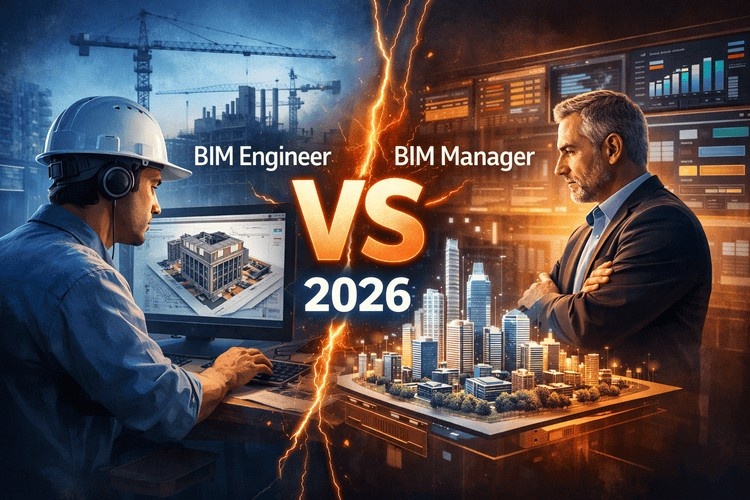
A BIM Engineer is a technical professional who is responsible for creating, managing, and coordinating digital building models throughout a construction project. Their work is primarily hands-on and execution-focused; they build the models, run clash detection, manage project data in a Common Data Environment, and ensure that every element of the federated model is accurate and up to date.
BIM Engineers work closely with architects, structural engineers, MEP engineers, and contractors, acting as the technical backbone of the project's digital delivery. They are expected to be highly proficient in tools like Autodesk Revit and Navisworks, and at mid-to-senior levels, knowledge of Dynamo for automation and ISO 19650 standards becomes increasingly important. The role is deeply technical, detail-oriented, and project-specific, and it is where the vast majority of BIM careers begin and develop.
Who is a BIM Manager?
A BIM Manager operates at a strategic level, overseeing the entire BIM process across a project or across an organisation. Rather than building models themselves, a BIM Manager defines how models are built, establishing the BIM standards, workflows, and protocols that the entire team follows. They write and own the BIM Execution Plan, manage the team of BIM Engineers and Coordinators working under them, ensure ISO 19650 compliance, and handle the relationship with the client on all digital delivery matters.
A real-world example of this is a BIM Manager at a firm like AECOM or Mott MacDonald overseeing a large metro rail project. They would not be building Revit models day to day; instead, they would be defining the information requirements, setting up the Common Data Environment, running quality audits on the models produced by the team, and presenting project-level BIM status updates to the client. It is a role that demands both deep technical knowledge and strong leadership, communication, and project management skills. Most BIM Managers have spent several years working as BIM Engineers or Coordinators before stepping into this position.
BIM Engineer vs BIM Manager: Full Comparison
Here is a detailed side-by-side comparison of the two roles across the most important dimensions:
| Criteria | BIM Engineer | BIM Manager |
| Years of Experience Required | 2 to 6 years | 8 to 12 years |
| Primary Focus of the Role | Technical execution — model creation, clash detection, coordination | Strategy and leadership — BIM standards, team management, client delivery |
| Who They Report To | BIM Coordinator or BIM Manager | Project Director or Senior Management |
| Team Management Responsibilities | None or minimal — primarily an individual contributor | Manages a team of BIM Engineers, Modellers, and Coordinators |
| Salary Range in India 2026 | ₹4.5 L to ₹18 LPA depending on experience | ₹12 L to ₹35 LPA depending on experience and firm |
| Key Software Used | Revit, Navisworks, Dynamo, BIM 360, Civil 3D | Revit, Navisworks, BIM 360, ProjectWise, ACC, ISO 19650 tools |
| Typical Project Types | All project types — residential, commercial, infrastructure, MEP | Large-scale, complex, or multi-discipline projects at MNCs and global consultancies |
| BIM Execution Plan | Follows and implements the BEP | Writes, owns, and maintains the BEP |
| ISO 19650 | Awareness and compliance | Deep working knowledge and enforcement |
| Decision Making | Technical and model-level decisions | Project-wide and organisational-level decisions |
Sources: Glassdoor India, AmbitionBox, Kaarwan Industry Reports, March 2026.
Salary Comparison: BIM Engineer vs BIM Manager in India 2026
Salary is one of the clearest indicators of the difference in seniority and responsibility between a BIM Engineer and a BIM Manager. Here is how the numbers compare across experience levels in India:
| Experience Level | BIM Engineer Salary (Annual CTC) | BIM Manager Salary (Annual CTC) |
| Entry to Mid (2 to 5 years) | ₹4.5 L to ₹10 LPA | Not typically applicable at this level |
| Mid to Senior (6 to 9 years) | ₹10 L to ₹18 LPA | ₹12 L to ₹22 LPA |
| Senior and Above (10 or more years) | ₹15 L to ₹25 LPA | ₹20 L to ₹35 LPA |
Sources: AmbitionBox, Glassdoor India, Naukri.com, Kaarwan Industry Reports, March 2026.
The gap between the BIM Engineer salary and the BIM Manager salary roles widens significantly at senior levels. A BIM Manager with 10 or more years of experience at a global AEC firm like Jacobs, WSP, or Arcadis can earn well above ₹30 LPA, while a senior BIM Engineer at the same firm would typically sit in the ₹15 to ₹20 LPA range. The premium for the management role reflects the added responsibility of team leadership, client management, and organisational BIM strategy.
It is also worth noting that the best cities for both roles in India are Bengaluru, Gurugram, and Pune, where global delivery centres consistently pay more than domestic firms for the same level of experience, significantly influencing overall BIM engineer salary trends across the country.
Career Path from BIM Engineer to BIM Manager
Moving from a BIM Engineer role to a BIM Manager role is very achievable, but it does not happen automatically with time alone. It requires a deliberate combination of technical depth, coordination experience, leadership exposure, and the right certification at the right stage.
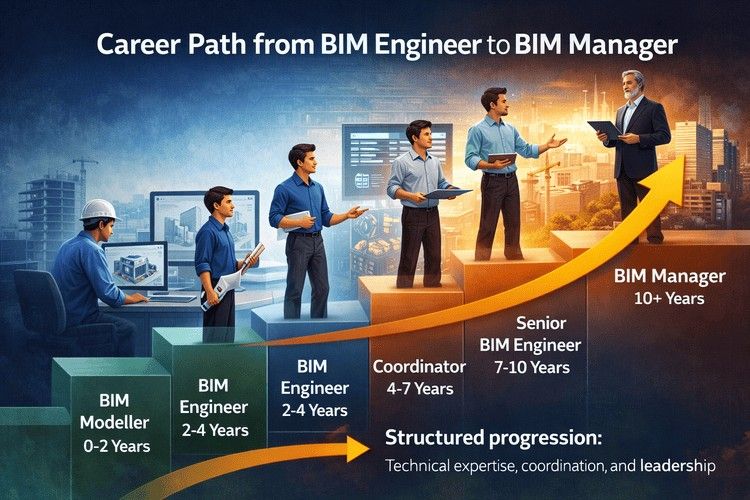
Here is a realistic and structured timeline for how that progression typically looks in India, especially when you follow a clear bim engineer career path:
BIM Modeller / Junior BIM Engineer ( Years 0 to 2): At this stage, you are focused entirely on building your technical foundation. Learning Revit thoroughly, getting comfortable with project documentation, and understanding how BIM models are structured and managed are the priorities. This is where you develop the hands-on skills that everything else builds on.
BIM Engineer ( Years 2 to 4): You are now working more independently, coordinating across disciplines, running basic clash detection in Navisworks, and starting to contribute to BIM Execution Plan discussions. This is also the stage where adding Dynamo and getting familiar with ISO 19650 concepts starts making a visible difference to your profile and your earning potential.
BIM Coordinator (Years 4 to 7): This is the critical bridge role on the path to management. As a BIM Coordinator you are managing multi-discipline model coordination, running full coordination meetings, owning clash resolution workflows, and increasingly being the person the project team comes to for BIM-related decisions. This is where leadership and communication skills become just as important as technical skills.
Senior BIM Engineer or BIM Lead (Years 7 to 10): At this level, you are taking ownership of BIM strategy on individual projects — writing BEPs, managing CDEs, mentoring junior engineers, and interfacing directly with clients on digital delivery requirements. This is the final step before the BIM Manager role.
BIM Manager (Years 10+): You are now responsible for the BIM process across multiple projects or across the entire organisation. You define standards, manage teams, ensure compliance, and drive digital transformation at a strategic level.
The key things that accelerate this journey:
Getting an Autodesk certification or a recognised BIM programme certification early, certified professionals move up faster and earn more at every stage. Building a strong portfolio of real coordination work, clash reports, BEPs, and federated models that demonstrates your capability to take on more responsibility. Actively seeking coordination and leadership exposure rather than staying in a pure modelling role beyond the first two years.
Build the skills that take you from execution to leadership. Master tools, workflows, and coordination with our Professional Revit & BIM Certification Program, designed to help you grow from BIM Engineer to BIM Manager and stay ahead in 2026.
Which Role is Right for You?
This is ultimately a personal decision, and there is genuinely no wrong answer; both roles are in high demand and offer strong career trajectories. But here are some honest questions that can help you figure out which direction suits you better:
You are probably better suited to the BIM Engineer track if: You genuinely enjoy the technical side of BIM, building models, solving coordination problems, and getting into the details of how a building comes together digitally. You prefer working on specific projects rather than managing multiple projects simultaneously. You find satisfaction in producing high-quality deliverables rather than overseeing a team producing them. You are excited by tools like Dynamo and the idea of becoming a BIM automation specialist or technical expert.
You are probably better suited to the BIM Manager track if you find yourself naturally drawn to the bigger picture, how a project is organised, how teams communicate, and how standards are set and maintained. You enjoy working with people, leading meetings, and making decisions that affect the whole team. You are comfortable with client-facing responsibilities and can present technical information clearly to non-technical stakeholders. You want to move into a role where your influence extends beyond a single project and into how an organisation approaches digital delivery.
A useful real-world way to test this, if you are currently a BIM Coordinator, pay attention to which parts of your job you find most energising. If it is the coordination meetings and the team problem-solving, management is probably your direction. If it is the technical deep-dives into the model, the engineering track might suit you better.
Start Your BIM Career with Kaarwan
Whether you are building toward a senior BIM Engineer role or aiming for BIM Manager level, the skills you develop in the next one to two years will define where you land. Kaarwan's BIM programmes are designed to give you exactly the technical skills, real project experience, and career support you need to get there.
Kaarwan offers three specialised BIM certification programmes:
Professional Revit and BIM Certification Program — for architects, covering the full Revit and BIM workflow with real project simulations.
BIM Certification for MEP Engineers — newly launched, five months long, with 150 or more hours of hands-on training, designed for mechanical, electrical, and plumbing engineers.
BIM Certification Program for Civil Engineers — V2.0, fully aligned to 2026 job requirements, six months long, with 200 or more hours of structured learning.
Every programme includes hands-on training in Revit, Navisworks, Dynamo, and BIM 360, five or more real portfolio projects, Autodesk certification preparation, ISO 19650 workflows, BIM Execution Plan training, and lifetime 1:1 job support — resume building, mock interviews, and LinkedIn optimisation, until you are placed.
Kaarwan graduates have been placed at firms including Morphogenesis, Virtual Building Studio, Tesla Outsourcing Services, Graniti Vicentia, Cube Consultancy, Kent Data Centres, and SABS.
Explore Kaarwan's BIM Courses and take the next step in your BIM career in 2026.
Frequently Asked Questions
What is the main difference between a BIM Engineer and a BIM Manager?
A BIM Engineer is focused on technical execution, building models, running clash detection, and coordinating across disciplines on a project. A BIM Manager is responsible for strategy and leadership, defining BIM standards, writing BIM Execution Plans, managing teams, ensuring ISO 19650 compliance, and handling client relationships on digital delivery. The engineer does the work; the manager defines how the work gets done.
Can a BIM Engineer become a BIM Manager?
Absolutely, and this is the most common career path in the BIM field. Most BIM Managers have spent several years working as BIM Engineers and Coordinators before stepping into management. The typical timeline in India is eight to twelve years of total experience, with a strong emphasis on coordination roles, leadership exposure, and recognised certification along the way.
What is the salary difference between a BIM Engineer and a BIM Manager in India?
At mid-level, the gap is moderate; a senior BIM Engineer with six to nine years of experience earns ₹10 LPA to ₹18 LPA, while a BIM Manager at that level earns ₹12 LPA to ₹22 LPA. At senior levels with ten or more years of experience, the gap widens significantly. Experienced BIM Managers at global AEC firms earn ₹20 LPA to ₹35 LPA and above, while senior BIM Engineers typically sit in the ₹15 LPA to ₹25 LPA range.
Does a BIM Manager need to know Revit?
Yes, a strong working knowledge of Revit and other BIM tools is essential for any BIM Manager. While they may not be building models day to day at a senior level, they need to understand the technical workflows their team is following, review model quality, and make informed decisions about standards and deliverables. Most BIM Managers have extensive hands-on experience with Revit from their earlier career stages.
Which role has better career prospects in India in 2026?
Both roles have strong career prospects given the current growth in India's BIM job market. The BIM Engineer track offers clear progression toward senior technical roles and BIM automation specialisation. The BIM Manager track opens doors to leadership positions, higher salaries at senior levels, and the opportunity to drive digital transformation across organisations. The better choice depends on your individual strengths, preferences, and long-term career goals.