If you've spent a couple of years as a site engineer and you're now eyeing that site manager title, you already know the job isn't really about knowing more theory. It's about proving you can hold a chaotic site together without losing your mind - or your schedule. And that's exactly what gets tested in a construction site manager interview questions round. Not textbook stuff. Real "what would you actually do" stuff.
This guide is built specifically for that. Not the generic HR-blog version you'll find floating around with UK site manager jargon that doesn't map to how Indian sites actually run. We're talking Indian project types, Indian recruiter expectations, and yes - the BIM-adjacent skills that more and more employers here are quietly starting to ask about, even for site roles.
Also Explore : Site Engineer in Civil Engineering: Roles, Salary and Career Path
What Does a Construction Site Manager Actually Do?
Somewhere between the site engineer grinding it out on the ground and the project manager sitting in client meetings, there's the site manager - the one actually running the show day to day. They're coordinating subcontractors, chasing schedules, keeping safety compliance from slipping, and making sure the budget doesn't quietly bleed out through change orders nobody flagged. It's less "manage a team" and more "hold fifteen moving parts together at once, and don't let any of them drop."
If you're a site engineer wondering whether this is even the right next step for you - it usually is, if you're already the one people come to when something goes sideways on site. That's basically the job description in one sentence.
Also Read : Site Engineer to BIM Civil Engineer: A Realistic & Honest Transition
How to Prepare for a Site Manager Interview
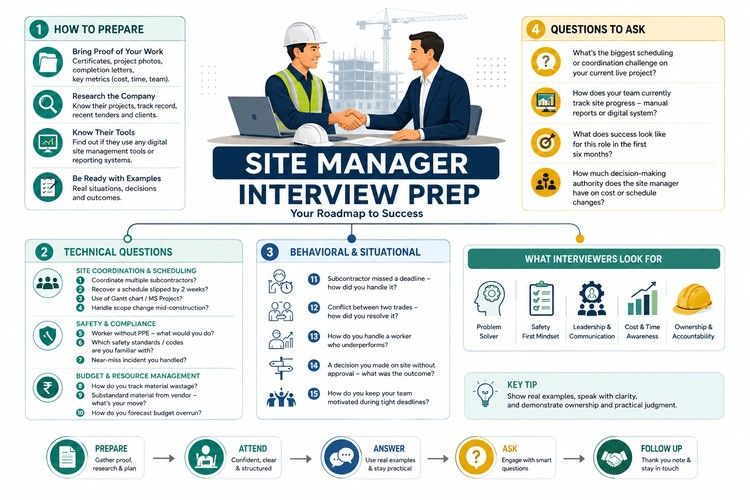
Don't walk in with just your resume. Bring documentation of real project outcomes - completion certificates, photos of finished work, anything that shows scale. Recruiters here respond well to numbers: budget size, team size, how many months you shaved off a schedule.
Before the interview, dig into the projects the company has actually built. If it's a residential developer, look at their delivery track record. If it's an infra contractor, know their recent tenders. And genuinely - research whether they use any digital site tools, because that question is coming up more often than it used to, even at mid-sized firms.
Also Read : Site Diaries, BOQs, and GFCs: Must-Know Terms for Every New Site Engineer
Technical Interview Questions
Site coordination and scheduling questions
1. How do you coordinate multiple subcontractors working on the same floor or zone?
What they're checking: whether you can sequence work without causing clashes. A decent answer walks through how you'd stagger trades - say, electrical conduit work before plastering, plumbing rough-in before tiling - and how you communicate that sequence so nobody shows up expecting a clear site that isn't clear.
2. Walk me through how you'd recover a schedule that's slipped by two weeks.
This is less about the "how" and more about whether you panic or think. A strong answer covers identifying the actual bottleneck first (not just throwing more labour at the problem), then options like running parallel activities, adding a shift, or renegotiating float on non-critical tasks.
3. How do you use a Gantt chart or MS Project in your daily site routine?
Be honest here - if you've only used Excel trackers on smaller sites, say so, but show you understand what a proper schedule tool would add. Recruiters aren't expecting you to be a scheduling wizard; they want to know you respect the schedule as a living document, not a PDF someone made once at kickoff.
4. What do you do when a client asks for a scope change mid-construction?
Talk about documentation first - getting it in writing, assessing cost and time impact, then formally raising it as a change order rather than just absorbing it quietly (which, let's be real, happens far too often on Indian sites and ends up costing the contractor).
Safety and compliance questions
5. What would you do if you saw a worker without proper PPE?
Stop the work. That's genuinely the answer they want to hear first, before anything else. Then talk about retraining, documentation, and how you'd reinforce it without making the worker feel humiliated in front of the team - because that matters for retention too.
6. Which safety standards or codes are you familiar with?
This is where knowing your National Building Code basics and relevant IS codes for safety helps. You don't need to recite sections, but showing you know they exist and apply them practically goes a long way.
7. Tell me about a near-miss incident you handled.
Pick a real one if you have it. If you don't, be honest and talk through how you'd investigate root cause rather than just filing an incident report and moving on.
Want to move beyond site execution into digital project coordination? Kaarwan's BIM Certification for Civil Engineers builds exactly the skills employers are now expecting from site managers.
Budget and resource management questions
8. How do you track material wastage on site?
Talk about reconciling delivered quantities against BOQ estimates, spot-checking storage and handling practices, and flagging unusual variance early rather than discovering it at project closeout.
9. A vendor delivers substandard material. What's your move?
Reject it, document it with photos, and escalate through proper channels rather than accepting it to avoid delay - a mistake juniors sometimes make under schedule pressure.
10. How do you forecast whether a project will go over budget?
Weekly cost tracking against baseline, watching for creeping change orders, and flagging variance to the PM early instead of at month-end when it's too late to course-correct.
Also Read: BIM Civil Engineer Salary India 2026: Honest Numbers by City and Experience
Behavioral and Situational Interview Questions
11. Tell me about a time a subcontractor missed a deadline. How did you handle it?
Structure this like a mini case study - situation, what you did, what happened. Interviewers are listening for whether you escalate too fast (burns relationships) or too slow (burns schedules).
12. Describe a conflict between two trades on your site and how you resolved it.
Classic example: electrical and HVAC teams both wanting the same ceiling void space at the same time. Show you can mediate without picking favourites.
13. How do you handle a worker who consistently underperforms?
Talk about having the direct conversation first, understanding if it's a skill gap or a motivation issue, and only escalating to disciplinary action if it continues.
14. Tell me about a decision you made on site without approval from above, because there wasn't time to wait.
This is a favourite among Indian construction recruiters specifically, because site managers here often do need to make real-time calls. Show judgment, not recklessness.
15. How do you keep your team motivated during a tight deadline crunch?
Small, honest gestures work better than grand promises - recognising effort publicly, adjusting shift timings where possible, being visible on site yourself rather than managing from an office.
Questions to Ask the Interviewer
This part genuinely separates a strong candidate from someone reciting answers. Try:
- "What's the biggest scheduling or coordination challenge on your current live project?"
- "How does your team currently track site progress - manual reports, or is there a digital system in place?"
- "What does success look like for this role in the first six months?"
- "How much decision-making authority does the site manager have on cost or schedule changes without escalation?"
Asking about digital tracking specifically tends to land well right now, because a lot of Indian firms are mid-transition from paper diaries to proper software, and showing awareness of that shift signals you're thinking ahead.
How to Move From Site Engineer to Site Manager
Honestly, the jump isn't as far as it feels.
Most site engineers already do 70% of a site manager's job without the title or the pay to match. What usually holds people back is the coordination and reporting side - being comfortable owning subcontractor relationships, budget conversations, and client-facing updates, not just execution.
If you've spent time getting your fundamentals right - knowing your site engineering terms you should know inside out, understanding the full site engineer career path - the next logical layer is picking up the digital coordination skills that are increasingly expected even at the site level. A growing number of Indian employers now want site and project management professionals who at least understand BIM workflows, even if they're not the ones modelling.
If you're curious where that leads, it's worth looking at how professionals are approaching the path from site roles into BIM management - it's a more realistic bridge than most people expect. And if you're specifically weighing whether BIM knowledge is worth the time investment right now, this breakdown on moving from site engineer to BIM civil engineer is a genuinely honest one - it doesn't oversell the transition.
Kaarwan's BIM Certification for Civil Engineers is built for exactly this kind of career layering - engineers and site managers who want the digital coordination edge without stepping away from their site experience.
For safety and qualification standards specific to Indian construction, the Construction Industry Development Council (CIDC) is a useful reference point if you want to cross-check certification claims before an interview.
If BIM feels like the missing piece in your career jump from site engineer to manager, Kaarwan's BIM Certification for Civil Engineers is designed to close that gap fast.
Key Takeaways
Cracking a construction site manager interview isn't about memorising answers - it's about showing you've actually run a site under pressure and lived to talk about it calmly. Come with real numbers, real stories, and a clear sense of where you want this role to take you next.
FAQs
Q: What qualifications do you need to become a site manager in India?
A bachelor's degree in civil engineering or construction management is the standard entry point, though many site managers work up through diplomas and years of hands-on site experience instead. Certifications in project scheduling or safety add weight to an application.
Q: What's the difference between a site engineer and a site manager?
A site engineer handles the technical execution - layout, quality checks, day-to-day supervision of specific work. A site manager owns the bigger picture: schedule, budget, subcontractor coordination, and client communication across the whole site.
Q: How much does a construction site manager earn in India?
It varies widely by city and company size, but experience and coordination skills - not just years on the job - tend to be the biggest driver of the higher end of that range.
Q: Is BIM knowledge required for site manager roles?
Not mandatory everywhere yet, but it's becoming a genuine differentiator, especially at firms handling larger commercial or infrastructure projects where digital coordination is now standard practice.