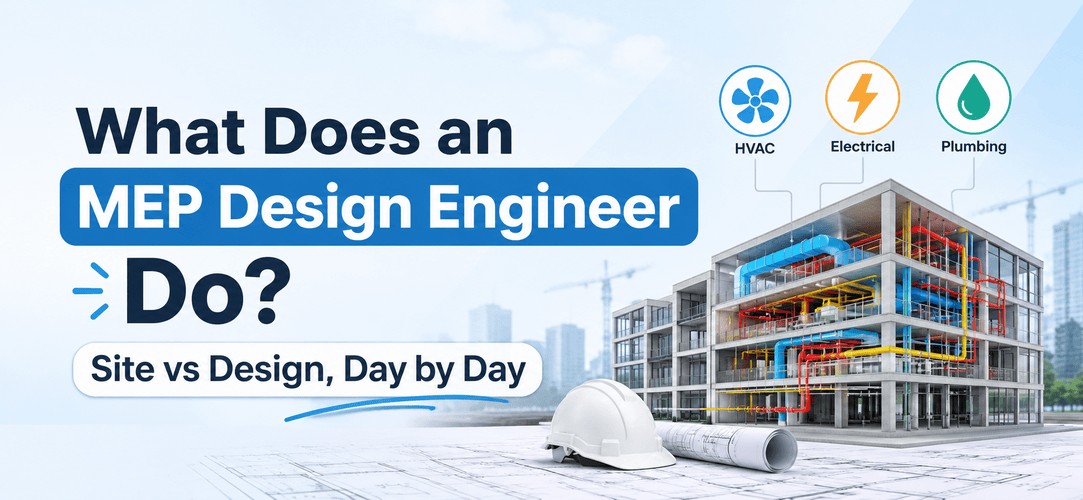
An MEP design engineer calculates, sizes and draws a building's mechanical, electrical and plumbing systems in a design office, while an MEP site engineer installs and supervises them on site.
That's the one-line version. The honest version is more interesting: it's two completely different workdays chasing the same building. One person is staring at a Revit model at 11 a.m., arguing with an architect about a shaft. The other is standing on a slab at 11 a.m., watching a crew hang a duct and wondering why it doesn't match the drawing.
If you're trying to choose between the two (or move from one to the other), this guide walks through both days, the skills each needs, and how careers actually move. For the bigger picture, start with our MEP design guide.
The role in one paragraph
An MEP design engineer takes an architect's building and works out how to keep it cool, powered, supplied with water and safe from fire, then turns that into calculations, drawings and schedules a contractor can build from.
In practice that means load calculations, equipment selection, duct, pipe and cable routing, coordination with the architect and structural team, and a lot of revisions. That's the MEP design engineer job description in plain English. Most MEP design engineers in India work at an MEP consultancy, a large architecture firm's services team, or a contractor's design wing.
They usually specialise in one discipline (HVAC, electrical, or plumbing and fire) and build up to understanding all four. Hiring is concentrated in Mumbai, Pune, Bengaluru, Hyderabad and the NCR, and many engineers eventually target the Gulf, where ASHRAE and NFPA often appear in contract documents.
Also Read : The MEP Design Process: 5 Stages from Concept to As-Built
A day in the life: design engineer vs site engineer
A design engineer's day is mostly screens, calculations and meetings, while a site engineer's day is mostly walking, checking and solving problems in person. Here's the same project seen from both sides, say a 12-storey office block in Pune:
| Time | MEP design engineer (consultancy office) | MEP site engineer (on the project) |
| 8:00 | Not in yet | Site briefing with contractors and toolbox talk; checks today's work plan |
| 9:30 | Reads overnight emails and architect's revised plans; checks what changed | Walks the floors; inspects duct hangers and cable trays against approved drawings |
| 11:00 | Runs a cooling load check for a revised layout; resizes a duct | Resolves a contractor query: a drain line meets an unexpected beam |
| 1:30 | Models duct and pipe runs in Revit; checks clearance against beams | Witnesses a pressure test on a water riser; records readings |
| 3:30 | Coordination call with architect and structural engineer about a shaft | Updates progress report; chases a material delivery |
| 5:30 | Marks up drawings; updates equipment schedules for tomorrow's issue | Signs off the day's inspection report before the crew leaves |
Notice what's missing from each column. The design engineer rarely gets to see the finished work. The site engineer rarely gets time to question the design. That gap is exactly where the best MEP careers get built.
Want to train for the MEP design engineer role? Build calculations, drawings and coordination skills on real projects in Kaarwan's MEP BIM certification.
Key responsibilities
An MEP design engineer's responsibilities fall into five buckets: calculations, system selection, drawings, coordination and approvals.
- Calculations. Cooling and heating loads, electrical load estimates and cable sizing, water demand and pipe sizing, fire system hydraulics. Our guide to heat load calculation shows what this looks like.
- System and equipment selection. Choosing between split, VRF or chilled water; sizing transformers, pumps and AHUs; writing equipment schedules.
- Drawings and models. Layouts, risers, single line diagrams, schedules and sections, in AutoCAD or Revit.
- Coordination. Checking services against structure and architecture, resolving clashes, and attending coordination meetings.
- Codes and approvals. Designing to NBC 2016, ECBC 2017 for commercial buildings, the relevant IS codes, and supporting fire NOC submissions. ECBC 2017, for example, applies to new commercial buildings with a connected load of 100 kW or more, or a contract demand of 120 kVA or more.
And a sixth, unofficial one: answering the contractor's questions politely at 6 p.m., even when the answer is on sheet four.
Also Read: MEP Coordination: 5 Common Clashes and How to Prevent Them
Skills and software employers ask for
Employers look for solid fundamentals in one MEP discipline, comfort with Indian codes, and working knowledge of AutoCAD and Revit, usually in that order. These are the MEP design engineer skills that come up most in job descriptions.
| Skill | Why it matters | How to learn it |
| Discipline fundamentals (HVAC, electrical, plumbing/fire) | Every calculation depends on them | Your degree, plus worked examples and a mentor |
| Load and sizing calculations | The core of the job | Practise full examples by hand, then in software |
| Indian codes (NBC 2016, IS codes, ECBC) | Approvals and reviews depend on them | Read the code parts directly; apply them to a sample project |
| AutoCAD | Still widely used for 2D drawings | Draw layouts and SLDs from scratch |
| Revit | 3D models, schedules and drawings from one source | Model a full floor of services; start with our guide to designing MEP systems in BIM |
| Navisworks and coordination | Finds clashes before site does | Run a clash test on a combined model |
| Communication | Most delays are conversations, not calculations | Write clear RFI replies and meeting notes |
Also read: MEP Systems in Revit: Workflow Guide
Career path: junior to senior to lead to manager
The usual path through MEP engineer roles runs from junior engineer to senior engineer, then lead, then design manager, with each step adding more responsibility for decisions and for other people's work.
- Junior MEP design engineer (0 to 3 years). Drafting, basic calculations, markups. You're learning how a drawing becomes a decision.
- Design engineer / senior design engineer (3 to 8 years). Owning calculations for a discipline, running coordination with other trades, reviewing juniors' work.
- Lead / principal engineer. Taking responsibility for a whole project's services design, client meetings, sign-off.
- Design manager / department head. Running teams, approvals, proposals and quality.
What about pay? Salary data in India is patchy and crowd-sourced, so treat it as indicative. On AmbitionBox, based on user-reported salaries, junior MEP design engineers were listed at roughly ₹1.8 to ₹3.6 lakh a year, and MEP design managers at ₹8.5 to ₹26.7 lakh a year across 8 to 18 years of experience (pages last updated in 2024-25).
Our MEP engineer salary guide will carry 2026 figures by city and role. The pattern is what matters: pay climbs with scope, not just years.
How site engineers switch to design
Site engineers can switch to design by learning calculations, codes and design software, and then proving it with a small portfolio.
That's how to become an MEP design engineer from a site background. This is a common move, and you already have a real advantage: you know how things get built. But site experience doesn't automatically make you a design engineer. Installation is about execution. Design is about decisions. So the gap is mostly skills, not talent:
- Pick one discipline. HVAC, electrical or plumbing and fire. Don't try all three at once.
- Learn the calculations. Start with the load calculations for your discipline and do them end to end, by hand first.
- Learn the software. AutoCAD for drawings, then Revit.
- Learn the codes. NBC 2016 and the IS codes for your discipline.
- Build a portfolio. Two or three worked projects: a floor's layout, calculations, schedules. Hiring managers care more about this than a certificate.
- Use your site knowledge in interviews. Explain how you would design a duct run so it's easy to install. That's the sentence that makes you stand out.
Ready to move from site or study into MEP design? Train for the design engineer role in Kaarwan's MEP BIM certification, with mentor feedback.
Where the course fits
If you want structured practice instead of piecing it together alone, Kaarwan's MEP BIM certification is a 5-month live online programme built for MEP engineers, covering the coordination and modelling skills design offices expect. It's most useful if you're a fresher choosing a direction or a site engineer making the jump into design.
Also Read: How to Read MEP Drawings: Symbols, Layers and Legends
FAQ
Is MEP design engineer a good job?
For engineers who enjoy calculations, drawings and problem-solving, yes. Every building needs MEP design, so work is steady across India and the Gulf. It's a desk-based, software-heavy role with strong growth into lead and manager positions. It suits people who prefer detail and documentation over daily site work.
What qualification do you need to be an MEP design engineer?
Most employers look for a B.E. or B.Tech in mechanical or electrical engineering. Civil engineers and diploma holders also enter, especially in plumbing, drainage and fire design. Beyond the degree, employers value calculation skills, knowledge of NBC and IS codes, and working skill in AutoCAD and Revit.
Do MEP design engineers go to site?
Sometimes. Design engineers usually work in an office but visit site for design reviews, coordination issues and inspections, especially on larger projects. Day-to-day installation supervision belongs to the site engineer. Design engineers who understand site conditions tend to produce designs that are easier to build.
Can a civil engineer become an MEP design engineer?
Yes. Many civil engineers move into MEP design, particularly plumbing, drainage and fire design, because the work overlaps with building and site knowledge. You'll need to learn the calculations, codes and software for your chosen discipline, but the transition is common and achievable with focused practice.