.jpeg)
You have your engineering degree. You have been reading about HVAC systems, studying electrical distribution diagrams, and watching enough Revit MEP tutorials to feel mildly confident. And now there is an interview in a few days, and you have no idea what they are actually going to ask you.
That is exactly what this guide is for. MEP stands for Mechanical, Electrical and Plumbing, the three interconnected systems that make any building actually function. And MEP interview questions cover a lot of ground, from basic system concepts to BIM coordination to site problem-solving scenarios.
Whether you are appearing for your first MEP interview or preparing to enter the field, this guide covers everything you need: the most commonly asked questions and how to answer them, what MEP companies actually look for when hiring freshers, which cities have the most MEP jobs for freshers, and how BIM skills genuinely change your hiring prospects.

These are the questions that come up consistently across MEP interviews in India — at firms like AECOM, WSP, L&T, Jacobs, and smaller consultancies alike.
Top MEP Interview Questions and Answers
These are the questions that come up consistently across MEP interviews in India , at firms like AECOM, WSP, L&T, Jacobs, and smaller consultancies alike.
What does MEP stand for, and what are the three systems?
MEP stands for Mechanical, Electrical, and Plumbing. The mechanical system primarily covers HVAC, heating, ventilation, and air conditioning. The electrical system covers power distribution, lighting, and low-voltage systems. The plumbing system covers water supply, drainage, sanitation, and firefighting.
In your answer, be specific about what each system does and how they interact. Interviewers are not looking for a textbook definition; they want to know you understand that these three systems have to coexist in a building without clashing with each other or with the structure. That coordination challenge is the core of the job.
Explain the difference between HVAC and plumbing systems
HVAC deals with air: how it moves through the building, how temperature is controlled, how fresh air gets in, and stale air goes out. Plumbing deals with water, supply, drainage, and sanitation. They use different pipe types, different sizing methods, different pressure requirements, and different codes.
Where they connect is coordination. A hospital, for example, needs both systems working to specific standards in the same ceiling space. Clashes between HVAC ductwork and plumbing pipes are one of the most common coordination problems on construction sites, and knowing this is relevant to almost every MEP role.
What software have you used for MEP design or drafting?
Be honest and specific. If you have used AutoCAD, say how: floor plan drafting, duct layouts, and section drawings. If you have done any work in Revit MEP, even training projects, mention it specifically. Revit MEP proficiency is increasingly the differentiator between shortlisted and rejected applications at most serious MEP firms.
If you have only AutoCAD experience, do not oversell it. Acknowledge it and mention that you are developing Revit MEP skills. Interviewers respect honesty and learning intent far more than inflated claims.
What is clash detection, and why is it important?
Clash detection is the process of identifying where two different building systems, say, a structural beam and an HVAC duct, occupy the same space in the model. In practice, this is usually done using Navisworks, where architectural, structural, and MEP models are combined and tested against each other automatically.
Why it matters: a clash discovered during design costs almost nothing to fix. The same clash discovered during construction can cost tens of lakhs and weeks of delay. MEP engineers are central to the coordination that prevents this. Freshers who understand clash detection basics, even conceptually, stand out immediately.
Also Read: What is MEP BIM Modelling?
What is BIM, and how is it used in MEP projects?
BIM, Building Information Modelling, is the process of designing and delivering buildings through intelligent, coordinated 3D models where every element carries information. In MEP, BIM means modelling HVAC systems, electrical distribution, and plumbing in 3D, coordinating them with the architectural and structural models, and producing construction documentation directly from those models.
At firms like AECOM India, WSP, and L&T, BIM is now the standard delivery method for commercial and institutional projects. Revit MEP is the primary authoring tool. For freshers, even basic Revit MEP knowledge, being able to model a simple duct system, create a schedule, and produce a drawing sheet, is a genuine hiring advantage.
How do you handle coordination conflicts between MEP and structural systems?
This is where the interview shifts from theoretical to practical. The honest answer for freshers is: by catching conflicts in the model before they become site problems. The process is to run clash detection using Navisworks or Revit's built-in interference check, categorise conflicts by severity, bring them to a coordination meeting, assign resolution responsibility, and verify fixes before construction proceeds.
If you have any project or training experience with this workflow, describe it specifically. If you do not, describe the process accurately and frame it as something you are actively building towards. Either way, showing you understand the coordination workflow puts you ahead of most fresher candidates.
What is LOD in BIM, and why does it matter?
LOD means Level of Development, which defines how much detail and information a model element carries at each stage of a project. LOD 100 is conceptual, LOD 300 is design-complete and coordination-ready, LOD 400 is fabrication-detail, LOD 500 is as-built.
Why it matters in interviews: most freshers have never heard of LOD. When you explain LOD 100 through 500 clearly and connect it to project phases, schematic design, construction documents, and handover, the interviewer immediately understands you have been doing your homework. It is a small detail that makes a large impression.
What are the key MEP systems in a high-rise building?
High-rise buildings have specific MEP challenges that low-rise buildings do not. Pressure zoning for water supply, because water pressure at floor 30 requires different management than at floor 1. Multiple air handling zones rather than a single HVAC system. Electrical distribution across multiple floors with separate panels and risers. Firefighting systems with dedicated pump rooms and zone control valves.
For freshers targeting roles at commercial MEP firms, understanding that high-rise MEP is fundamentally different from residential MEP, in scale, coordination complexity, and system design, shows genuine industry awareness.
Freshers who understand BIM coordination basics consistently stand out in MEP interviews. Most entry-level roles at serious MEP firms now list Revit MEP as a required or preferred skill, not a bonus. If you can demonstrate even foundational Revit MEP knowledge in an interview, you are ahead of the majority of fresher applicants.
Want to confidently answer MEP and BIM interview questions? Kaarwan's MEP BIM Certification helps you gain hands-on Revit MEP project experience that employers value.
Also Read: MEP International Jobs in India 2026
What Do MEP Companies Look for When Hiring Freshers?
This is the question most freshers do not think to ask, and it is as important as the interview questions themselves.
Technical skills come first, but they are not what you think. MEP system knowledge matters, but at a fresher level, firms know you do not have deep expertise yet. What they are actually testing is whether you understand HVAC, electrical, and plumbing systems conceptually and whether you can read MEP drawings, understand what they show, and translate them into practical questions.
AutoCAD is table stakes. Revit MEP is the differentiator. Increasingly, MEP firms are filtering fresher candidates by BIM software knowledge, specifically Revit MEP. Freshers who can demonstrate even basic Revit MEP skills are shortlisted faster and offered 20–30% higher starting packages than those with only AutoCAD experience. This is not promotional language; it is what hiring managers at L&T, AECOM, and WSP are reflecting in their actual requirements.
Soft skills matter more than most freshers expect. MEP is an inherently coordination-heavy field; architects, structural engineers, MEP engineers, and contractors all have to work from the same drawings without creating conflicts. Firms are specifically looking for freshers who can communicate clearly, ask the right questions, and flag problems before they become expensive. That mindset is as valuable as technical knowledge.
Attention to detail signals readiness. MEP drawings are dense. A missing sleeve opening, an incorrect duct elevation, a wrong pipe diameter; these are mistakes that show up on site and cost money. Firms want freshers who take accuracy seriously.
Also Read: MEP Software Skills That Employers Look For
Where Are MEP Jobs for Freshers in India? Top Hiring Cities
Delhi NCR is India's largest MEP hiring market for freshers. The volume of commercial real estate, government infrastructure, and hospital construction in Gurgaon, Noida, and central Delhi creates consistent demand for MEP engineers at every level. Firms like AECOM, Jacobs, WSP, and CP Kukreja all have active hiring in the region. MEP jobs in Delhi skew toward commercial and institutional projects, good for freshers who want exposure to varied project types.
Hyderabad has become one of the fastest-growing MEP markets in India, driven by IT park development, healthcare infrastructure, and the city's expanding commercial real estate sector. Mid-size MEP consultancies and MEP contracting firms here hire freshers with BIM skills actively.
Bangalore has a strong MEP consulting ecosystem, particularly for sustainable design, data centre MEP, and large corporate campus work. For freshers interested in green building MEP or tech campus projects, Bengaluru firms are particularly worth targeting.
Chennai has a consistent demand for MEP engineers across healthcare, industrial, and commercial sectors. MEP engineer jobs in Chennai are particularly strong at mid-size consultancies handling hospitals, pharma facilities, and IT parks. JS Consultants, based in Chennai, is one example of a practice that hires MEP freshers with demonstrated coordination and BIM skills.
Pune has a growing MEP market driven by its industrial and IT corridor. MEP firms here handle a mix of manufacturing facility MEP, commercial projects, and residential high-rise work.
Coimbatore is an underrated MEP hiring market; the city's manufacturing and textile industry base creates strong demand for industrial MEP engineers. MEP jobs in Coimbatore at industrial MEP firms offer early exposure to plant-level mechanical and electrical systems that are harder to get in larger cities.
Also Read: Top Mep Consultants in India
MEP Engineer Salary for Freshers in India
For freshers entering the MEP field in India, starting salaries typically range from ₹2.5 to ₹4.5 LPA, depending on city, firm size, and technical skills. Mid-level engineers with 3–5 years of experience and BIM certification earn ₹7–12 LPA. Gulf and UAE opportunities for BIM-skilled MEP engineers can reach ₹18–40 LPA, but those roles are almost exclusively for engineers with Revit MEP proficiency and documented BIM coordination experience.
Also Read: Mep Bim Engineer Salary India 2026
How BIM Skills Change Your MEP Interview and Job Prospects
This is the honest version of a conversation that most career guides dance around.
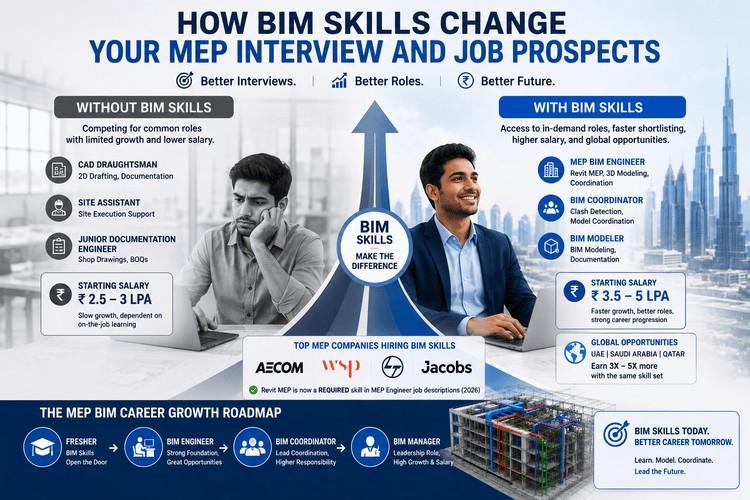
Without BIM skills, you are applying for the same roles as every other MEP fresher, CAD drafting positions, site assistant roles, and junior documentation jobs. Starting salary ₹2.5–3 LPA. Career progression depends heavily on how quickly you can pick up BIM on the job.
With Revit MEP skills and BIM certification, you are applying for roles that others simply cannot. AECOM India, WSP, L&T, and Jacobs now list Revit MEP as a required skill, not preferred, in their MEP engineer job descriptions. Engineers who can demonstrate BIM coordination experience, even from training projects, are shortlisted faster. Starting salary ₹3.5–5 LPA. International opportunities in the UAE, Saudi Arabia, and Qatar are accessible, where the same skill set earns three to five times Indian salaries.
If you have BIM skills, you will get shortlisted for roles that others simply cannot apply for. That is not an opinion; it is what the job descriptions from India's top MEP firms are saying in 2026.
Also Read: MEP Engineering Career Growth Roadmap
Discover how Kaarwan's MEP BIM Certification helps you build the Revit MEP and coordination skills sought by leading firms across India and the Gulf.
Frequently Asked Questions
What questions are asked in an MEP engineer interview?
MEP interviews typically test four categories: MEP system knowledge, HVAC, electrical distribution, plumbing, and firefighting fundamentals. Software skills, AutoCAD drawing ability and Revit MEP proficiency. Coordination understanding, how you would handle a clash between MEP and structural systems, how you read coordinated drawings, and what BIM means in practice. And at least one scenario question, a site problem that tests how you think, not just what you know. The questions in the section above cover all four categories. Start there.
How do I get my first MEP job as a fresher?
Start with an engineering degree in mechanical, electrical, or civil. Build MEP system knowledge, understand HVAC load concepts, electrical distribution basics, and plumbing design principles at a conceptual level. AutoCAD skills are a minimum. Revit MEP skills are what actually get you shortlisted at serious firms. If you have a small portfolio, even a training project showing a duct layout or an electrical schematic in Revit, include it. Direct applications to MEP consultancies with a targeted cover letter work better than generic job portal applications. Kaarwan's MEP BIM certification is specifically designed to get freshers to job-ready Revit MEP proficiency in 10 weeks.
Which city has the most MEP jobs for freshers in India?
Delhi NCR leads on sheer volume; the combination of government infrastructure, commercial real estate, and healthcare construction creates consistent MEP fresher hiring across Gurgaon, Noida, and Delhi. Bengaluru follows, particularly for sustainability-focused and data centre MEP work. Hyderabad is growing fast, driven by the IT park and healthcare development. Chennai has strong industrial and healthcare MEP hiring. Pune is growing. Coimbatore is underrated for industrial MEP roles.
What is the fresher's salary for MEP engineers in India?
₹2.5–4.5 LPA is the realistic fresher range, depending on city, firm size, and skills. BIM-certified freshers with Revit MEP proficiency consistently earn at the higher end of this range and get shortlisted faster. For a full breakdown including mid-level and Gulf salaries.
Do freshers need BIM skills for MEP jobs?
Increasingly, yes, and the expectation is accelerating. For roles at large MEP consultancies and firms handling commercial or institutional projects, Revit MEP proficiency is now listed as required rather than preferred in job descriptions. Even at mid-size firms, freshers who demonstrate BIM awareness, even from training projects, are shortlisted faster and offered better starting packages. For Gulf and international roles, BIM proficiency is essentially a non-negotiable requirement. The honest answer: You can get an entry-level drafting role without BIM skills, but the roles worth getting increasingly require them.