Structural engineering companies in India are having a genuinely interesting moment right now.
The infrastructure push from the central government — PM GatiShakti, the Smart Cities Mission, Bharatmala road programme, metro rail expansion in 20+ cities — has created a level of demand for structural engineering talent that the industry has not seen in a decade. Add to that the private real estate boom in Bengaluru, Hyderabad, Pune, and the NCR, where high-rise residential and commercial towers are going up at a pace that keeps structural consultancies busy with work years in advance. And then there is the industrial side — data centres, warehouses, semiconductor fabrication facilities, and large manufacturing plants — all of which require specialist structural engineering input that is different from what you need for a residential building.
What makes 2026 particularly significant for structural engineers is the BIM shift. Structural engineering companies in India that were still running purely on 2D drawings and STAAD Pro outputs three years ago are now being required, by international clients, by large EPC contractors, by government project management agencies, to deliver in BIM. Revit Structure for modelling, Navisworks for clash detection, ETABS for analysis, feeding into a BIM-coordinated design environment, this is no longer optional on serious projects. It is the baseline. And the gap between structural engineers who have these skills and those who do not is becoming increasingly visible in salary data, job postings, and shortlisting decisions at the firms covered in this page.
The firms below span the full spectrum from EPC giants and global MNC consultancies to pure-play Indian structural design firms that have built decades of reputation without ever having worked on anything less than a complex structure.
Top structural engineering firms like AECOM, Jacobs, and WSP now require BIM skills. Get certified with Kaarwan's BIM Civil Program.
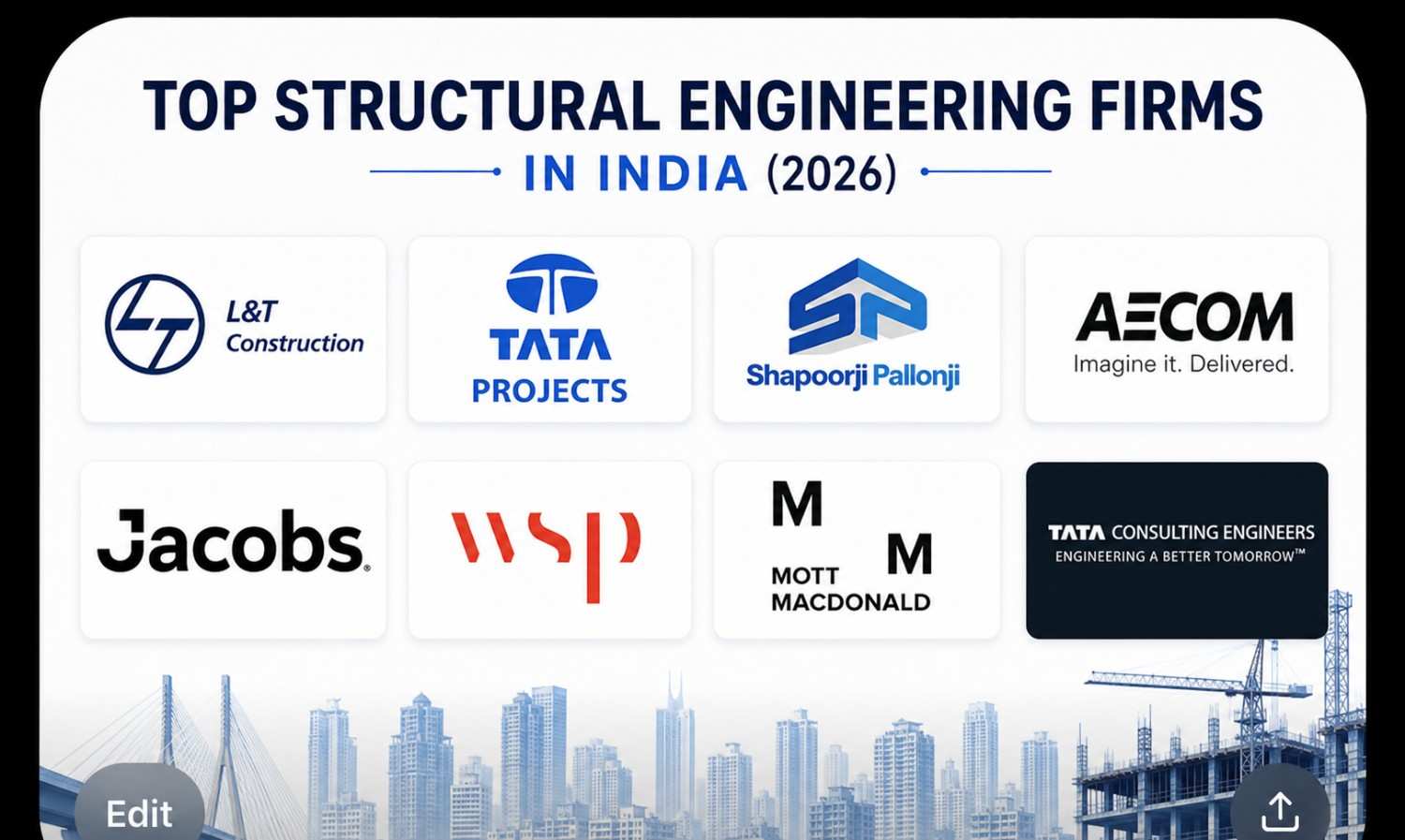
Top Structural Engineering Firms in India (2026)
A note before the table — this is not a ranking. Every firm on this list has a different strengths profile. L&T and Shapoorji Pallonji are right for engineers who want EPC-scale project exposure. AECOM and Jacobs are right for engineers who want international consultancy workflows. Stup Consultants and JW Consultants are right for engineers who want deep structural design specialisation at a pure consultancy. Knowing what kind of structural engineer you want to become is more important than knowing which firm has the most impressive name.
| Company | Specialisation | Headquarters | Known Projects | BIM Adoption | Hiring Freshers |
| L&T Construction | EPC, industrial, infrastructure | Mumbai/Chennai | Statue of Unity civil works, metro rail, airport terminals | High — BIM 360 on large packages | Yes |
| Tata Projects | Urban infra, industrial, power | Mumbai | New Parliament Building, ISRO facilities, metro packages | High — internal BIM mandate on major projects | Yes |
| Shapoorji Pallonji | EPC, high-rise, industrial | Mumbai | Chenab Railway Bridge, DLF commercial towers, data centres | Growing — BIM on international and premium projects | Yes |
| AECOM India | Infrastructure consulting, structural analysis | Gurugram | Delhi Metro, airport projects, highways | High — global BIM standard across offices | Yes |
| Jacobs Engineering India | Advanced facilities, defence, transportation | Mumbai/Bengaluru | Oil refinery structures, defence infrastructure, metro | High — ProjectWise BIM workflows | Yes |
| WSP India | Complex structures, automation, parametric design | Mumbai | Versova Bandra Sea Link, airport structural packages | High — parametric and Revit Structure standard | Yes |
| Mott MacDonald India | Transportation, water, buildings | Mumbai | Rail infrastructure, dam projects, urban water | Growing | Yes |
| Tata Consulting Engineers (TCE) | Industrial, power, infrastructure | Mumbai | Refineries, power plant civil and structural | Moderate | Yes |
| Stup Consultants | Bridge design, prestressed concrete | Mumbai | Numerous bridge and flyover projects across India | Growing | Selective |
| RITES Limited | Railway, metro, port structures | Gurugram | Railway stations, metro viaducts | Moderate — growing on metro packages | Yes |
| Gammon India | Bridge, marine, power structures | Mumbai | Gateway of India (restoration), bridge portfolio | Growing | Yes |
| Aarvee Associates | Road and transport infrastructure | Hyderabad | National highway packages, urban infrastructure | Moderate | Yes |
| Mahimtura Consultants | High-rise residential and commercial | Mumbai | Mumbai high-rise residential, commercial towers | Growing | Selective |
| JW Consultants | High-rise structural design, mixed-use | Pune | World Trade Centre Pune, Market City Mumbai | High — Revit and ETABS integrated | Selective |
| Optimum Design | High-rise residential, townships | Noida | Mahagun Marina Walk, CRC Sublimis, township projects | High — BIM as core workflow | Selective |
Most MNC structural firms and serious Indian consultancies now require Revit and BIM skills as a baseline requirement — not a differentiator, a baseline.
Structural engineering companies are no longer hiring only for theory — they want engineers who can work in BIM workflows from day one. Learn Revit Structure, ETABS, Navisworks, and real project coordination with Kaarwan’s BIM Civil Eng Program.
Top Structural Engineering Consultancies in India
There is an important distinction in the structural engineering jobs market that placement guides often miss. EPC companies like L&T and Tata Projects have structural engineers, but structural engineering is one of many things they do — procurement, construction, project management, commissioning all happen around it. Pure structural design consultancies are different. The entire business is structural engineering. Every project is a structural problem. The depth of technical learning you get in a specialist consultancy in three years is often equivalent to what you would get in seven years at a general EPC.
If deep structural design expertise is what you are building toward, here are the firms worth knowing.
STUP Consultants STUP — Structural Techniques and United Projects — was founded in 1963 by a team that included some of the first Indian engineers trained in prestressed concrete design. They are still, sixty-plus years later, one of the most respected names in bridge and prestressed concrete structural design in India. Their portfolio covers hundreds of major bridges, flyovers, and elevated infrastructure across the country. If you want to become genuinely good at bridge structural design and prestressed concrete, there is nowhere in India with deeper institutional knowledge. Hiring is selective, and competition for positions is real.
JW Consultants, founded in 1975, JW Consultants has built a half-century reputation on high-rise structural design for commercial and mixed-use buildings. The World Trade Centre in Pune, Market City Mumbai, River Valley One in Ahmedabad — the portfolio reflects consistent engagement with complex, multi-storey structural problems. What makes JW interesting in 2026 is that they have genuinely integrated BIM into their workflow — Autodesk Revit, ETABS, Tekla, SAP 2000 are all active tools, not aspirational ones. Engineers who join with these skills get into substantive design work faster.
Optimum Design, based in Noida, has built a strong reputation over 25 years on the back of high-rise residential and township structural design — a segment of the market where the volume of work in India's NCR, Mumbai, and Hyderabad real estate markets is enormous. Their BIM adoption is genuine — they use BIM to reduce construction costs and improve structural performance on projects, not just for coordination drawings. For structural engineers interested in the residential high-rise space, Optimum Design is one of the more technically serious options in North India.
Mahimtura Consultants is a Mumbai-based structural consultancy with a long track record on premium commercial and residential projects in Mumbai and the broader Maharashtra market. Known specifically for complex high-rise structural systems, foundation design in challenging Mumbai soil and rock conditions, and quality of technical output. Less national profile than STUP or WSP, but within Mumbai's premium development sector — consistently regarded as one of the sharper structural design practices.
Epicons Consultants was founded in 1985. Epicons has built a portfolio that spans heritage conservation structural work alongside conventional building structures — an unusual and valuable combination. Heritage structural assessment and remediation is a small but technically demanding niche, and Epicons is one of the few Indian firms that does it seriously. Their adoption of BIM for streamlining design and construction phases is active rather than theoretical for structural engineers who want work that is technically varied and involves something beyond standard new construction, worth exploring.
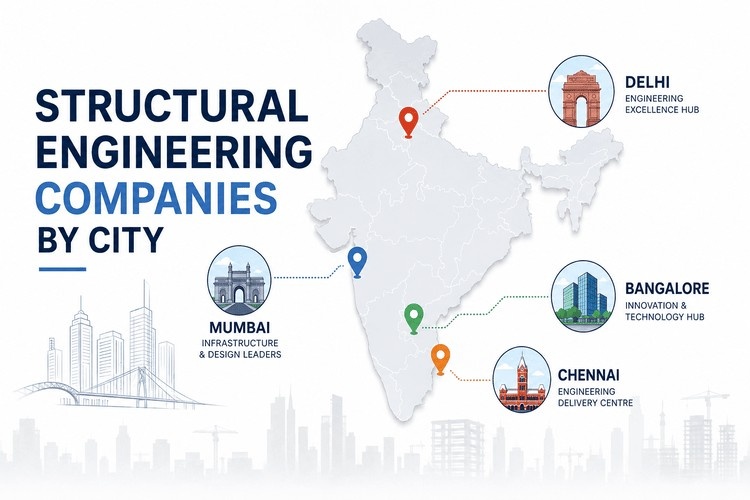
Structural Engineering Companies by City
Structural Engineering Companies in Bangalore
Bengaluru is one of the most active structural engineering markets in India right now — driven by the combination of technology industry office construction, residential high-rise development, the ongoing Namma Metro expansion, and a growing industrial infrastructure base in the surrounding corridors. The city also hosts significant operations for several MNC consultancies.
AECOM India — Bengaluru Office has been growing its Bengaluru team consistently, with a focus on transportation infrastructure and building structures. Strong BIM workflow culture, global project exposure, and above-average salaries for mid-level structural engineers.
Jacobs Engineering — Bengaluru is one of the fastest-growing Jacobs offices in India. Specialises in advanced facilities, defence infrastructure, and complex industrial structural design. Known internally for a collaborative culture and reasonable work-life balance relative to construction peers, which, at this level, matters.
L&T Construction— South India operations run significant structural design and EPC delivery work out of their Chennai-Bengaluru corridor. Site-based structural roles in metro and building projects across the region.
Shapoorji Pallonji - has active construction and structural coordination teams in Bengaluru working on commercial and technology campus projects across the city's major development corridors.
AtkinsRéalis (formerly SNC-Lavalin) — a global engineering consultancy with India operations anchored partly in Bengaluru. Known for transportation infrastructure and complex structural analysis. AmbitionBox data shows them offering Rs 6.8–9.2 LPA for structural engineer roles, with strong ratings for work-life balance.
Structural Engineering Companies in Mumbai
Mumbai remains the headquarter city for most of India's major structural engineering firms — STUP, Mahimtura, Gammon, WSP India, Jacobs India, L&T, Shapoorji Pallonji, TCE, and Mott MacDonald all have significant Mumbai operations. The city's structural engineering market is driven by premium high-rise residential, commercial towers, metro civil work, and the ongoing Navi Mumbai airport and coastal road projects.
WSP India — Mumbai is a strong option for structural engineers who want international consultancy workflows and complex structural analysis assignments. Their Versova Bandra Sea Link involvement and ongoing airport infrastructure work give junior engineers early exposure to serious structural problems.
Tata Consulting Engineers (TCE) — headquartered in Mumbai, TCE focuses on industrial and power sector structures — refineries, petrochemical plants, power stations. If industrial structural engineering is the direction you want to go, TCE is one of the few Indian firms that goes deep into this niche.
STUP Consultants — headquartered in Mumbai, irreplaceable for bridge and prestressed concrete structural design. See the consultancy section above.
Mahimtura Consultants — Mumbai-based, premium high-rise residential and commercial structural design. Selective hiring, technically demanding, and good reputation within the Mumbai developer community.
Gammon India — one of the oldest structural engineering and construction firms in India, headquartered in Mumbai. Bridge, marine, and power station structures. Their project history is longer than most institutions, but the hiring environment has become more selective.
Want to work at firms like L&T, AECOM, Jacobs, or WSP? Build the BIM, Revit Structure, and ETABS skills these companies actually shortlist for with Kaarwan’s BIM Civil Engineering Program — designed for future-ready structural engineers.
Structural Engineering Companies in Chennai
Chennai has a specific structural engineering profile — it is one of the primary delivery centres for L&T Construction's structural engineering operations, hosts significant activity from Tata Projects, and has a growing cluster of industrial and infrastructure structural engineering work driven by the port, automotive manufacturing corridor, and Chennai Metro expansion.
L&T Construction — Chennai is the main engineering delivery centre for L&T's structural design teams. This is where a large portion of the technical structural analysis, Revit and ETABS modelling, and structural drawing production happens for projects across India. For a structural engineer who wants to develop serious software depth — AutoCAD, Revit Structure, ETABS — L&T Chennai is one of the better environments in India.
Sedin Engineering — a Chennai-based structural engineering consultancy that has built a strong track record on industrial and commercial structural projects. Clutch reviews highlight their project management quality and technical responsiveness. Smaller firm, which means more responsibility at junior levels — a trade-off that works well for engineers who want accelerated learning.
AECOM India — Chennai office handles infrastructure and structural design projects across South India. The Chennai team has active involvement in transportation infrastructure structural work, including road and rail packages.
ASE Structure Design — a Chennai-based structural consultancy with a focus on civil and structural design for commercial and residential projects. Smaller, specialist firm with a Chennai-specific client base.
Arris Engineering Services — Chennai-based, with a structural and civil engineering portfolio covering commercial and industrial projects. Active hiring with a mid-size team profile.
What Skills Do Structural Engineering Companies Look For?
| Skill | Why required | Proficiency level expected |
| STAAD Pro | Primary structural analysis tool for beam, slab, and frame analysis — IS code integration, load combination setup, output interpretation | Working proficiency — able to run analysis and interpret results independently |
| ETABS | High-rise and multi-storey building analysis — seismic analysis, lateral load assessment, column and shear wall design | Working proficiency — essential for building structures roles |
| Revit Structure | BIM-based 3D structural modelling, coordination with architectural and MEP models, drawing production | Active requirement at AECOM, Jacobs, WSP, JW Consultants and growing across Indian firms |
| AutoCAD | 2D structural drawing production, detailing, structural layouts | Expected as baseline — structural drawing literacy is non-negotiable |
| IS codes knowledge | IS 456 (RCC), IS 800 (steel), IS 1893 (seismic), IS 875 (loads) — design compliance basis for all Indian structural work | Strong working knowledge expected — codes are referenced daily |
| Navisworks | Clash detection and BIM coordination across structural, architectural, and MEP models | Growing requirement — essential at BIM-mature firms |
| Structural drawing reading | Interpreting structural plans, sections, details, bar bending schedules | Expected from day one — not optional |
| BIM coordination | Understanding federated model workflows, clash report management, ISO 19650 project information | Increasingly required at MNC consultancies and on large government projects |
BIM proficiency is now listed in 60%+ of structural engineering job postings in India. Firms like AECOM, Jacobs, and WSP shortlist candidates with BIM certification over those without — not as a tie-breaker, but as a first filter.
Frequently Asked Questions
Which are the top structural engineering companies in India?
The firms consistently recognised as the strongest for structural engineers in India are L&T Construction, AECOM India, Jacobs Engineering India, WSP India, Tata Projects, and Shapoorji Pallonji Group on the EPC and MNC consultancy side. On the specialist structural design consultancy side — STUP Consultants for bridges, JW Consultants and Optimum Design for high-rise buildings, and Mahimtura Consultants for premium Mumbai market projects.
What is the salary in structural engineering firms in India?
Fresher structural engineers in India start at Rs 3.5–6 LPA at Indian EPC companies and structural consultancies, and Rs 6–9 LPA at MNC consultancies like AECOM, Jacobs, and WSP. Mid-level structural engineers at 3–6 years of experience earn Rs 7–14 LPA at MNC firms, with senior roles at Jacobs and Bechtel hitting Rs 11–13 LPA based on AmbitionBox 2026 data. Engineers with BIM certification — specifically Revit Structure and ETABS in a BIM coordination workflow — consistently access the higher end of these salary bands. The premium for BIM skills over equivalent experience without them is 40–60% at most firms currently actively hiring.
Do structural engineering companies in India require BIM skills?
Yes — and the requirement is accelerating. AECOM, Jacobs, and WSP have required BIM-based workflows across their India offices for several years. What has changed in 2026 is that Indian EPC companies and domestic structural consultancies are increasingly following. L&T Construction runs BIM on large metro and airport packages. JW Consultants has integrated Revit and ETABS into their core workflow. Optimum Design uses BIM as a standard part of its high-rise design process. The structural engineering job postings that do not mention BIM are shrinking. The ones that require it — and pay a premium for it — are growing.
How do I get a job in a structural engineering firm in India?
Three things that move applications forward consistently. First, technical software depth — STAAD Pro or ETABS as a minimum, Revit Structure as a differentiator. A structural engineering candidate who can demonstrate real model-building and analysis output in these tools beats one who lists them on a CV without evidence. Second, internship or project experience on actual structural problems — even a final year project with real structural analysis, load calculations, and design output is significantly better than none. Third, BIM certification — at MNC firms like AECOM, Jacobs, and WSP, this is actively flagged in shortlisting. [
Which cities have the most structural engineering companies in India?
Mumbai, Bengaluru, Chennai, and Gurugram/Delhi are the four primary structural engineering hubs. Mumbai concentrates the most structural engineering consultancy headquarters — WSP, STUP, Mahimtura, Gammon, TCE, Shapoorji Pallonji, L&T ECC all have major Mumbai operations. Bengaluru has the strongest MNC consultancy cluster — Jacobs, AECOM, AtkinsRéalis — driven by the city's technology sector and growing infrastructure investment. Chennai is the primary structural engineering delivery centre for L&T Construction and has a growing cluster of specialist structural consultancies. Hyderabad is the fastest-growing secondary hub, with Jacobs and Tata Projects both expanding significantly in the Hyderabad-Secunderabad corridor.