You've got the portfolio. The renders look good, the mood boards are tight, you actually know your way around a floor plan. And then you open a blank document to write your resume and just freeze.
It happens to almost everyone in this field. Design is visual - you think in layouts and materials, not bullet points. But here's the thing recruiters won't tell you upfront: your resume is what gets your portfolio opened in the first place. Get the format wrong, and nobody even scrolls to the good part.
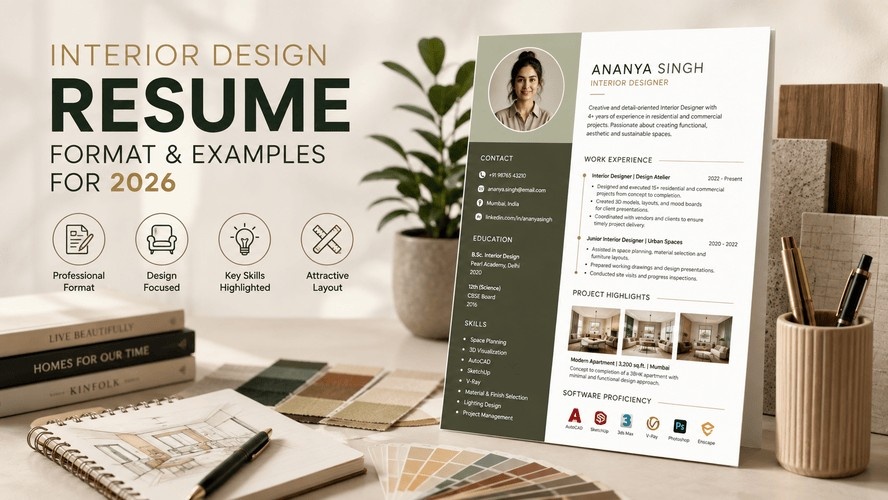
So let's actually sit down and build this properly. Not a generic template you download and forget about - an interior design resume built the way Indian studios and firms actually read them in 2026.
Also Read : How to Build a Stunning Interior Design Portfolio in 2026
What Recruiters Look for in an Interior Design Resume
Talk to anyone who's screened resumes for a design studio in Mumbai or Bangalore and they'll tell you the same thing: they're not reading, they're scanning. Fifteen, maybe twenty seconds per resume before they decide whether to keep looking.
In that window, they're checking for three things. First - can this person actually execute, not just design? Second - do they know the software the role needs, AutoCAD, SketchUp, 3ds Max, whatever the studio runs on? Third - is there a portfolio link they can click right now, without hunting for it?
Miss any of these and your resume goes in the "maybe" pile, which honestly is just a slower way of saying no. If you want the fuller picture of what hiring managers are actually screening for beyond the resume itself, this breakdown of interior design skills employers actually screen for is worth a read too - a lot of it maps directly onto what belongs in your CV.
Also Read: Interior Designer Salary in India (2026)
A resume that actually reflects job-ready skills starts with the right training - Kaarwan's interior design programs are built around the software and workflows studios hire for.
Interior Design Resume Format (Section by Section)
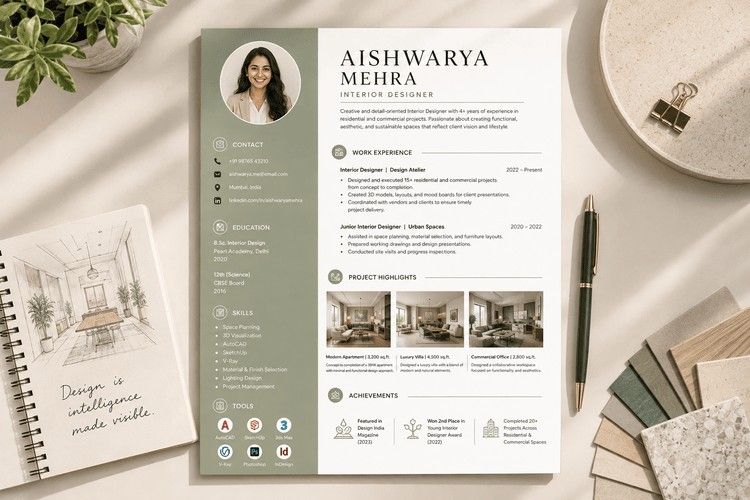
There isn't one universal cv format for interior designer roles, but there's a structure that works for almost everyone starting out or a few years in. Here's how to build it.
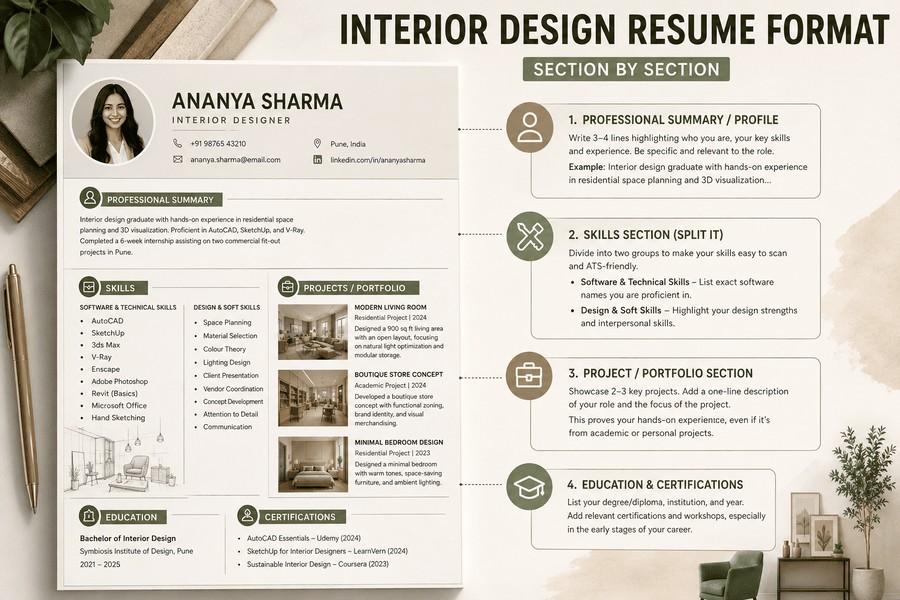
Professional summary / profile
Three to four lines, right under your name. This is not the place to write "creative and passionate designer seeking opportunities" - every recruiter has read that sentence four hundred times and it tells them nothing.
Instead, say what you actually do. Something like: "Interior design graduate with hands-on experience in residential space planning and 3D visualization. Proficient in AutoCAD, SketchUp, and V-Ray. Completed a 6-week internship assisting on two commercial fit-out projects in Pune." That's specific. It's checkable. It gives the recruiter something to hang a decision on.
Skills section (split it - don't dump everything together)
This is where a lot of interior design resumes fall apart. People list "creativity, teamwork, AutoCAD, communication, SketchUp, hardworking" all in one clump, and it reads like a word cloud, not a skill set.
Split it into two clear groups instead:
- Software & technical: AutoCAD, SketchUp, 3ds Max, Photoshop, Revit (if you know it), rendering tools like V-Ray or Enscape, and hand-sketching if that's genuinely a strength.
- Design & soft skills: space planning, material selection, colour theory, client presentation, vendor coordination.
Recruiters - and increasingly the ATS systems bigger firms use - scan for exact software names. "Design software" as a phrase gets you nowhere. "AutoCAD" does.
Project / portfolio section
Even if you've never had a paid job, you've done projects. A studio assignment, a family member's apartment you helped lay out, a competition entry - all of it counts if you present it right.
List two or three, each with a one-line description of what you actually did and what the project involved. "Designed a 900 sq ft residential layout as part of coursework, focusing on natural light optimization and modular storage" tells a recruiter far more than "worked on residential project."
Education and certifications
Keep this simple: degree or diploma name, institution, year. If you've done any short certifications - software courses, styling workshops, sustainability credentials - list them here too, especially early in your career when your education section is doing a lot of the heavy lifting.
Also Read: Interior Design Interview Questions and Answers
Interior Design Resume for Freshers (No Experience)
If you're staring at this thinking "I don't have anything to put in the experience section," take a breath. Nearly every hiring manager in this field expects a fresher's resume to look different from a five-year veteran's, and they read it accordingly.
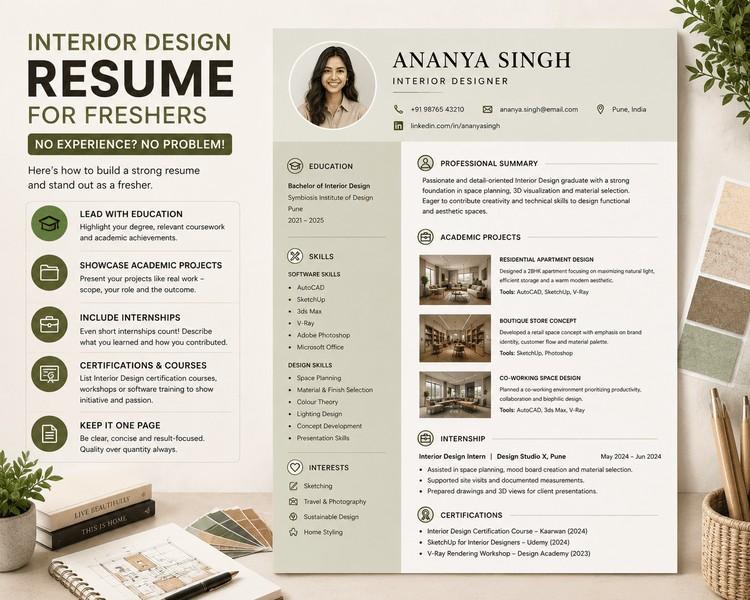
Here's what actually works when you're building a fresher interior designer resume from close to nothing:
- Lead with education and coursework, not a thin experience section that's mostly padding.
- Turn academic projects into resume bullets the same way you would real work - scope, your role, the outcome.
- Internships, even short ones, go near the top. A two-week internship where you shadowed site visits and helped with material boards is legitimate experience - describe what you actually contributed.
- If you've done any structured upskilling, an Interior Design Certification course, a software bootcamp, a styling workshop, it signals to recruiters that you're taking the field seriously beyond your degree.
- Keep it to one page. A fresher's resume that runs to two pages usually just means there's a lot of filler in there.
This same logic applies for anyone building an interior design resume for internship applications specifically - the bar isn't "prove you're already a professional," it's "prove you're ready to learn fast and contribute."
Also Read: How to Become an Interior Stylist in India in 2026
Common Mistakes That Get Interior Design Resumes Rejected
Most of the resume advice floating around online tells you what to add. Less of it tells you what's quietly killing your chances. A few patterns show up constantly:
- Vague verbs, no outcomes. "Worked on design projects" says nothing. "Designed layouts for two residential units, reducing wasted floor space by rethinking storage placement" says a lot.
- A resume that's trying to look designed. Heavy colour blocks, decorative fonts, graphics - it might look nice to your eye, but a lot of firms now run resumes through applicant tracking software first, and fancy formatting can get your text scrambled or skipped entirely. Save the visual flair for your portfolio.
- No portfolio link, or a buried one. If a recruiter has to search for how to see your work, most won't bother. Put it right under your contact details.
- Listing software you've barely touched. If you list Revit and can't answer a basic question about it in an interview, that's worse than not listing it at all.
- Copy-pasting the same resume everywhere. A hospitality-focused studio and a residential design firm are looking for different signals. It takes ten minutes to tweak your summary and skills order per application - do it.
Also Read: Interior Design Software List 2026
How Your Resume and Portfolio Work Together
Your resume gets you noticed. Your portfolio gets you hired. They're doing two different jobs, and mixing them up is a common trap - people either try to cram portfolio-level detail into their resume, or they treat the portfolio like an afterthought once the resume's done.
Think of the resume as the pitch and the portfolio as the proof. The resume says "I can do space planning and I know AutoCAD." The portfolio shows the actual floor plan, the actual render, the actual before-and-after. Neither one works well without the other backing it up.
If you haven't built yours out yet, or you're not sure it's actually doing its job, this guide on how to build a stunning interior design portfolio in 2026 walks through it properly - worth reading before you finalize your resume, since the two should feel like they're telling the same story.
Ready to make your resume and portfolio interview-ready? Kaarwan's Interior Design Certification course builds the exact software and project skills recruiters screen for.
Key Takeaways
Your interior design resume format should do exactly one job well: get someone to click your portfolio. Keep the structure clean, split your skills instead of dumping them together, quantify your projects wherever you can, and don't let decorative formatting get in the way of an ATS actually reading your text. If you're a fresher, lean on your education, internships, and coursework projects — they count for more than you think, as long as you describe them properly.
FAQs
How long should an interior design resume be?
One page if you're a fresher or have under five years of experience. Two pages only if you genuinely have enough project depth to justify it - padding a one-page resume into two rarely helps.
Do I need a portfolio link on my resume, or a separate one?
Both, kind of. Your resume should have a clickable link to your portfolio, placed near your contact details so it's impossible to miss. The portfolio itself lives separately, wherever you're hosting it - Behance, a personal site, a PDF.
What skills should I list on an interior design resume?
Split them into software (AutoCAD, SketchUp, 3ds Max, Photoshop) and design or soft skills (space planning, material selection, client communication). Listing them separately, rather than mixed together, reads far more professional.
How is an interior design resume different from an interior stylist resume?
An interior designer's resume leans harder on technical software and space-planning experience. A stylist's resume tends to emphasize aesthetic sensibility, sourcing, and styling portfolios over CAD proficiency - though there's overlap, especially early in a career.