So you've typed "interior styling course India" into Google about four times this week, and you're still not sure what you're actually looking for. Fair. The space is genuinely confusing right now — there's a flood of options, half of them calling themselves "interior design" and the other half "interior styling," and nobody's explaining what separates the two before asking for your card details.
Let's actually sort this out.
What a Good Interior Styling Course Actually Teaches
Strip away the marketing language and most solid interior styling programs — anywhere in the country — circle back to the same handful of things.
Space planning shows up first, even in styling-focused courses. Not the technical, load-bearing-wall kind of planning architects do, but the practical version: how do you arrange furniture and objects so a room reads as intentional instead of just... full. There's a real skill difference between a space that has nice things in it and a space where those things are actually working together. You feel it the second you walk in somewhere that's been styled well. Hard to explain why. Easy to notice.
Colour theory comes next, and it's less "here's a colour wheel" and more "here's why this palette makes a small room feel calm instead of cramped." Good courses spend real time on how colour, texture, and material choices interact — because picking three nice fabrics doesn't automatically mean they'll sit well next to each other.
Then there's furniture and material selection, which sounds obvious until you're actually doing it. Knowing what a client can source locally, on their budget, within a realistic timeline — that's a different skill from knowing what looks good on Pinterest. And this is exactly where a lot of self-taught stylists get stuck. The ideas are fine. The execution against real Indian supplier availability is where the gap shows up.
Mood boards get taught in almost every course worth its salt, digital or physical, because that's how you actually pitch a concept to a client before touching a single cushion. And client management — the unglamorous part nobody puts on the brochure — is usually the difference between someone who styles one project and disappears, and someone who gets referred again and again.
If a course skips most of this and jumps straight into "trends," that's worth noticing.
Also explore: How to Become an Interior Stylist in India in 2026 — it walks through the skills employers actually screen for, if you're trying to figure out whether a course is even worth it first.
Want to actually get hands-on with this instead of just reading about it? Kaarwan's one-day Master Interior Styling & Spatial Decoration masterclass is built to give you real, practical exposure to spatial styling fast — no year-long commitment needed.
Full Courses vs. Masterclasses — What's the Real Difference?
Here's the honest, no-fluff version: a full interior design or styling course typically runs 12 to 18 months and can cost upwards of ₹1 lakh depending on the institute, and it's built to take you deep across the entire discipline — construction basics, materials science, drafting, the works. A masterclass is the opposite bet. It's a fast, focused way to test the field or sharpen one specific skill — spatial decoration, styling for a shoot, whatever you actually need right now — without committing a year and a chunk of savings to it.
Neither is "better." They're solving different problems. If you're not sure interior styling is even the right career fit yet, sinking a year and a lakh-plus into a full program before finding out is a rough way to learn that lesson. A masterclass gets you hands-on with the actual work fast, and if it clicks, you can always go deeper later. If you already know this is your path and you want the full technical grounding — drafting, construction knowledge, the breadth to move across the industry — that's when the longer route earns its cost.
We've actually covered the certification question in more depth in How to Become an Interior Stylist in India — short version, the credential matters a lot less than what you actually walk away able to do.
Where Kaarwan's Interior Styling Masterclass Fits
To be upfront about it — Kaarwan's Master Interior Styling & Spatial Decoration masterclass is a focused, one-day format built around spatial decoration and styling fundamentals.
It's not trying to be a substitute for a full certification, and honestly, it shouldn't be sold as one anywhere. Think of it as the fastest possible way to get real, structured exposure to how styling actually works — good for students figuring out if this is their thing, or working professionals (architects, interior designers) who want to add a styling skillset without a year-long detour.
If what you actually want is broader, deeper training — the kind that covers interior design as a whole discipline, not styling specifically — Kaarwan's Advanced Interior Design Course is the closer fit. Worth being clear on this distinction upfront: it's a design course, not a styling-specialist one, so pick based on which skill you're actually trying to build.
Who Is Interior Styling Right For?
Styling tends to suit people who already have decent visual instincts — you rearrange your own room compulsively, you notice when a café's lighting is doing something interesting, you have opinions about cushion placement that your friends find slightly excessive. That instinct is the raw material. A course just gives it structure and vocabulary.
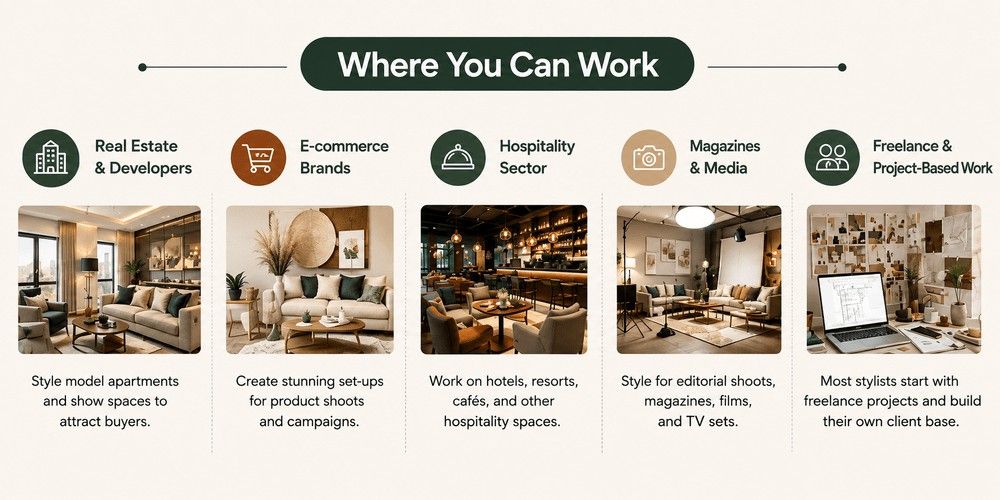
Career-wise, the field's opening up in a lot of directions right now — real estate developers styling model apartments before site visits, e-commerce brands needing product shoots that look like actual styled interiors instead of catalogue photos, hospitality projects, magazine and set work. It's rarely a single 9-to-5 role; most working stylists are piecing together project-based work, at least early on.
If you want the fuller picture on where this is headed as an industry, How to Become an Interior Stylist in India gets into the career path and realistic salary ranges in more detail.
Already sure interior design is the deeper path you want? Kaarwan's Advanced Interior Design course gives you the fuller technical grounding across the discipline, taught by working industry professionals.
Conclusion
Start with what actually matches your time and budget right now, not the biggest, most expensive program you can find. A masterclass is a perfectly legitimate way to begin — the goal is momentum, not credentials.
Try Kaarwan's Master Interior Styling & Spatial Decoration Masterclass
Frequently Asked Questions
Is interior styling the same as interior design?
No, though people use the terms interchangeably. Interior design covers the technical and structural side of a space — layouts, construction knowledge, materials science. Interior styling comes in after that groundwork exists (or works within a space that already has it) and focuses purely on the aesthetic layer: furniture arrangement, textiles, objects, the visual composition that makes a room feel finished.
Do I need a full course to become an interior stylist, or is a masterclass enough?
It depends on where you're starting from. A masterclass is enough to get real, structured exposure and figure out if the field suits you, and plenty of working stylists build careers off certificates or short focused programs rather than full degrees. What actually matters more than the credential is your portfolio and whether you can execute — a full course helps if you want deeper technical grounding across the whole design discipline.
How much does interior styling training cost in India?
It ranges widely. Short certificate courses and masterclasses can run from a few thousand rupees to around ₹1 lakh depending on format and duration, while full diploma or degree-style programs — 12 to 18 months — often start north of ₹1 lakh. Always check what's actually included: live projects, software training, portfolio support.
Can I build a career in interior styling without a design degree?
Yes. A creative eye and a solid portfolio carry more weight in this field than a specific degree. Many working stylists in India come from certificate or diploma backgrounds, or transition in from architecture and graphic design. What clients and employers actually check is your body of work, not your transcript.