There is a moment a lot of people have. Could be scrolling Instagram at 1am, or walking through a hotel lobby that makes you stop mid-step, or flipping through a magazine and staring at a beautifully arranged bookshelf, wondering , who decided to put that small terracotta pot exactly there? Who chose that shade of dusty green for those cushions?
Someone did. Deliberately. And that person's job title is interior stylist.
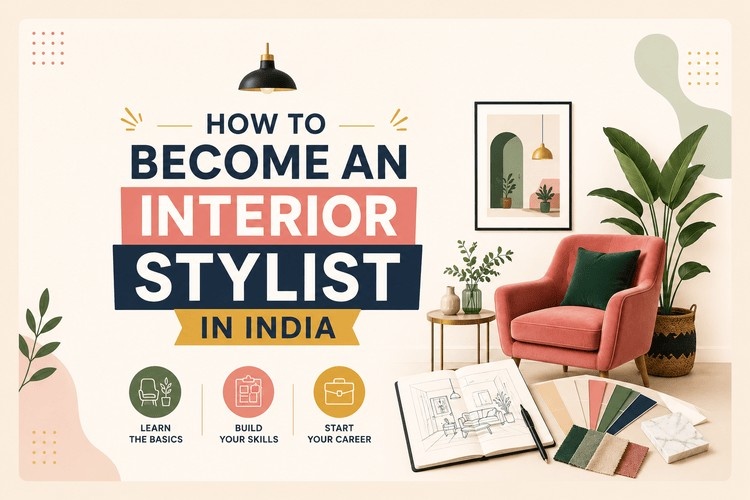
If you have ever wondered how to become an interior stylist in India, you are not alone. The interior stylist career in India is growing fast and is more reachable than many think. You don't need a degree to get started. You also don't need a huge budget to begin. What you really need is a sense of style, proper training, a portfolio that you're proud to share, and the determination to get in front of the right people early on.
Let's go through this step by step.
Also Read: Key Interior Design Elements Every Designer Should Know
What Does an Interior Stylist Actually Do?
This needs clearing up first because the confusion is constant.
An interior stylist is not an interior designer. The terms get used all the time interchangeably, and they are genuinely different things , and understanding the interior stylist vs interior designer distinction early will save you a lot of confusion.
An interior designer handles the structural and spatial side , floor plans, built-in furniture, lighting fixtures, the relationship between walls and openings. It often involves technical drawings, contractor coordination, and in many contexts a license or formal qualification.
An interior stylist comes in after the bones of the space exist , or works within a space that already has its structure , and creates the aesthetic layer. The furniture arrangement. The textiles and cushions. The artwork on the walls. The objects on the shelves. The colour palette that ties everything together. That specific quality a room has where it just feels right.
No structural changes. No construction drawings. Pure visual composition.
In India, stylists do all sorts of jobs. They work on homes, hotels, stores, and showrooms. They also do photo shoots for stores and magazines. You can even find them on movie and television sets. Some stylists work on model homes for property developers. The jobs are all different and usually project-based. People need stylists more and more because everyone wants their spaces to look great in pictures , and the market for home decor is only getting bigger.
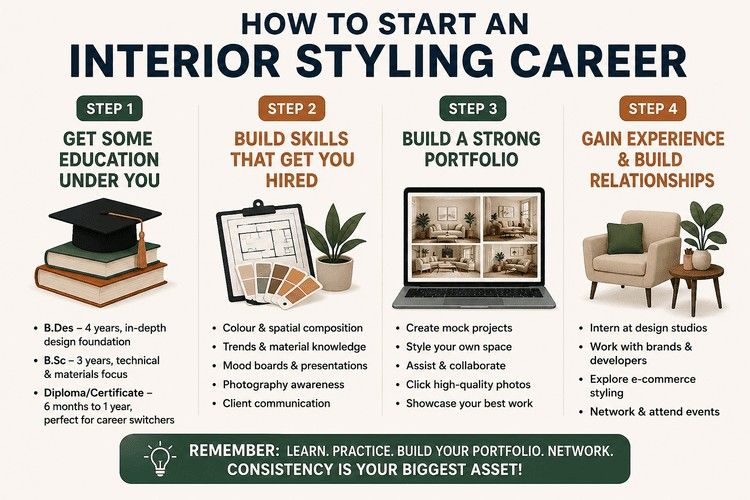
Step 1: Get Some Education Under You
A creative eye matters most. But if you are serious about how to start interior styling as a real career, formal education , even a focused diploma or certificate course , gives you vocabulary, technical grounding, and a process that self-teaching alone rarely produces.
The common routes for an interior design career in India:
B.Des in Interior Design is the full four-year undergraduate path. It covers space planning, colour theory, materials, lighting, furniture design, design history , the works. Best if you want the deepest foundation and the flexibility to move across different parts of the industry later.
B.Sc in Interior Design runs three years and tends to lean slightly more technical, with stronger emphasis on materials and construction knowledge. Useful if you plan to work closely with builders and contractors alongside your styling work.
Diploma and Certificate Courses are where things get interesting for career switchers. Six months to a year. An interior design diploma in India at this level focuses specifically on interior styling skills , colour, furniture layout, mood board creation, visual merchandising, client communication. If you already have a background in architecture, graphic design, fashion, or any visual field and want to pivot specifically into styling, this is often the most sensible starting point. You are not repeating a full degree. You are adding a specific layer.
The honest advice: the credential matters significantly less than what you actually build from the program. Pick the course that gives you real project work, teaches you the software you will use day-to-day, and pushes you to develop a point of view , not just technical skills.
Step 2: Build the Interior Stylist Skills That Actually Get You Hired
Interior styling is a skill set. Here is what the core interior stylist skills specifically consist of.
Colour: Not just knowing that blue is calming and red is energetic , that level you already know. Real colour understanding means knowing how colours interact with each other, how they change completely under different light conditions, how the proportions you use determine whether a palette feels grounded or chaotic. This is foundational. Non-negotiable.
Spatial composition: How to arrange objects and furniture so a space feels intentional rather than just full. Scale, proportion, negative space, focal points, visual rhythm. This is the skill that separates a styled room from a room that just has things in it. It sounds abstract until you do it wrong and suddenly understand it very well.
Trend awareness and material knowledge: The Indian interior design market in 2026 is moving quickly , biophilic elements, Indian craft materials in contemporary contexts, a real push toward sustainability, maximalist colour palettes returning after years of minimalism dominating. Knowing what is happening allows you to speak the language of clients who come to you with a Pinterest folder and a vague instruction to "make it feel like this." Knowing materials lets you deliver on those references within actual Indian supplier availability and budgets , which is where local knowledge genuinely counts.
Also Read: Interior Design Tools for Students
Mood boarding and presenting: Before anything moves or gets purchased, you present a vision. Mood boards help clients feel what a space will look like before it exists. You should be comfortable with tools like Photoshop or Canva for mood boards, SketchUp for layouts, and platforms like Milanote or Morpholio Board for client presentations. You do not have to be great at all of them; you just need one workflow that produces professional-looking results.
Photography awareness: Interior stylists frequently work directly with photographers on editorial and product shoots. Knowing what looks good in a frame, how to create depth, how to handle light reflections, and how to style a corner for the camera without making it look "set up" is genuinely useful even when you are not the one holding the camera.
Client communication: This one is under-discussed and probably causes more career problems than weak design does. Listening properly. Translating vague references into concrete decisions. Managing expectations around budget, timeline, and scope. A lot of talented stylists lose repeat clients because of communication gaps rather than creative ones. It is worth thinking about early.
Also Read: How to build an Interior design Portfolio
Step 3: Build an Interior Styling Portfolio , Even Without Clients
Every working interior stylist started with zero clients. Every single one. Your interior styling portfolio does not require paid work , it requires showing your sensibility, your process, and what you are capable of.
Mock projects: Pick a room type, a bedroom, a living room, a café corner, and fully style it on paper and screen. Create a mood board. Specify the materials and furniture pieces. Produce a layout. Write a short rationale explaining your decisions. This tells a potential client or employer exactly how you think, which is what they are actually evaluating.
Style your own space: Your bedroom. Your study corner. A section of your family home. Photograph it properly. Before-and-after comparisons are particularly powerful; they make the transformation tangible and visible in a way that mood boards alone cannot.
Assist someone: Even unpaid help on a photoshoot or a residential styling project gives you real, documented work. You also learn things in that context that no classroom replicates: the gap between a concept and an actual physical space, the reality of working with what a vendor delivers versus what you specified.
Collaborate with photographers and content creators: Instagram home decor accounts, real estate photographers, furniture brands, all of them need styled photography regularly. Offer to style a shoot in exchange for the images. Both of you get something useful.
One more detail: photograph everything well. High-quality images of modest work beat poor images of ambitious work every single time. Edit your portfolio ruthlessly, fifteen strong images, not sixty average ones.
Build a professional portfolio, master interior styling concepts, and learn from experts with Kaarwan's Advanced Interior Design Certification Course. Start today.
Step 4: Get Real Experience and Build Relationships
Education gives you the skills. Portfolio shows what you can do. Experience is where you get confident enough to do it without second-guessing yourself on every decision.
Design studios: Look for internships with firms handling residential or hospitality projects. Most mid-sized studios in Bengaluru, Mumbai, Delhi NCR, Hyderabad, and Pune take interns. You learn workflows, vendor relationships, client management, and project reality all at once.
Furniture and home decor brands: Brands that sell furniture or accessories need in-house or freelance styling for showroom setups, catalogue shoots, and marketing content. These roles give you exposure to product knowledge and commercial styling simultaneously.
Real estate developers: Model apartments need styling before photography and site visits. This is consistent, reasonably well-paid work in Indian metros where developers compete hard on how their marketing materials look.
E-commerce platforms: Brands selling home decor products need product photography that looks like styled interiors rather than catalogue images. Not the most glamorous work, but consistent volume and is excellent for building speed and confidence.
On networking: Actually go to things. Trade shows, design weeks, architecture and interior events. The Indian design industry is smaller than it looks from the outside. Referrals and personal relationships drive a large proportion of freelance styling work.
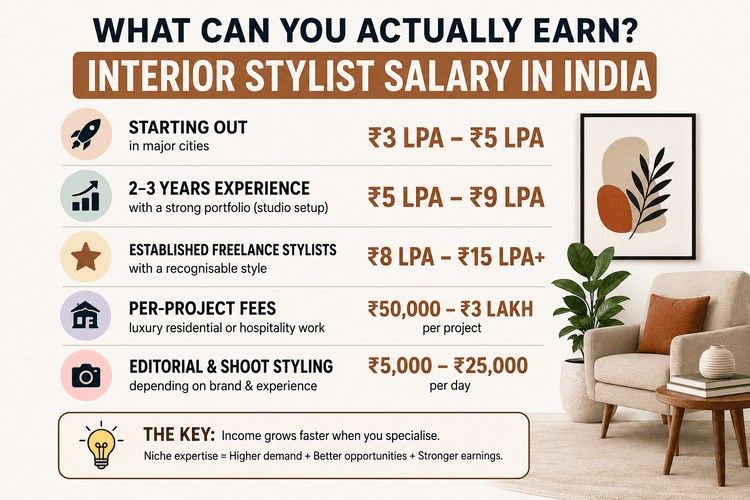
What Can You Actually Earn? Interior Stylist Salary in India
The truth about interior stylist salary in India varies considerably depending on the city, type of work, clients, and whether you are employed or freelancing.
- Starting out: roughly ₹3 LPA to ₹5 LPA in major cities
- With two to three years of experience and a strong portfolio: ₹5 LPA to ₹9 LPA in a studio setup
- Established freelance stylists with a recognisable style: ₹8 LPA to ₹15 LPA or more
- Per-project fees for luxury residential or hospitality work: ₹50,000 to ₹3 lakh per project
- Editorial and shoot styling: ₹5,000 to ₹25,000 per day, depending on the brand and your experience
The income is not immediately large. But it builds faster when you specialise. Stylists who become known for a specific niche , luxury residential in Bengaluru, hospitality shoots in Goa, editorial work for home decor publications , find sustainable demand more quickly than those trying to do everything for everyone.
Interior Stylist vs Interior Designer: Which One Are You?
If you are still deciding, the interior stylist vs interior designer question comes down to where your interest actually lives.
Does it live in the spatial problem-solving , how people move through a space, how structural decisions affect function, the relationship between architecture and human experience? That pulls toward interior design.
Does it live in the aesthetic layer , the specific quality a room has when everything is exactly right, the way two textures work together, the colour of afternoon light on a particular wall? That pulls toward interior styling.
Neither path is more valid. They serve different aspects of the same industry. Many stylists eventually move into broader design work as their career develops, but starting in the place that actually excites you is the fastest way to build momentum.
Ready to turn your passion for interiors into a career? Enrol in Kaarwan's Advanced Interior Design Certification Course and gain industry-relevant, practical skills.
Conclusion
The interior styling career path in India is not a single ladder with fixed rungs. You pick a starting point, build skills seriously, build a portfolio honestly, assist people who are further along than you , and then at some point, the work starts coming to you rather than you chasing it.
The first project feels strange. The second feels easier. By the third or fourth, you start to understand your own instincts.
Frequently Asked Questions
Q1: Do I need a degree to become an interior stylist in India?
Not necessarily. Many working interior stylists in India have certificates or diplomas rather than full degrees. What matters most is your portfolio, your skills, and your ability to execute a brief professionally. That said, formal education, even a six-month focused certificate course, gives you structured skill development and credibility that pure self-teaching often lacks.
Q2: What software should an interior stylist know?
At minimum: Adobe Photoshop or Canva for mood boarding, SketchUp for basic 3D layouts, and basic AutoCAD familiarity is useful. Instagram and Pinterest are genuinely important tools for trend research and portfolio presentation. You do not need to be a CAD expert, but enough software fluency to produce professional presentations is expected.
Q3: How long does it take to start earning as an interior stylist?
With focused learning and active portfolio building, most people start getting their first paid projects, small residential assignments, photoshoot styling, and showroom work within six to twelve months of starting. The timeline compresses significantly if you are assisting an experienced stylist or interning actively alongside your studies.
Q4: Is interior styling a stable career in India?
The market is growing. Real estate, hospitality, and retail sectors continue to expand in Indian metros, and each of them needs interior styling at various scales. The freelance structure of the work means income can be variable early on, but stylists who build a reputation in a specific niche (luxury residential, hospitality, editorial) find sustainable demand relatively quickly.
Q5: Can I become an interior stylist after an architecture or graphic design degree?
Absolutely — both backgrounds transfer well. Architecture graduates already understand spatial thinking and technical drawing, which means the skill gap to move into styling is primarily about aesthetics and client communication. Graphic designers bring strong visual composition and colour skills that translate directly into moodboarding and presentation. A short, focused course in interior styling is usually enough to bridge the gap from either background.