If you've landed on this page, you're probably somewhere in one of two spots. Either you're thinking about getting into UI/UX and want to know if it's actually worth the time and money before you commit, or you're already a couple of years in and quietly wondering if you're being paid what you're worth. Fair questions, both of them. Let's just get into it.
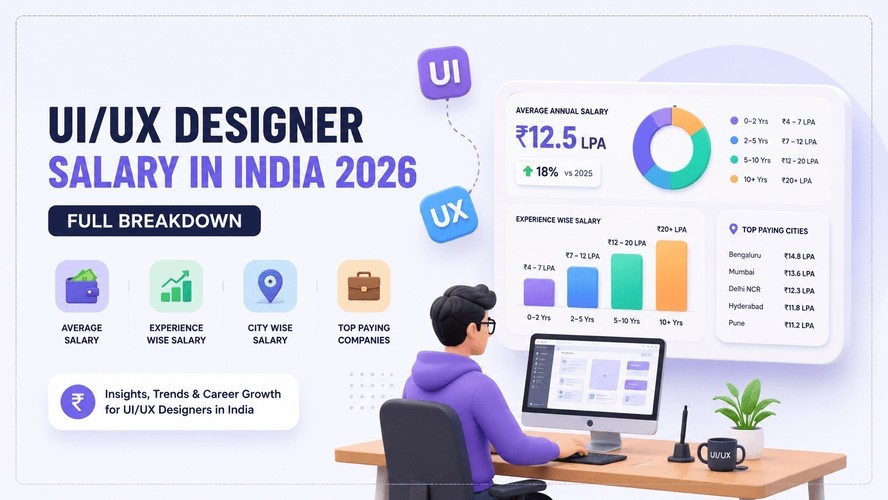
Quick answer, since you're probably skimming: UI/UX designer salary in India in 2026 ranges anywhere from ₹3-6 LPA for a fresher to ₹40+ LPA for senior product designers and design leads at top companies. That's a massive spread, and the honest reason for it isn't experience alone — it's role, city, company type, and how well you can actually talk about the impact of your design work. We'll walk through all of it.
This guide is built for students, career-switchers, and working designers — especially those coming from architecture, engineering, or other creative backgrounds who are eyeing UI/UX as their next move. If that's you, you're in good company; a lot of Kaarwan's own students have made exactly this jump. If you're earlier in that decision, starting your UI/UX career is worth reading alongside this one.
UI/UX Designer Salary by Experience Level
Let's start with the basics, because this is what most people search for first.
| Experience Level | Salary Range (CTC) | What You're Actually Doing |
| Fresher (0-2 years) | ₹3-7 LPA | Executing wireframes, basic UI screens, working under a lead |
| Mid-level (2-5 years) | ₹8-16 LPA | Owning a product surface, running user research, making independent calls |
| Senior/Lead (5+ years) | ₹16-35 LPA+ | Design systems, mentoring, stakeholder presentations, product strategy |
A few honest notes on this table. The fresher band has genuinely widened in the last year or two — AI tools have made basic screen production faster, so companies are paying less for designers who can only do that, and noticeably more for freshers who show up with real research chops or a portfolio that shows actual problem-solving. It's not fair, exactly, but it's the reality right now. These ranges track closely with Glassdoor India's employee-submitted salary data for the role, if you want to cross-check them yourself.
The mid-level jump is where things get interesting. This is usually when a designer either plateaus around ₹10-12 LPA doing solid-but-unremarkable work, or breaks past ₹16 LPA because they've picked up something specific — design systems, research depth, whatever. More on that later.
Salary by Role — Because "UI/UX Designer" Is Kind of a Catch-All Title Now
Here's something a lot of guides gloss over: "UI/UX Designer" as a single job title is slowly becoming less useful. Companies are hiring for more specific roles, and the pay differs quite a bit between them.
UI Designer — focused on the visual layer. Typography, components, layout, visual consistency. Pay: roughly ₹4-18 LPA depending on seniority. This is usually the entry point, but the ceiling is lower if you stay purely visual.
UX Designer — user flows, information architecture, interaction patterns, wireframing before visuals. Pay: ₹5-25 LPA. Tends to pay a bit more than pure UI because it's harder to fake — you can't wing user flows without actually understanding the user. Glassdoor's data for UX Designers in Bengaluru shows this gap over pure UI roles pretty clearly.
UX Researcher — interviews, usability testing, synthesis, presenting findings that actually change roadmaps. Pay: ₹6-25 LPA. There aren't many good ones in India right now, honestly, which means the ones who are good get paid disproportionately well.
Product Designer — the full loop: research, ideation, UI, and enough business sense to defend decisions in front of a VP. Pay: ₹8-40 LPA+. This is where the real money is in 2026, and most of the highest-paying job listings you'll see are for this title, not "UI/UX Designer."
If you're not sure which of these fits you yet, that's completely normal at this stage — most people figure it out by doing the work, not by reading a job description.
Ready to launch your UI/UX career? Join Kaarwan's UI-UX Design Certification & Job Support Program to master design tools, create a standout portfolio, and receive job placement support.
UI/UX Salary by City in India
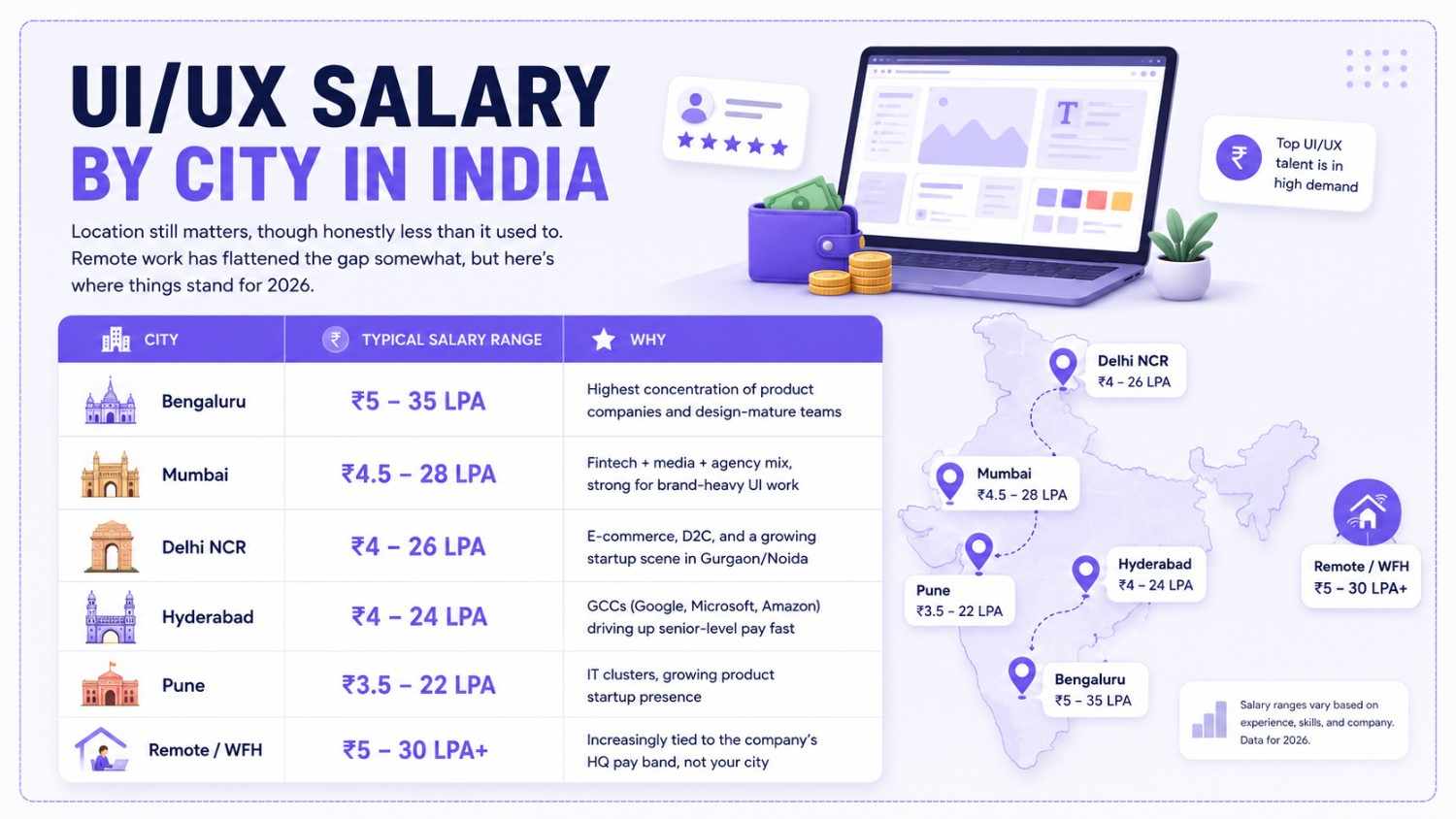
Location still matters, though honestly less than it used to. Remote work has flattened the gap somewhat, but here's where things stand for 2026.
| City | Typical Salary Range | Why |
| Bengaluru | ₹5-35 LPA | Highest concentration of product companies and design-mature teams |
| Mumbai | ₹4.5-28 LPA | Fintech + media + agency mix, strong for brand-heavy UI work |
| Delhi NCR | ₹4-26 LPA | E-commerce, D2C, and a growing startup scene in Gurgaon/Noida |
| Hyderabad | ₹4-24 LPA | GCCs (Google, Microsoft, Amazon) driving up senior-level pay fast |
| Pune | ₹3.5-22 LPA | IT clusters, growing product startup presence |
| Remote/WFH | ₹5-30 LPA+ | Increasingly tied to the company's HQ pay band, not your city |
Worth saying out loud: if you're working remotely for a Bengaluru-headquartered product company while living in a Tier-2 city, you're often earning at Bengaluru rates while paying Tier-2 living costs. That arbitrage is real, and more designers are figuring this out every year.
In-House vs Agency vs Freelance — Which One Actually Pays Better?
This question comes up constantly, and the honest answer is: it depends on what stage of your career you're at.
Agencies tend to pay less upfront — often 10-20% below product companies for the same experience level — but they throw a much wider variety of client work at you. If you're early on and need to build a portfolio fast, an agency (or even a couple of solid freelance projects) can get you there quicker than sitting at one product company for two years.
In-house / product companies pay better on average and offer the deeper, longer-term context you need to eventually become a senior product designer. This is where the ₹20 LPA+ jobs mostly live.
Freelance income is the wildcard. It genuinely ranges from ₹20,000 a project to lakhs, depending entirely on your client base and reputation. It's not a stable starting point for most people, but it's a decent way to supplement income once you already have a portfolio and some client trust built up.
There's no universally "right" path here — a lot of designers do agency-then-product-company, and it works well precisely because it front-loads portfolio variety before you need stability.
Also read: Why UI/UX is a strong career move for architecture and design backgrounds.
What Actually Moves Your Salary Up (Beyond Just Waiting for Experience)
This is probably the section worth reading twice, because it's where most people leave money on the table without realizing it.
Your portfolio matters more than your years of experience. This isn't a throwaway line — recruiters genuinely spend under a minute on a portfolio before deciding whether to move forward. A designer with 2 years of experience and 3 well-documented case studies (real problem, real research, real outcome) will often out-earn someone with 4 years of experience and a portfolio full of pretty screens with no context.
Figma proficiency is table stakes now, not a differentiator. Everyone knows Figma. What separates a ₹10 LPA designer from a ₹20 LPA designer is usually one of these: design systems ownership, UX research depth, or the ability to talk about design decisions in terms of business metrics (conversion, drop-off, retention) instead of just "it looks cleaner."
Specialization pays. Designers who can build and govern a design system, or who run proper research instead of guessing, are commanding real premiums right now — anywhere from 20% to 40% above generalist pay, depending on the company. If you're deciding what to learn next, this is usually a better bet than another visual design course.
A certification helps, but only if it comes with real project work. A certificate alone won't move your salary. A certificate that forced you to build 2-3 genuine case studies, on the other hand, absolutely will — because that's what actually shows up in the interview. If you're building yours out, building a portfolio that gets you hired is a good next stop.
Also read: Transitioning into UI/UX from another field.
Build industry-ready UI/UX skills through live projects, expert mentorship, portfolio development, and dedicated placement support with Kaarwan's UI-UX Design Certification & Job Support Program.
Summary
UI/UX designer salary in India in 2026 isn't really one number — it's a range shaped by your role (UI vs UX vs product design), your city, your company type, and honestly, how well your portfolio tells a story.
Freshers can expect ₹3-7 LPA, mid-level designers ₹8-16 LPA, and senior product designers and leads well past ₹25-35 LPA at the right companies. If you're building toward that senior band, the fastest lever isn't waiting out the years — it's picking up research depth, design systems experience, and a portfolio that actually shows impact.
If you're just starting out — a structured program that actually forces you through real case studies (not just theory) is genuinely the fastest way to close the gap between "knows Figma" and "gets hired at ₹8 LPA+." Kaarwan's UI/UX Design Certification & Job Support Program is built around exactly that.
If you're already working and stuck around the same number for a while — it's usually not a skills problem, it's a positioning problem. Before your next appraisal or interview, it's worth reading how to negotiate your UI/UX salary — most designers ask for less than the market actually supports.
FAQs
Is UI/UX design a well-paying career in India?
Yes, relative to most other creative fields — but the range is wide. Entry-level pay (₹3-7 LPA) is comparable to most white-collar first jobs, but the ceiling for product designers and design leads (₹30-40 LPA+) is genuinely high, especially at product companies and GCCs.
Do you need a design degree to get hired?
No. A large share of working UI/UX designers in India come from architecture, engineering, psychology, or commerce backgrounds. What actually gets you hired is a portfolio that shows real problem-solving, not a specific degree.
Which pays more, UI or UX?
UX roles generally edge out pure UI roles in pay, because research and flow-design skills are harder to fake and rarer to find. That said, designers who are strong at both — the "product designer" profile — out-earn either specialist track.
How much can a fresher expect in the first job?
Realistically, ₹3-7 LPA depending on city and portfolio quality. A fresher with 2-3 solid case studies and decent Figma fluency tends to land toward the higher end of that range, even without prior work experience.
Does a certification course improve starting salary?
Indirectly, yes — not because the certificate itself impresses anyone, but because a good course forces you to build the case studies and portfolio depth that actually get you shortlisted and paid better.