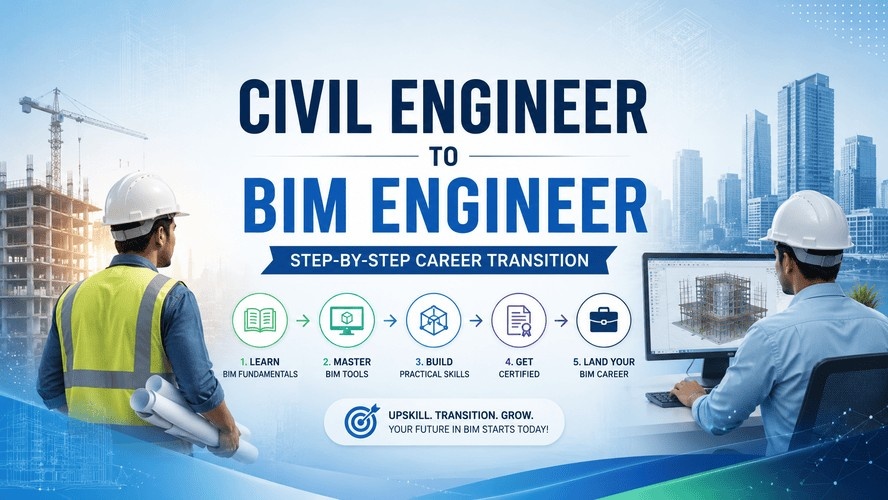
Most civil engineers do not plan this transition. It happens when something shifts , a project where the BIM-trained engineer on the team seemed to have a completely different level of visibility into what was happening, a job posting where the BIM requirement appeared three times in the first paragraph, a salary number that stopped you mid-scroll.
Or sometimes it is simpler than that. You are two or three years into your career. You are good at your work. And you start realising that the trajectory you are on , 2D drawings, manual BOQs, site execution, traditional coordination workflows , has a ceiling. Not immediately. But eventually.
The civil engineer to BIM engineer transition is not a dramatic career pivot. It is a deliberate upgrade. Your civil engineering foundation , understanding of structures, construction sequencing, material behaviour, site constraints , is actually an advantage in BIM work, not something you leave behind. BIM work is better when it is done by people who understand what they are modelling and coordinating. That is you.
This guide is the complete roadmap , what changes, what the steps actually are, how long it honestly takes, what you will earn, and what mistakes to avoid on the way.
Why Civil Engineers Are Moving to BIM in 2026
The demand shift is real and it is measurable.
India's infrastructure expansion under the Smart Cities Mission, PMAY, and the National Infrastructure Pipeline has created a floor of demand for BIM professionals that is not reversing. Metro rail projects , Mumbai, Bengaluru, Hyderabad, Delhi NCR expansion , are being delivered under BIM mandates. Highway projects above a certain scale through NHAI increasingly require digital delivery. Government-funded public buildings are moving toward BIM submissions for permits.
The practical effect: firms are hiring for BIM skills. And civil engineers with BIM capability are being paid significantly more than those without it , roughly 40 to 60 percent more at equivalent experience levels, based on salary data across Indian AEC firms in 2026.
Simultaneously, demand for purely 2D drafting and manual BOQ work is declining. Not disappearing , but shrinking. The career risk of staying exclusively in traditional workflows is a real and growing one for civil engineers in Indian metros.
The positive framing: the gap between BIM demand and BIM supply is large right now. Firms want civil engineers with BIM skills. That gap is your opportunity.
Civil Engineer vs BIM Engineer , What Actually Changes
Before the roadmap, it helps to understand what the shift actually involves day-to-day. Because the change is real, but it is not what most people assume.
Day-to-day work
A civil engineer working in a traditional role spends significant time on 2D drawing production, manual quantity estimation, site coordination, and discipline-specific execution. Problems are often caught on site , which means they are expensive to fix.
A BIM engineer works in 3D models that carry data , geometry plus specifications, quantities, relationships between elements. Their work involves building and maintaining those models, federating them across disciplines (structural, architectural, MEP), running clash detection to find conflicts before construction starts, and producing automated quantity take-offs from the model rather than manual calculations.
The shift is from discipline-specific execution to cross-discipline coordination. And from reactive problem-solving (on site, after the fact) to preventive problem-solving (in the model, before anyone mobilises).
Tools
AutoCAD → Autodesk Revit for building modelling. Civil 3D for infrastructure (roads, corridors, drainage, earthworks). Navisworks for federation and clash detection. Dynamo for automation and parametric workflows. BIM 360 / Autodesk Construction Cloud for collaboration.
Mindset shift
This is the part that takes the most adjustment. Civil engineers are trained to think within their discipline. BIM work requires thinking about how your discipline interacts with every other discipline , how the structural slab edge affects the MEP routing, how the drainage alignment conflicts with the utility corridor. Cross-discipline awareness is a skill. It is also something your site experience already partially gives you.
Also Read: BIM vs CAD: What's the Difference?
Take the next step in your career. Explore Kaarwan's BIM Certification Program and gain the practical BIM skills, portfolio projects, and industry exposure employers look for.
Step-by-Step Transition Roadmap
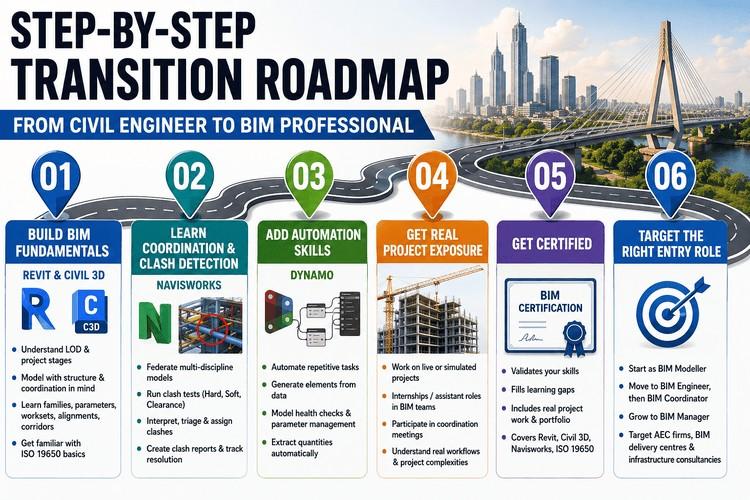
Step 1: Build BIM Fundamentals , Revit and Civil 3D
The starting point for any civil engineer to BIM transition is the core modelling tools. For building and structural work, that is Revit. For infrastructure , roads, bridges, drainage, land development , it is Civil 3D.
The critical thing here is not to stop at surface-level software familiarity. You need to understand the underlying logic , what LOD (Level of Development) means and why it matters at different project phases, how to structure a model so it is coordination-ready rather than just visually correct, how families and parameters work in Revit, how corridors and alignments function in Civil 3D.
LOD is particularly important and frequently misunderstood. LOD 100 is a conceptual representation. LOD 300 is construction-ready geometry. LOD 400 is fabrication-level. Different project stages require different LOD , and a BIM engineer who does not understand this produces models that are either underdeveloped (useless for coordination) or over-detailed (creating performance issues and unnecessary effort).
ISO 19650 is the international standard for BIM information management , naming conventions, model structure, information containers, CDE requirements. You do not need to memorise it in the first week, but you need familiarity with it before you start applying for coordinator-level roles. Employers in India working on international projects or government-mandated BIM projects will expect it.
Step 2: Learn Coordination and Clash Detection , Navisworks
Navisworks is where BIM stops being about individual models and starts being about coordination.
In Navisworks, you federate the separate discipline models , structural, architectural, MEP , into a single combined model. Then you run clash detection tests to find where elements from different disciplines conflict with each other. A structural beam running through an HVAC duct. A plumbing riser in conflict with a column. These are the kinds of problems that, in traditional construction, get discovered on site and cost ₹2–10 lakh each to fix depending on the project scale. In BIM, you find them in the model.
Learning Navisworks means learning to set up clash tests, understand the different clash types (hard clash, soft clash, clearance clash), interpret and triage the results, produce clash reports that discipline teams can act on, and track resolution status. This is genuinely coordination work , not just software operation.
For civil engineers making this transition, this is also where your site experience starts paying dividends. You know what kinds of conflicts actually matter on a real project. You know the difference between a clash that will cause a problem and one that is a modelling artefact that can be dismissed. That judgment is not something you can learn from software tutorials.
Also Explore: What is a BIM Engineer? Roles, Skills, Salary and Career Path
Step 3: Add Automation Skills , Dynamo
Dynamo is a visual programming environment that runs inside Revit. It allows you to automate repetitive tasks , generating model elements from spreadsheet data, running model health checks, extracting quantities automatically, applying parameters across large numbers of elements at once.
This is not an entry-level requirement. You can get your first BIM role without Dynamo. But for civil engineers who want to move from BIM modeller to BIM engineer to BIM coordinator on a reasonable timeline, Dynamo is what separates the candidates who get shortlisted for senior roles from those who plateau.
The good news: Dynamo is a visual scripting environment, not a text-based programming language. You do not need to write Python or C#. You connect nodes , blocks of logic , to build workflows. Engineers with analytical thinking (which civil engineering training builds strongly) tend to pick up Dynamo faster than they expect.
Also Read: How AI is Changing BIM Work for Civil Engineers
Step 4: Get Real Project Exposure
This is the step that YouTube-only learners skip and it is why they plateau.
Software knowledge from tutorials is decontextualised. You can watch fifty Revit tutorial videos and still not know how a model is structured on a real coordination project, how changes are tracked and communicated across teams, or why certain things that seem straightforward in a tutorial become genuinely complex in a live project environment.
Real project exposure fixes this. It could come from:
Structured learning with live project components. A certification program that includes actual project simulation , not just exercises , gives you exposure to real workflow dynamics before you are in a job interview defending your project experience.
Internships or assisting roles. Many mid-sized Indian AEC firms and BIM delivery centres will take on interns or junior assistants who bring BIM training. The work is sometimes modest at first , but the context you gain from watching how a real coordination process operates is worth more than months of self-directed software practice.
Contributing to your current firm's BIM work. If you are already employed as a civil engineer at a firm that has started using BIM , even partially , volunteering to assist on that work, attending coordination meetings, helping maintain the model , is the fastest route to real exposure without changing jobs.
Step 5: Get Certified
A structured BIM certification does three things. It validates your skills to employers. It fills the gaps that self-directed learning consistently leaves. And it gives you a project portfolio to show in interviews.
Not all certifications are equal. What a credible BIM certification for civil engineers should cover: Revit and Civil 3D at construction-documentation depth (not just introductory modelling), Navisworks coordination workflows, ISO 19650 standards familiarity, and real project-based output you can include in a portfolio.
Also Read: BIM Course for Civil Engineers.
The portfolio point matters enormously. In interviews for BIM roles, you will be asked to show what you have done. "I completed an online course" is significantly weaker than "here is a coordinated structural model with clash reports and quantity schedules I produced during my certification." Certification programs that include project work give you the second thing.
Also Read: Top Civil Engineer's Companies in India.
Step 6: Target the Right Entry Role
The career ladder for a civil engineer to BIM career change is well-defined:
Civil Engineer → BIM Modeller → BIM Engineer → BIM Coordinator → BIM Manager
Your civil engineering degree and experience do not automatically place you at BIM Engineer level. Most people making this transition realistically enter at BIM Modeller , even with certification , because employers want to see BIM-specific project experience before placing someone in a coordination role.
This is not a demotion. It is how the industry works and it is temporary. Engineers who enter as BIM Modellers and demonstrate coordination awareness, clash detection skill, and cross-discipline thinking typically move to BIM Engineer or BIM Coordinator within 12 to 18 months.
The firms to target for entry-level BIM civil roles: AEC delivery centres in Bengaluru, Hyderabad, and Pune (many international firms outsource BIM coordination to Indian teams), large infrastructure consultancies handling highway, metro, and airport projects, and EPC firms that are scaling BIM capacity in response to government mandates.
Realistic Timeline
Let's be direct about this because most guides oversell it.
3 to 6 months: Foundational software skills in Revit/Civil 3D and Navisworks. Basic understanding of BIM standards and coordination workflows. Enough to have a credential and initial portfolio.
6 to 12 months: Coordination proficiency. Dynamo basics. Ability to contribute meaningfully on a BIM project without constant guidance. This is when you become genuinely competitive for BIM Modeller and junior BIM Engineer roles.
12 to 24 months of BIM-specific work experience: BIM Engineer to BIM Coordinator transition. By this point your civil engineering background plus BIM coordination experience is a genuinely valuable combination.
The timeline compresses when learning is structured (a certification with real project components rather than scattered YouTube tutorials), when you get live project exposure during learning, and when you actively pursue BIM work at your current firm while training.
It extends when learning is entirely self-directed, when you stop at software familiarity without developing coordination understanding, and when you do not build a portfolio.
Salary Comparison , Civil Engineer vs BIM Engineer in India 2026
| Role | Entry Level | Mid-Level | Senior |
| Civil Engineer (traditional) | ₹3–4.5 LPA | ₹5–8 LPA | ₹8–14 LPA |
| BIM Modeller | ₹3.5–5 LPA | ₹5–7 LPA | ₹7–10 LPA |
| BIM Engineer | ₹5–7 LPA | ₹7–12 LPA | ₹12–18 LPA |
| BIM Coordinator | ₹6–9 LPA | ₹9–15 LPA | ₹15–22 LPA |
| BIM Manager | ₹12–16 LPA | ₹16–25 LPA | ₹25–35 LPA |
The salary premium for BIM-skilled civil engineers is real and grows significantly at coordinator and manager levels. At international AEC delivery centres handling global projects from Indian offices, these ranges extend further , BIM Coordinator roles at multinational firms with 5+ years of experience in Bengaluru and Hyderabad frequently exceed ₹15 LPA.
Also Explore: BIM Civil Engineer Salary India 2026.
Common Mistakes Civil Engineers Make When Switching to BIM
Stopping at Revit basics only. Revit proficiency without Navisworks coordination knowledge is a significant gap. Most BIM roles , even entry-level ones , require clash detection experience. Engineers who only learn Revit are missing half the toolkit.
Not learning Dynamo. This does not block entry-level roles but it does create a plateau. Engineers who stay at basic Revit without adding automation skills find their career progression slowing significantly after two to three years.
No portfolio. A certificate without project evidence is significantly weaker in interviews than no certificate at all with strong self-directed project work. Portfolio is not optional , it is the primary evidence of your capability.
Choosing unstructured or free-only learning. YouTube and free platforms are excellent for supplementary learning. They are not sufficient as a primary learning path because they lack the project-based workflow context that employers test for in interviews. Engineers who learn exclusively from free resources often have software knowledge without coordination understanding , and interviewers can tell the difference within five minutes.
Not using their site experience. Civil engineers making this transition often undervalue what they already know. Site experience , understanding construction sequences, recognising where clashes typically occur, knowing what information contractors actually need , is directly valuable in BIM coordination work. Lead with it in interviews and use it to differentiate yourself from candidates who only have modelling skills.
Ready to transition from Civil Engineering to BIM? Build industry-relevant skills in Revit, Civil 3D, Navisworks, and project coordination with Kaarwan's BIM Certification Program.
Conclusion
The civil engineering foundation you have built , understanding of structures, construction sequencing, material behaviour, what actually happens on a site , is not a liability in BIM work. It is what makes your BIM work credible and practical rather than technically impressive but disconnected from construction reality.
The transition takes focused effort, structured learning, and a portfolio that shows you can do coordination work , not just model elements. But for civil engineers who make this investment, the combination of domain knowledge and BIM skill is genuinely rare and genuinely valued.
Frequently Asked Questions
Q1: Is BIM only for architects, or can civil engineers do it too?
BIM was originally associated primarily with architectural workflows, but this has changed significantly. Civil engineers are now among the most in-demand BIM professionals , particularly for infrastructure projects involving roads, bridges, metro systems, and drainage. BIM civil roles including BIM Engineer, Structural BIM Specialist, Civil 3D Specialist, and BIM Coordinator are distinct from architectural BIM roles and require civil engineering understanding. In India's current market, BIM for civil infrastructure is a rapidly growing specialisation with strong demand.
Q2: Do I need to quit my job to learn BIM?
Not at all , and for most civil engineers, learning BIM while employed is the better path. It gives you time to develop skills properly without income pressure, and it often creates opportunities to start applying BIM knowledge at your current firm before you formally transition. Many civil engineers in India complete BIM certifications through evening and weekend programs while working full-time. The transition then happens more smoothly , into a BIM role with a credential and some applied experience rather than starting with neither.
Q3: How long does it take to become job-ready in BIM?
Three to six months of structured, focused learning is enough to reach entry-level job readiness for a BIM Modeller role with a portfolio. Six to twelve months is enough to become competitive for BIM Engineer roles. The timeline depends significantly on whether learning is structured (certification with live project work) versus unstructured (YouTube-only), and whether you get real project exposure during training. Self-directed learning without project context typically takes longer and produces weaker interview performance.
Q4: Is BIM engineer a good long-term career compared to traditional civil engineering?
The long-term trajectory strongly favours BIM-skilled civil engineers over traditionally-skilled ones in the Indian market. Government mandates for BIM on public infrastructure are expanding. International delivery centres in India handling global BIM projects are growing. The salary premium at senior levels is significant. And critically , BIM skills are transferable internationally in a way that purely traditional civil skills are not, giving BIM engineers access to Gulf, UK, Australia, and Singapore markets where civil infrastructure spend is substantial and BIM is standard. Civil engineers who combine domain knowledge with BIM proficiency are in the strongest position.
Q5: Will AI replace BIM engineers?
AI is changing how BIM work is done , automated clash detection, AI-assisted model review, generative design for infrastructure , but it is not replacing the coordination and judgment function that BIM engineers provide. AI tools operate on the model; BIM engineers decide what the model should contain, how it should be structured, and how conflicts between disciplines should be resolved. The role is evolving toward more analytical and decision-making work as repetitive tasks automate. Engineers who develop both BIM coordination skills and familiarity with AI-assisted workflows are the ones best positioned for 2026 and beyond.