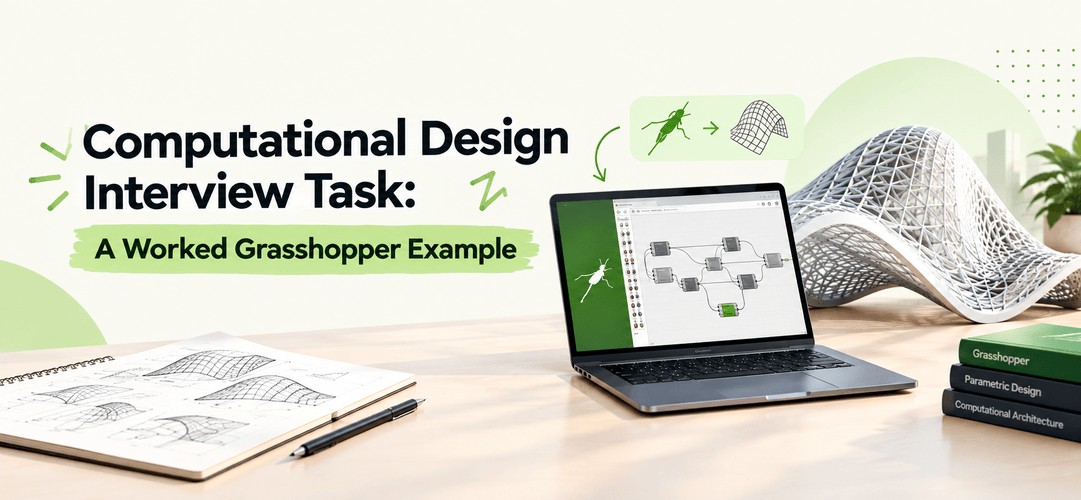
A computational design interview task is usually a timed Grasshopper exercise where you build a small parametric system and talk the interviewer through it as you go. That second part catches most people out. You can answer questions all day and still freeze when someone says "share your screen and start with a blank canvas."
This guide gives you one realistic sample brief, worked through step by step, plus a way to explain your decisions without rambling. If you want the verbal side, the full list of common interview questions sits in a separate guide. Read the two together: one is what you say, the other is what you build.
Also Read: Advanced parametric design techniques in Rhino and Grasshopper
What Interview Tasks Actually Look Like
Most Grasshopper interview tasks are either a live screen-share of 30 to 60 minutes or a take-home you finish in a day or two. The brief is nearly always a small facade, roof or massing problem, because those show data handling, geometry and judgement in one go.
There's a reason facades dominate. A Gensler Technical Designer opening in Bangalore, posted in June 2026, asks for people who can build and deploy Grasshopper and Dynamo scripts and who understand panelization and rationalization. A facade exercise is that job description shrunk to forty-five minutes.
If you're a final-year B.Arch student or a young architect applying to studios in Bengaluru, Mumbai, Delhi NCR or Hyderabad, expect this. Even if the task is never mentioned in the job post.
Also Read : A guide to parametric modelling with Rhino
The Sample Brief
Here's the brief, stated in full. Treat it like the real thing and set a 45-minute timer.
You're designing the west-facing facade of a commercial office in a hot, sunny Indian city. The facade is a gently curved surface, roughly 24 m wide and 12 m high. Add horizontal fins across it. Fin depth should be larger where the afternoon sun hits the facade more directly, and smaller where it doesn't. Fin depth must stay between 150 mm and 600 mm. The panel count must be adjustable. The definition must still work if the surface is swapped for a different one. Deliver a working definition, one screenshot, and a two-minute explanation.
Notice the surface is curved. On a flat facade every panel faces the same direction, so every panel would get the same fin. The curve is what makes the exercise interesting.
Also Read : How to use Grasshopper for generative design
Want to rehearse this under real pressure? Kaarwan's Rhino & Grasshopper Certification includes interview prep as part of placement support in its final two weeks.
Working Through It: The Approach, Step by Step
Step 1: Reference and divide the surface. Bring the surface in with a Surface parameter, then use Divide Domain² and Isotrim to cut it into panels. Drive the U and V counts with two sliders (try 24 by 12 to start).
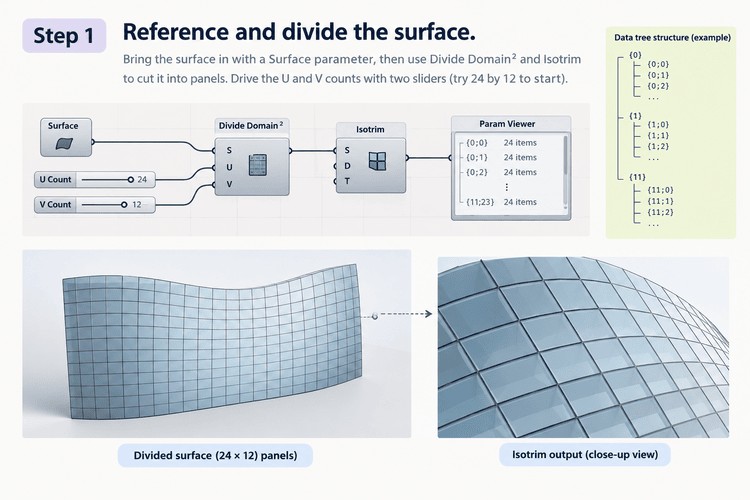
Before you move on, open a Param Viewer on the Isotrim output. Isotrim hands back a data tree, and everything downstream depends on that structure staying intact. This is where data trees quietly ruin interviews: the geometry looks fine and the branches don't line up. Grasshopper repeats the last item of a shorter list to match a longer one, so a mismatch rarely throws an error. It just gives you the wrong answer.
Say this out loud: "I'm checking the tree now, because every later step assumes one branch per row."
Step 2: Find each panel's centre and its facing direction. Run the sub-surfaces through Area to get centroids. Feed those points into Surface Closest Point on the original surface, then Evaluate Surface to read the normal at each one.
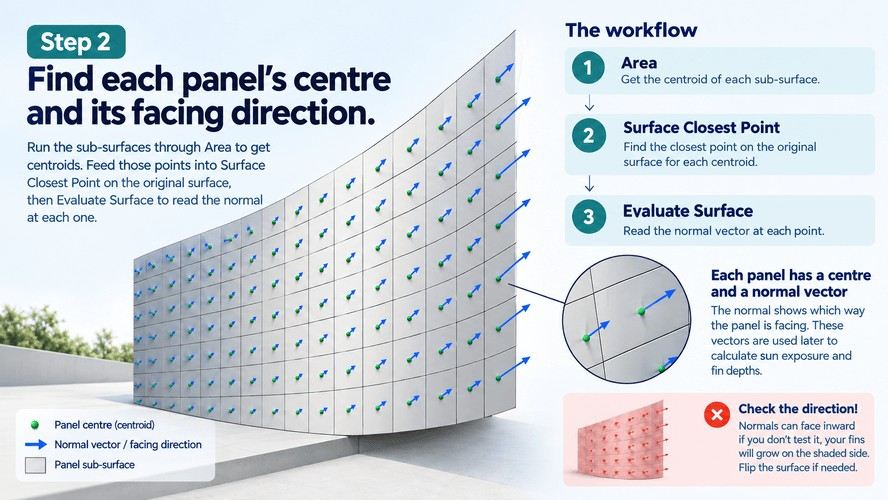
Now check which way those normals point. Surface normals can face inward, and if you don't test it your fins will grow on the shaded side. Flip the surface if you have to. Interviewers notice when you check this unprompted.
Say this out loud: "I'm confirming the normals face outward before I trust any exposure number."
Step 3: Define the sun, simply. Build a direction vector pointing toward a low, west-southwest afternoon sun using Vector XYZ and a Unit Vector, with sliders for the angles. Take the Dot Product of each panel's normal and this sun vector. A value near 1 means the panel faces the sun head-on. Near 0 means the sun is grazing it.
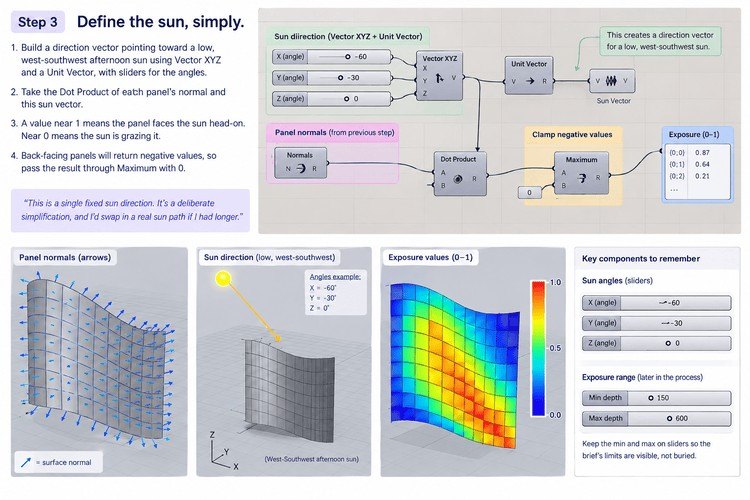
Back-facing panels will return negative values, so pass the result through Maximum with 0.
Say this out loud: "This is a single fixed sun direction. It's a deliberate simplification, and I'd swap in a real sun path if I had longer."
Step 4: Turn exposure into fin depth. Remap Numbers is your friend here. Source domain 0 to 1, target domain 150 to 600, built with two Construct Domain components or one domain driven by sliders. Put the min and max on sliders so the brief's limits are visible, not buried.
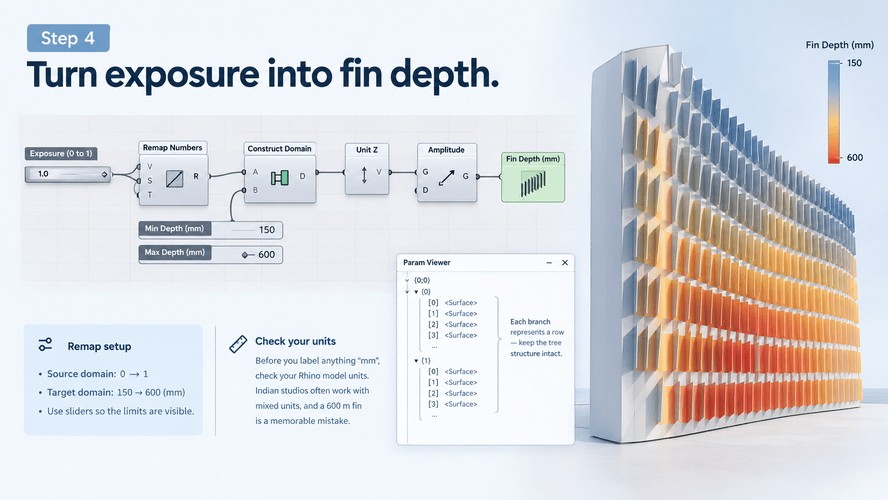
Check your Rhino model units before you label anything "mm." Indian studios often inherit drawings in mixed millimetres, metres and even feet, and a fin that's 600 metres deep is a memorable way to end an interview.
Step 5: Build the fins. Pull the bottom edge of each panel (Edges component, then List Item; confirm in the viewport which edge you grabbed). Extrude that curve along the normal, using Amplitude to set the length from your remapped depth.
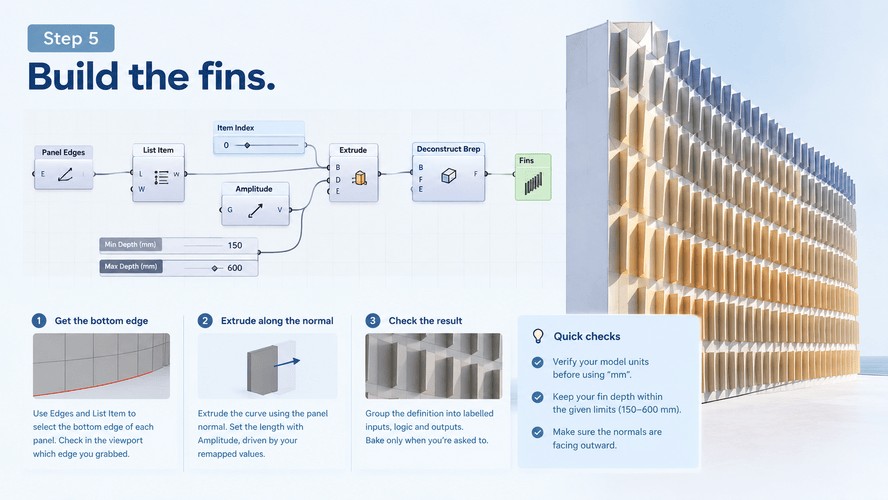
Group the definition into labelled inputs, logic and outputs, and bake only when you're asked to. That's it. Five steps, no plugins, and every one of them is something you can explain.
Also Read : Ladybug tools tutorial for India
What Assessors Are Actually Scoring
Nobody publishes a universal rubric, so treat this as what the exercise tends to reveal rather than an official scoring sheet. The posting above gives a real anchor: firms want scripts that run reliably across projects, with sensible panelization and rationalization behind them.
In practice, interviewers usually watch four things:
- Whether your data structure stays clean from first component to last
- Whether the definition survives a changed input (swap the surface, change the count)
- Whether you check your own work as you go
- Whether you can say why you made each choice, in plain words
Notice that "was the facade pretty" isn't on that list.
David Rutten, who created Grasshopper, once wrote on the McNeel forum that he'd tell his younger self to read more theory than how-to tutorials and to think about how to test an outcome before writing the code. That's a decent summary of what the checks in Steps 1 and 2 are for.
How to Explain Your Trade-offs Out Loud
The trade-offs are where you stop sounding like someone following a tutorial. Pick two or three and say them calmly.
First, the simple sun. One fixed vector is quick but crude. A real study would use weather data and a full sun path, which is the territory of Ladybug and Honeybee. Being upfront about this shows maturity, not weakness.
Second, deeper fins block more heat but also cut daylight and views. India's ECBC 2017 sets envelope requirements for larger commercial buildings, so a good answer acknowledges that fin depth isn't only a design choice, it's tied to code and energy performance.
Third, fabrication. Right now every fin has a unique depth, which means hundreds of unique parts. Say you'd round the depths into four or five bands to keep the panel count manageable. That one sentence shows you understand algorithmic design as something that has to get built, not just rendered.
Say this out loud: "Here's what I simplified, here's what it costs, and here's what I'd do next."
This Is Different From a Question List, Here's Why
A question list tests whether you know things. A task tests whether you can do them while someone watches, and those are different muscles. Plenty of people who ace the full list of common interview questions still lose the room when the screen share starts.
So use both. Learn the vocabulary from the question guide, then do this exercise out loud with a timer. Record yourself if you can bear it. It's uncomfortable and it works.
Also Read : Integrative design and analysis with Grasshopper
Shaky on data trees or attractors? Kaarwan's Rhino & Grasshopper Certification takes you from first node to a definition you can explain out loud.
Rhino Grasshopper Interview Preparation: The Week Before
Rebuild this exact task from scratch three times, faster each time. Then change the brief (a roof instead of a facade, rotation instead of depth) and do it again. If you want structure around this, Kaarwan's Rhino & Grasshopper Certification is built for exactly this kind of practice.
FAQs
What is a typical computational design interview task?
A short, timed Grasshopper exercise, most often a facade, roof or massing problem. You build a small parametric system, usually with no plugins, and explain your choices while the interviewer watches.
How long do Grasshopper interview exercises usually take?
It varies by firm. Live tasks commonly run 30 to 60 minutes, and take-home versions often give you a day or two. Ask the recruiter for the format when you're invited, and practise to the shorter end.
Should I explain my process or just show the result?
Explain it. A finished definition with no reasoning tells the interviewer very little. Short, steady narration of what you're checking and why usually counts for more than a perfect-looking output.
What if I don't finish the task in time?
Say so calmly, show where you got to, and describe the remaining steps and what you'd test. A clean, half-finished definition you can fully explain beats a rushed, tangled one.