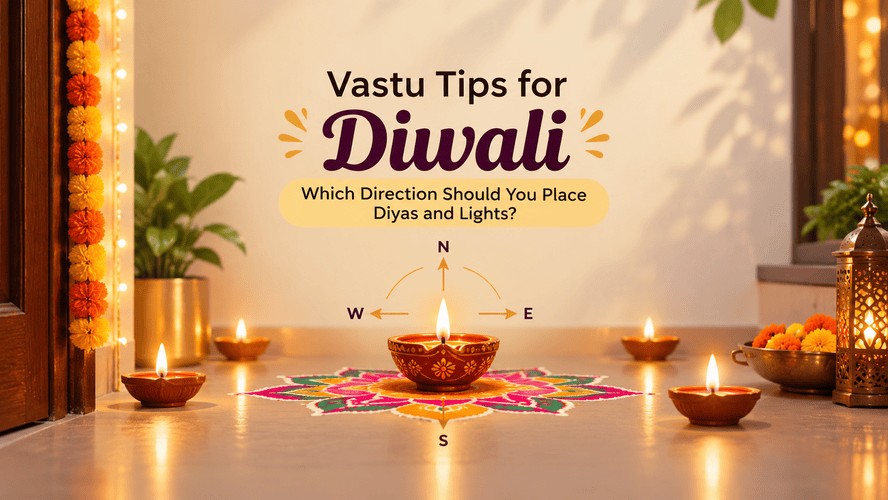
Every year it's the same scene - the diyas are out, the ghee's warming up, and someone in the house is yelling "wait, which way does this face again?" If that's you right now, you're not alone. Getting the direction right is one of those small details that people either obsess over or completely ignore, and honestly, there's a middle ground worth knowing about, especially if design and space planning happen to be your actual profession.
So let's get into the real question at the heart of most vastu tips for diwali diyas searches this time of year: where exactly should the light go?
Why Direction Matters for Diwali Diyas as per Vastu
Here's the basic logic behind diwali lighting vastu, stripped of the mysticism for a second: Vastu treats every direction in a home as carrying a different kind of energy, and fire (agni) is one of the five elements it works with most literally. A diya isn't just decorative - it's meant to activate a specific zone. Point it the "right" way, and it's said to draw in whatever that zone governs - wealth, health, protection, whatever the case. Point it carelessly, and Vastu experts will tell you it's just... light. Nothing wrong with that either, but if you're going to do the ritual, you might as well do it with intention.
If you've studied Vastu Purusha Mandala even briefly, you'll recognise why the north-east keeps showing up everywhere in this guide - it's treated as the "head" of the home in Vastu geometry, which is also why it's the go-to zone for prayer spaces and, by extension, your first diya.
Also Read : Vastu Purush Concept: Origins, Direction & Significance in Architecture
Best Direction to Place Diyas at the Main Entrance
The entrance is where most of the visual drama happens on Diwali night anyway, so it makes sense that Vastu gives it real weight.
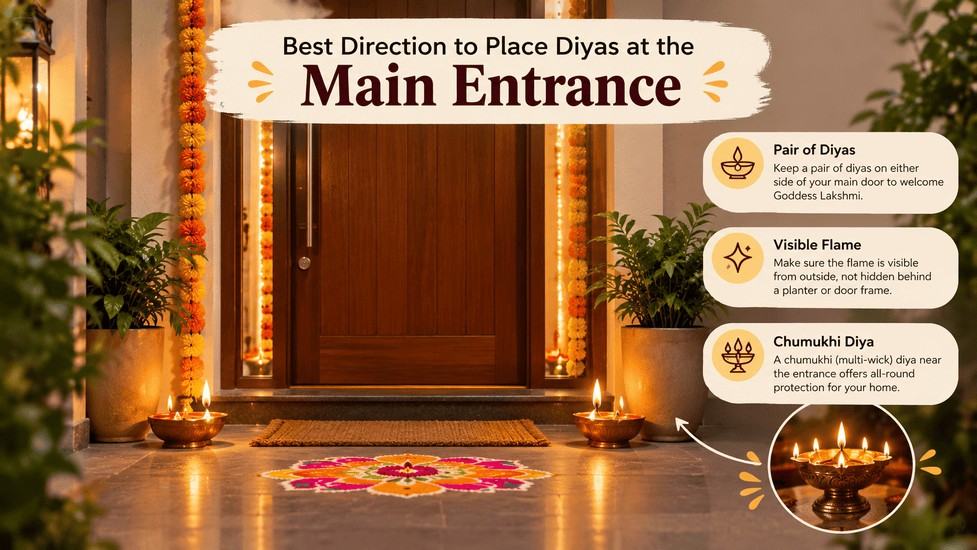
- Keep a pair of diyas on either side of your main door - this is the classic setup meant to welcome Goddess Lakshmi in, and it's genuinely one of the more universally agreed-upon vastu for diwali rules across every source I checked.
- Make sure the flame is visible from outside, not tucked behind a planter or door frame. The whole point is an inviting glow, not a hidden one.
- If you want to go a step further, a chumukhi (multi-wick) diya near the entrance is considered good for all-round protection of the home. It's a nice detail if you're designing the festive layout for a client's home too - it reads as intentional, not just decorative clutter.
Want to understand the logic behind Vastu placements, not just follow a checklist? Kaarwan’s Vastu Masterclass teaches the design principles professionals use in practice.
Vastu Tips for Diyas in the Pooja Room
This is where the "first flame" tradition comes in, and it's honestly one of the more consistent pieces of advice across every regional variation of this ritual.
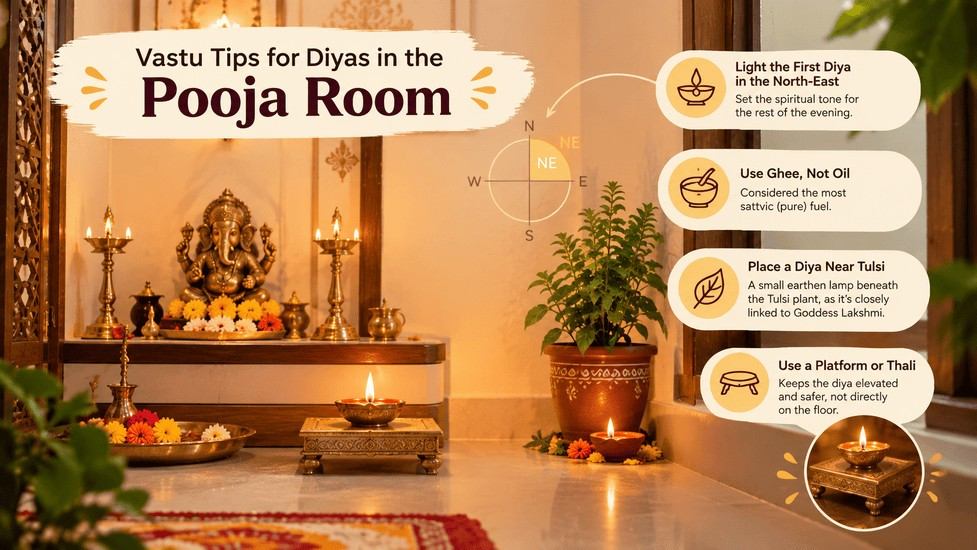
Light your very first diya here, ideally in the north-east corner, before you light anything else in the house. It's meant to set the spiritual tone for the rest of the evening. If your pooja room design already follows the best direction for temple placement in a home, you're basically halfway there already - the diya just activates what the room's orientation is already doing.
A few more pointers specific to this zone:
- Use ghee, not oil, for this particular diya - it's considered the most sattvic (pure) fuel.
- If there's a tulsi plant anywhere near your pooja space, place a small earthen lamp beneath it. Tulsi is closely tied to Goddess Lakshmi in most Vastu texts, so this one shows up again and again.
- Don't place the diya flush on the floor. A small platform or thali elevates both the ritual and, practically speaking, keeps things safer.
Also Read : Vastu Secrets of the Most Prosperous Indian Temples
Diya Placement for Living Room, Kitchen and Balcony
Once the pooja room and entrance are sorted, the rest of the house is really about not leaving darkness anywhere - that's the underlying philosophy, more than any single fixed rule.
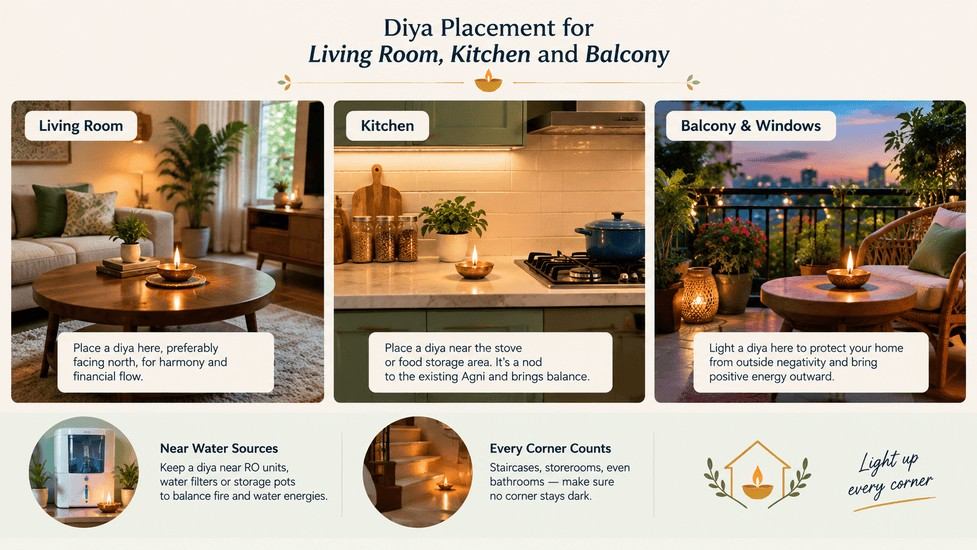
- Kitchen: Place a diya near the stove or food storage area. The kitchen is linked to Agni already, so lighting one here is more of an acknowledgment than a correction.
- Near water sources: RO units, water filters, storage pots - a diya nearby is meant to balance fire and water energies. Small gesture, but it's one of those details that shows up in almost every credible Vastu source.
- Living room: This is your social, gathering space, so a diya here (especially facing north) is tied to harmony and, in some readings, career or financial flow.
- Balconies and windows: Don't skip these. Diyas here send light outward and are considered a way of protecting the home from outside negativity - plus, practically, they just make the building look gorgeous from the street.
- Every corner counts: Staircases, storerooms, even bathrooms - the idea is that stagnant, dark corners shouldn't exist on this one night of the year.
Directions to Avoid While Lighting Diyas
Just as important as knowing where to place things is knowing where not to.
- Avoid the south direction for diya placement in living spaces - it's associated with Yama in most Vastu texts and generally considered inauspicious for fire rituals indoors.
- Skip cluttered or dusty corners entirely. A diya sitting next to a pile of stuff kind of defeats the purpose.
- Don't place a diya where it directly faces a mirror in a way that multiplies the flame's reflection - some Vastu practitioners flag this as destabilising for the space's energy.
If you're curious about how these directional rules extend beyond just diyas - into full room layouts, this is a good moment to glance at the 16 directions of Vastu Shastra, since a lot of Diwali-specific advice is really just a compressed version of that larger framework.
Want to go beyond basic Vastu tips and understand how to apply them in real designs? Kaarwan’s Advanced Vastu Design & Compliance Course helps you build practical Vastu knowledge for professional projects.
FAQs
Which direction should Laxmi face during Diwali puja?
Most Vastu sources agree the Lakshmi idol or diya setup should face east or north during the puja, since these directions are tied to positive energy flow and prosperity respectively.
Which direction is not good for pooja or diya placement?
South is the one direction almost every Vastu source flags as unsuitable for diya or pooja placement, largely because of its association with Yama in Vastu texts.
Where should diyas be kept at home on Diwali?
The short answer: everywhere that isn't dark. But if you're prioritising, start with the entrance, the pooja room, the kitchen, near water sources, and under the tulsi plant before moving to the rest of the house.