.jpeg)
Building Information Modelling is reshaping how India builds. BIM in India has grown far beyond a design tool — it now connects 3D models, clash detection, cost analysis, and data management into one smart workflow that structural engineers can use across every stage of a project.
For students and professionals in structural engineering, BIM is no longer optional — it's expected. Companies like L&T, Tata Projects, and GMR already work in BIM-first environments, and global AEC firms are setting up outsourcing units right here in India. If you're building a career in this field, this is where the work is headed.
What Is BIM and Why Does It Matter for Structural Engineers?
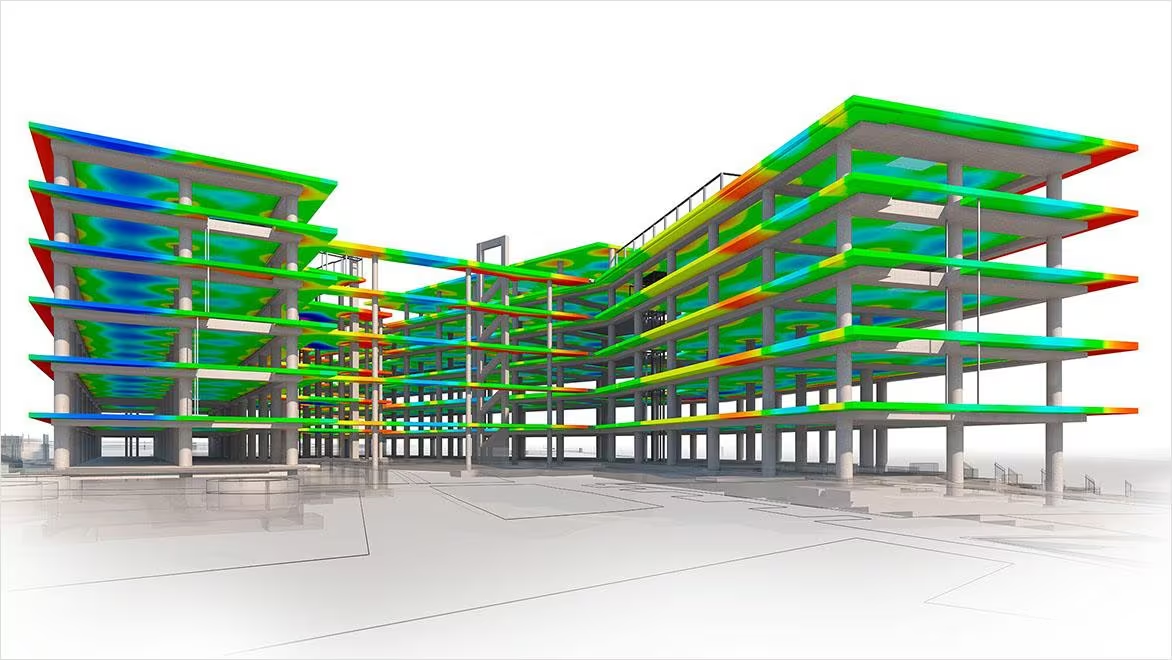
Image Source : Autodesk
At its core, Building Information Modelling is far more than 3D drawing. It is a data-rich digital replica of a structure — every beam, column, slab, and connection carries properties like material grade, load capacity, cost, and lifecycle data. For structural engineers, this means you're not just designing — you're virtually constructing the building before a single brick is laid.
Here's why it matters:
- Early conflict resolution: Clash detection flags overlaps between structural and MEP systems before construction, preventing costly rework.
- Accurate structural analysis: BIM software like Autodesk Revit and Tekla Structures enables real-time load analysis and simulation.
- Improved documentation: Drawings, schedules, and specs auto-update whenever the model changes.
- Better collaboration: Architects, MEP consultants, and contractors all work from one single source of truth.
- Cost and time savings: 5D BIM integrates cost and scheduling data, helping teams stay on budget and on track.
- Digital twin creation: A live digital twin supports post-construction monitoring and lifecycle management.
How BIM Is Changing Structural Design and Analysis in India

Traditional structural engineering design relied on 2D CAD and disconnected workflows — and if you want to understand just how far the industry has come, this breakdown of the AutoCAD to BIM evolution is worth a read. BIM software and Revit for structural engineers changed that completely, bringing precision, parametric modelling, and seamless coordination to every project.
Research in 2025 indicates that BIM adoption delivers average cost savings of up to 30% per project while cutting design cycles by up to 35%. For a country where project delays and cost overruns are a known challenge, these aren't small numbers.
Key Changes in the Structural Design Process:
- Parametric modelling: Changes to one element automatically propagate through the entire model, keeping drawings and schedules consistent.
- Structural analysis integration: BIM models can be exported directly to tools like ETABS and STAAD.Pro and SAP2000, eliminating double-entry of data.
- 4D & 5D BIM: Adding time and cost layers to the structural model enables smarter project planning and real-time budget tracking.
- Digital twin creation: A live digital twin supports post-construction monitoring, predictive maintenance, and lifecycle management.
Real-World Case Study: Delhi Metro Phase IV
The Delhi Metro Phase IV project is one of the best examples of BIM for infrastructure in India. The DMRC used BIM software across its 103.93 km corridor to model complex structures like viaducts and pier caps in 3D, improving accuracy, reducing rework, and cutting construction costs by 33%, boosting labour productivity by 43%, and reducing greenhouse gas emissions by 50%.
"Autodesk cloud solutions helped us optimise model design and encouraged collaboration." — Techture, AEC Consultancy (Delhi Metro Phase IV)
Mumbai Metro Line 3 tells a similar story — saving over ₹2,500 crore through clash detection and BIM-driven coordination across its 27-station underground corridor. Together, these projects prove that BIM in India delivers results you can actually measure.
BIM for Infrastructure Projects in India
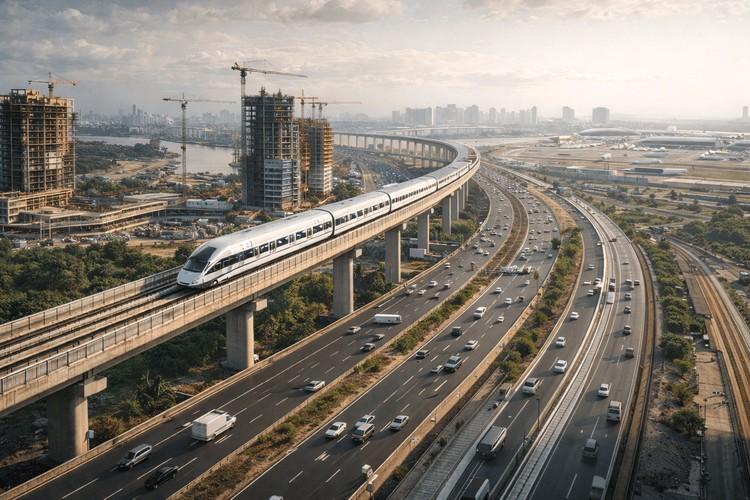
India's infrastructure boom — highways, airports, smart cities, and high-speed rail — is driving massive demand for BIM for infrastructure. At this scale, traditional methods simply can't keep up. Teams are also increasingly moving to cloud-based BIM collaboration to manage large, multi-stakeholder projects more efficiently.
Here's where BIM in India is already making an impact:
- Smart Cities Mission: BIM is being used for utilities mapping, infrastructure planning, and urban management across multiple cities.
- Delhi–Meerut RRTS: India's first semi-high-speed rail corridor uses BIM across its full project lifecycle.
- Mumbai Trans Harbour Link (MTHL): BIM streamlined multi-discipline coordination and digital documentation.
- Delhi Airport Expansion: BIM managed complex coordination during phased construction and retrofitting.
What's exciting in 2025 is the growing link between BIM and IoT. Sensors embedded in structures send live data — stress loads, vibrations, and temperature — straight into the digital twin model. This lets structural engineers spot and fix problems early, before they become costly on-site failures.
The Role of Government and Industry in Pushing BIM Adoption
The Indian government is a strong force behind BIM in India. MoHUA has mandated Building Information Modelling for major projects like Delhi Metro Phase IV, while Digital India and Gati Shakti are pushing construction digitalisation at a national scale.
The industry is responding fast. Firms like L&T, GMR, and Neilsoft are actively hiring BIM-trained structural engineers, and the Council of Architecture has made BIM training mandatory in architectural education.
Several universities and ed-tech platforms are now offering structured BIM software courses for civil and structural professionals. With India's construction sector set to hit ₹36.58 trillion by 2028, a BIM career in India has never looked more promising.
BIM Career Opportunities for Structural Engineers in India
BIM isn't just a technical skill — it's a career upgrade. Companies today don't just want CAD operators; they want engineers who understand the full project lifecycle and can collaborate within a BIM software environment. If you're a site engineer looking to make this shift, this guide on transitioning from site engineer to BIM civil engineer is a great starting point.
Some of the most in-demand roles right now:
- BIM Structural Modeller — using Revit for structural engineers or Tekla Structures
- BIM Coordinator — handling clash detection and MEP-structural coordination
- 5D BIM Estimator — integrating cost and scheduling into structural models
- BIM Manager — leading BIM for infrastructure and large-scale civil projects
- Digital Twin Engineer — managing asset monitoring and lifecycle data
The global BIM software market is projected to hit USD 22.08 billion by 2032, growing at 13.5% CAGR. India, as a growing AEC outsourcing hub, is right in the middle of that demand. The skills gap is still wide, which means a strong BIM career in India is very much up for grabs for those who start early.
Ready to go from learning to certified? Kaarwan's Professional BIM Certification Program for Civil Engineers is designed specifically for structural and civil engineering professionals looking to master BIM software, Revit for structural engineers, and real-world project workflows – and stand out in a competitive industry.
Conclusion
BIM is no longer a niche skill or a corporate-only tool — it's fast becoming the operating standard for structural engineering in India. From the complexity of metro tunnels to the scale of smart city infrastructure, Building Information Modelling is enabling engineers to design smarter, collaborate better, and deliver projects with far fewer surprises. The Delhi Metro and Mumbai Metro case studies prove that these benefits are real, measurable, and repeatable.
If you're a student or professional looking to future-proof your career, now is the time to invest in BIM. Learning BIM, Revit, and computational design in 2026 is one of the smartest moves you can make. The buildings and infrastructure of tomorrow are being designed today, in BIM. Make sure you're part of that story.
FAQ'S
1. What is BIM in structural engineering?
BIM is a digital process where structural engineers create data-rich 3D models for better design, coordination, and project management.
2. Is BIM mandatory for structural engineers in India?
Not universally yet, but government mandates for major infrastructure projects make it an essential industry skill today.
3. Which BIM software is best for structural engineers?
Autodesk Revit, Tekla Structures, Navisworks, and Bentley STAAD are widely used for structural engineering BIM workflows in India.
4. How does clash detection work in BIM?
BIM software flags overlaps between structural, MEP, and architectural elements digitally, avoiding costly on-site construction conflicts.
5. What is 5D BIM, and how is it used?
5D BIM adds cost data to a 3D model with time scheduling, enabling real-time budget tracking throughout the construction lifecycle.
6. How is BIM used in metro rail projects in India?
Delhi Metro Phase IV and Mumbai Metro Line 3 used BIM for parametric structural modelling, clash detection, and significant cost reduction.
7. What is a digital twin in structural engineering?
A digital twin is a live BIM model connected to real-world sensor data, used for ongoing structural health monitoring and maintenance planning.
8. Is BIM a good career option for structural engineers in India?
Yes, BIM career opportunities in India are growing rapidly, with high demand across infrastructure, airports, and smart city projects.
9. What are the government BIM initiatives in India?
MoHUA's BIM mandate for Delhi Metro Phase IV and Digital India initiatives are key government drivers for BIM adoption in India.
10. Can freshers learn BIM for structural engineering?
Absolutely, platforms like Kaarwan offer beginner-friendly BIM and Revit courses designed specifically for students and early-career engineers.