So you've landed on one of those "is Kaarwan good" searches, probably at 11pm, probably with six other tabs open comparing courses. Fair enough - dropping money on an upskilling program when you're already stretched thin on time isn't a decision to make on a whim.
I'm not going to sell you on it. I'm going to walk through what Kaarwan actually is, what it does well, where it falls short, and who it genuinely makes sense for - so you can decide for yourself whether it's worth it.
Also Read : Best BIM Courses in India 2026 | Honest Comparison
Who Is Kaarwan, and What Does It Actually Offer?
Kaarwan is an upskilling platform built specifically for architects, civil and MEP engineers, interior designers, and UI-UX designers - mostly people in India, though the reach has widened. It came out of IIT Roorkee and has stuck close to its original pitch: practical, job-relevant skills without the price tag of a second degree.
The course catalog spans a lot of ground - Revit and BIM certifications, GATE Architecture crash courses, Rhino and Grasshopper, SketchUp with Lumion, UI-UX design programs, interior styling workshops. Some run as quick one-day masterclasses (a few hours, low cost, good for testing the waters). Others are full certification tracks running four to six months with real project work baked in.
That range is actually one of Kaarwan's more distinct features. You're not locked into one giant program - you can start small with a ₹499 masterclass and work your way up to a full certification once you know the teaching style suits you.
Also Read: BIM Course in India 2026 | Complete Guide for Architects & Engineers
Course Formats: Live Sessions, Recordings & Self-Paced Learning
Here's where it gets interesting. Kaarwan mixes live instruction with recorded content, and which one you get depends on the course.
The shorter masterclasses tend to be live, cohort-based sessions - you show up, ask questions in real time, get answers on the spot. The longer certification programs (the BIM and Revit courses, for instance) blend live mentorship with recorded modules you work through at your own pace, plus scheduled check-ins and project reviews.
Honestly, this hybrid setup works well for people juggling a job or college alongside the course. But it does mean you need a bit of self-discipline. If you're the type who lets recorded lectures pile up unwatched, that's worth being honest with yourself about before you enroll - no course format fixes a motivation problem.
Thinking about the BIM or Revit route specifically? Kaarwan's Advance Revit & BIM Certification pairs software training with real project work, built for exactly the kind of career switch this article's been talking through.
Instructors and Mentorship: Who's Actually Teaching You?
This part matters more than people give it credit for. A course is only as good as the person explaining it to you.
Kaarwan pulls instructors from actual industry roles - working architects, BIM leads, UI-UX designers currently employed at firms rather than full-time academics. The instructor bios on course pages consistently mention 8+ years of hands-on experience, and mentors come from a fairly wide spread of companies across the AEC and design space.
What students seem to appreciate most (based on the workshop feedback Kaarwan shares publicly) isn't just the technical teaching - it's that mentors answer doubts directly and keep sessions interactive rather than lecture-style. Smaller batch sizes help with that too; you're not one face in three hundred.
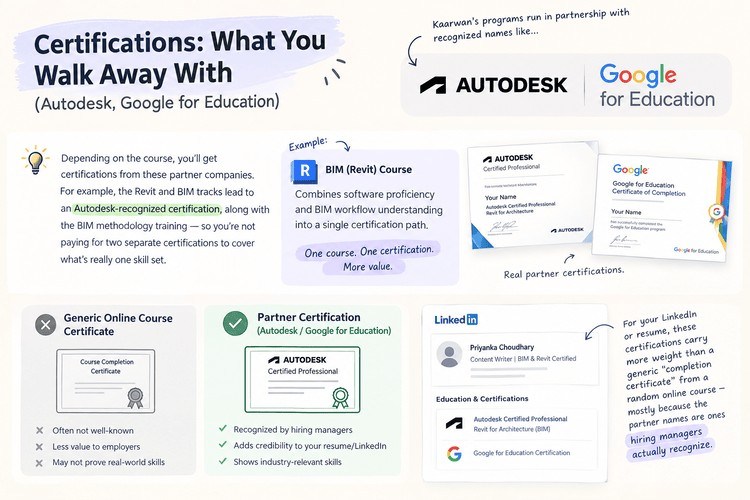
Certifications: What You Walk Away With (Autodesk, Google for Education)
Certificates only matter if someone else recognizes them, so this is a fair thing to scrutinize.
Kaarwan's programs run in partnership with names like Autodesk and Google for Education, depending on the course. The Revit and BIM tracks, for example, lead toward Autodesk-recognized certification alongside the BIM methodology training itself - which is a nice bit of efficiency, since you're not paying for two separate certifications to cover what's really one skill set.
The BIM (Revit) course is a good example of how this plays out - it folds software proficiency and BIM workflow understanding into a single certification path rather than splitting them.
For LinkedIn or a resume, these certifications carry more weight than a generic "completion certificate" from a random online course - mostly because the partner names are ones hiring managers actually recognize.
Career Support: Placement Assistance, Portfolio Building & Job Search
This is usually the part people care about most, and rightly so - a certificate that doesn't lead anywhere isn't worth much.
Kaarwan's longer certification programs come with structured job support built into the curriculum - not a vague "we'll help you find something" promise, but portfolio-building tied directly to the coursework, capstone projects modeled on real industry problems, and career guidance sessions. The MEP and Civil BIM programs, for instance, are built around a capstone that mirrors what an actual multi-disciplinary project handoff looks like, which gives you something concrete to show rather than just a certificate.
It's not a guaranteed placement service - nobody honest should promise that - but the portfolio-first approach means you leave with work samples, not just theory.
Also Read: Kickstart Your UI-UX Design Career: Expert Tips and Advice
Pricing: Is Kaarwan Affordable Compared to Alternatives?
Money's the part nobody likes discussing openly, so let's just be direct.
Kaarwan sits on the more affordable end of the upskilling spectrum. Short masterclasses run anywhere from ₹449 to ₹999. Full certification programs - the six-month BIM tracks, for instance - land somewhere in the ₹50,000 to ₹1,25,000 range depending on specialization, with EMI options available so you're not paying the full amount upfront.
Compared to a full postgraduate degree or an international certification program, that's a fraction of the cost for a fairly comparable set of practical skills. If you want the fuller fee breakdown across providers, see the full course comparison - it lays out what different platforms charge and what's actually included in that price.
One honest caveat: affordability doesn't automatically mean value. A ₹499 one-day workshop is genuinely useful for testing a skill, but it's not a substitute for the deeper six-month programs if you're trying to actually switch careers. Match the price point to what you're actually trying to achieve.
Also Read: BIM Certification Cost in India 2026: Fees, Comparison & Guide
Who Kaarwan Is a Good Fit For - and Who It Isn't
Let's be specific instead of vague here, because "it depends" isn't actually useful advice.
Kaarwan tends to work well for:
- Architecture, engineering, and design students who want practical, software-heavy skills that their college curriculum doesn't really cover
- Working professionals looking to pivot into BIM, UI-UX, or interior design without quitting their job to do it
- Fresh graduates who need a portfolio and job-ready skills fast, without the time or budget for a second degree
- Anyone who learns better through live, mentor-led sessions rather than pure self-study
It's probably not the right fit for:
- Someone who wants a formally accredited postgraduate degree with university backing - this is upskilling, not a substitute for a Master's
- People who need heavy hand-holding and can't manage any self-paced components
- Anyone expecting a guaranteed job at the end - the support is real, but it's support, not a placement guarantee
Kaarwan vs Novatr vs Traditional Master's Programs
Since this question comes up a lot in comparison searches, a quick word on it. Novatr and Kaarwan both operate in the BIM upskilling space in India, and the two get compared often enough that it's worth addressing directly rather than dodging it.
Broadly, Kaarwan tends to come out ahead on affordability and batch size, while some platforms lean more on flexible, self-paced lifetime access. Traditional Master's programs, meanwhile, offer formal accreditation but cost significantly more and take years rather than months. If you want the full side-by-side on fees, tools covered, and placement support, read the detailed Kaarwan vs Novatr comparison - it breaks down the specifics far better than a paragraph here can.
If Kaarwan sounds like the right fit, explore courses across Architecture, BIM/Revit, MEP, Civil, Interior Design, and UI/UX.
FAQs
Is Kaarwan worth the money?
For most people evaluating practical, job-relevant skills at a fraction of the cost of a formal degree, yes - provided you match the course length and depth to what you're actually trying to achieve. A one-day workshop and a six-month certification serve very different goals.
Does Kaarwan actually help with job placement, or just teach software?
It's more than pure software training. The longer certification programs build in portfolio work, capstone projects modeled on real industry scenarios, and career guidance. That said, it's structured support, not a guaranteed placement service.
Who should NOT take a Kaarwan course?
Anyone looking for a formally accredited postgraduate degree, anyone who needs constant hand-holding with zero self-paced learning, or anyone expecting a job offer to be handed to them at the end of the program.
Is Kaarwan legit?
Yes - it's built by a team with an IIT Roorkee background, runs certifications in partnership with recognized names like Autodesk and Google for Education, and has a public track record of student and instructor testimonials. For verification data and detailed student feedback, see verified student reviews once that page is live.