

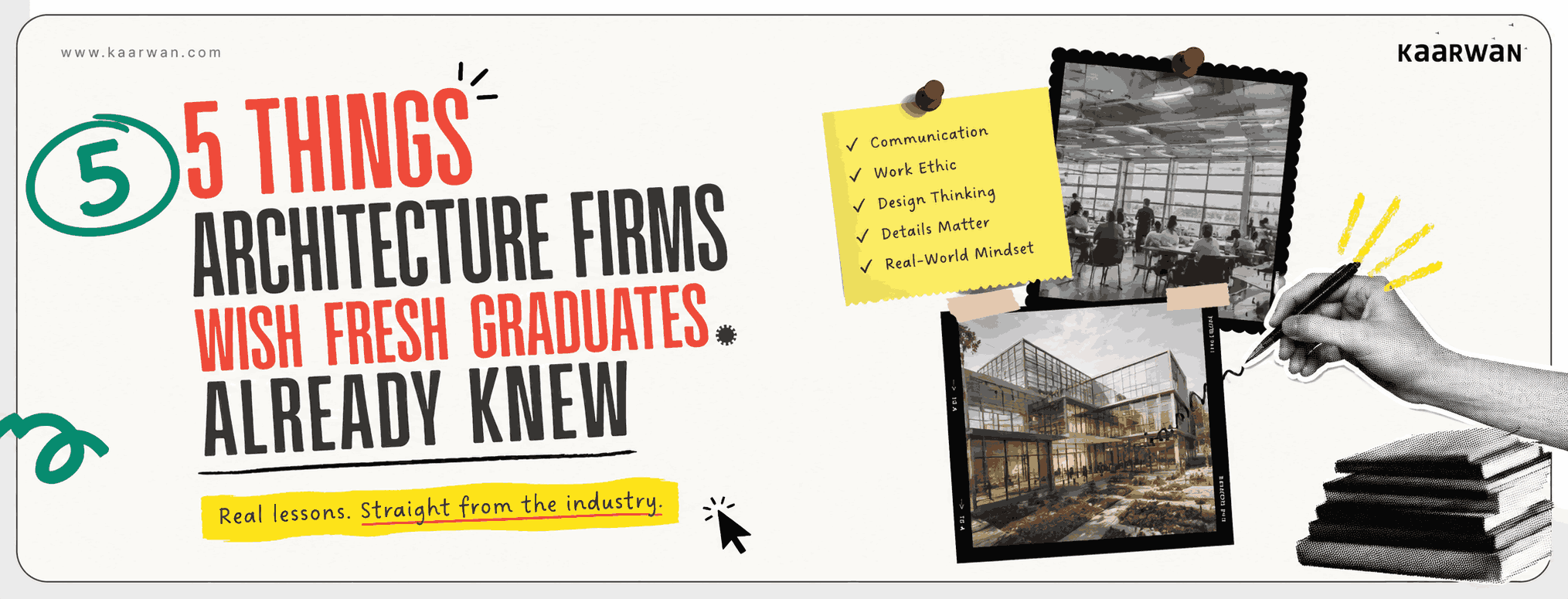
Every year, architecture firms across the country welcome a fresh batch of graduates through their doors.
And every year, without fail, the same gaps show up. Not gaps in creativity — fresh graduates are often brimming with that. Not gaps in ambition either. The gaps tend to be quieter, more practical, and entirely fixable. The kind of things that nobody explicitly teaches in five years of architecture school, but that every firm silently wishes they didn't have to spend the first three months correcting.
We've seen enough students make the transition from college to studio to recognise the patterns. And if there's one thing we know for certain, it's this — the graduates who hit the ground running aren't necessarily the most talented ones. They're the ones who walked in already knowing what the profession actually asks of you.
Here's what firms are looking for — and what's absolutely worth getting ahead of before your first day.
1. Software Fluency Is Not the Same as Software Familiarity
Most fresh graduates know their way around AutoCAD, Revit, and SketchUp. They've used them through college, submitted projects with them, and sat through tutorials. But knowing a tool and being fluent in a tool are two very different things — and firms feel the difference immediately.
Fluency means you're not thinking about the software while you're using it. It means your Revit families are set up correctly from the start, not patched together under deadline pressure. It means your AutoCAD drawings are clean, layered properly, and don't need three hours of fixing before they can be sent to a consultant. It means when a senior hands you a Grasshopper script and asks you to modify it, you don't spend the first hour just figuring out how to open it.
The technical bar in professional practice is higher than most students expect — and it moves fast. Firms invest time and resources into projects, not into retraining graduates on tools they were expected to know.
This summer, if there's one thing worth committing to, it's going genuinely deep on the software that your target firms actually use. Not surface level. Deep.
2. Communication Is Half the Job — And Nobody Teaches It
Architecture school rewards the quality of your ideas. Professional practice rewards your ability to communicate them clearly to people who weren't in your head when you had them.
Clients who don't speak design language. Contractors who need unambiguous instructions. Senior architects who are reviewing six projects at once and need a quick, clear update — not a presentation. The ability to translate complex design thinking into language that different audiences can actually act on is one of the most underrated skills in the profession, and one of the most consistently underdeveloped in fresh graduates.
This shows up in emails that bury the point, in presentations that lead with process instead of decisions, in site meetings where a graduate goes quiet because they're not sure how to hold the room. None of it reflects poorly on intelligence. It just reflects the fact that architecture school rarely puts students in situations where communication itself is the skill being tested.
Start paying attention to how good architects communicate — in meetings, in drawings, in the way they write a brief. It's a craft, just like design is. And it's one worth developing before you need it.
3. Construction Knowledge Is Not Optional
There's a version of architecture school where buildings are mostly ideas. Beautiful sections, atmospheric renders, compelling concepts. And then there's professional practice, where those ideas have to actually stand up, stay weatherproof, meet a budget, and be built by people who need clear instructions to do it.
The graduates who earn trust quickly in a firm are almost always the ones who understand — even at a basic level — how buildings go together. How a roof detail handles water. How expansion joints work and why they matter. How a material that looks perfect in a specification behaves differently on site six months later. How to read a structural drawing and understand what it's asking of the architecture.
This knowledge doesn't come from renders. It comes from studying real details, visiting construction sites with intention, and being genuinely curious about the gap between drawing and building. Firms notice immediately when a graduate has this foundation — and they notice just as quickly when they don't.
If you haven't spent real time with construction documentation and building technology beyond what your college required, this summer is a good window to start closing that gap.
4. Time and Project Management Are Design Skills Too
In college, deadlines are universal. Everyone is working toward the same submission, under the same pressure, in the same studio. In professional practice, you are managing multiple tasks across multiple projects, often for multiple seniors, each with their own priorities and timelines.
The ability to organise your own work, involving the understanding of what needs to happen first, to flag a problem before it becomes a crisis, to give a realistic timeline when asked for one, is something firms desperately wish graduates arrived with. It sounds administrative. It is, in fact, fundamental to being someone a firm can rely on.
The graduates who move up quickly are almost always the ones who can be trusted with a task and left to manage it. Not because they're the most creative, but because they make everyone around them's job easier. That reliability is rarer than it sounds, and it's noticed faster than almost anything else.
5. The Profession Is Wider Than the Studio
This one is less about a specific skill and more about a mindset — but it might be the most important thing on this list.
Architecture as a profession extends far beyond the design studio. There's urban planning and policy, there's design research, there's construction technology, there's building information management, there's sustainability consulting, and there's academic practice. Architects are working in real estate development, in product design, and in experience and spatial design for brands and institutions.
The graduates who struggle most in their early years are often the ones who arrived with a very narrow picture of what architecture is supposed to look like — and then felt lost or disappointed when their first job didn't match it. The ones who thrive are the ones who stayed curious, explored the edges of the profession, and found where their particular combination of skills and interests actually fit.
Clarity about the kind of work you want to do doesn't come from waiting. It comes from exposure to different firms, different typologies, and different ways of practising. Summer is one of the best times to build that picture deliberately, before the profession starts making the decisions for you.
To Sum It Up
The transition from architecture school to professional practice is one of the steeper learning curves you'll encounter. But it doesn't have to feel like starting from zero.
The students who walk into their first job ready — with real software fluency, an understanding of how buildings are built, and some honest clarity about where they want to go — don't just settle in faster. They grow faster, too.
If this is the summer you want to use to close those gaps, Kaarwan's courses are designed exactly for that moment. Whether it's getting genuinely fluent in the tools firms actually use, building your construction knowledge, or simply figuring out what kind of architect you want to become, this is a good place to start.
Your first job will ask a lot of you. Might as well walk in ready.
FAQs:
1. What is the biggest mistake fresh architecture graduates make?
Focusing only on design skills and overlooking communication, technical knowledge, and project management.
2. Which software should architecture students master before applying for jobs?
Focus on the tools your target firms use most, such as AutoCAD, Revit, SketchUp, Rhino, or Grasshopper. Fluency matters more than familiarity.
3. How important is Revit for architecture careers today?
Very important. Many firms use BIM workflows, and strong Revit skills can make you more job-ready from day one.
4. Do architecture firms expect fresh graduates to know construction details?
Not everything, but a basic understanding of building systems, materials, and construction documentation is highly valued.
5. Why are communication skills important for architects?
Architects work with clients, consultants, contractors, and teams. Clear communication helps turn ideas into successful projects.
6. How can students improve their construction knowledge?
Study real project drawings, visit construction sites, review technical details, and learn how buildings are assembled.
7. Is time management really important in architecture?
Yes. Managing deadlines, priorities, and multiple tasks is a key skill in professional practice.
8. What skills help graduates stand out during internships?
Technical proficiency, reliability, initiative, communication skills, and a willingness to learn.
9. Are there career options beyond traditional architectural practice?
Absolutely. Architects can work in BIM, urban planning, sustainability, research, construction technology, real estate, and design strategy.
10. How can students prepare for their first architecture job?
Build software expertise, strengthen construction knowledge, improve communication skills, and gain exposure to different areas of the profession.



.png)