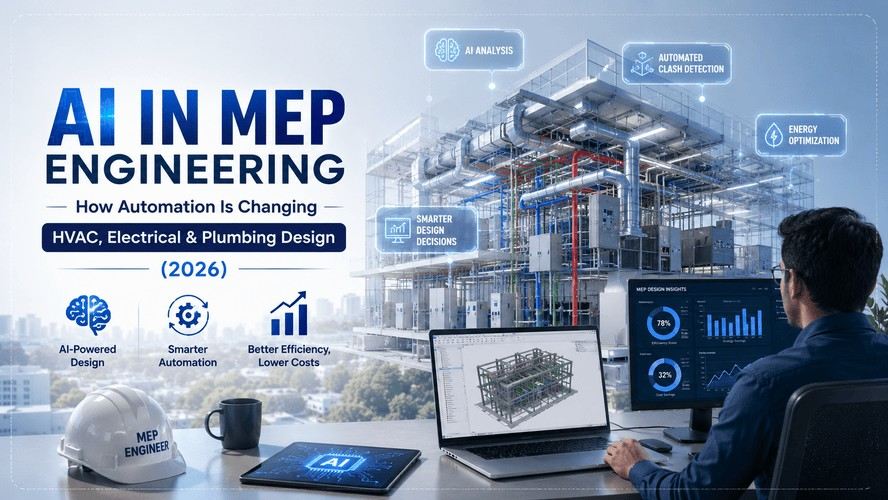
Here's a confession most MEP engineers won't say out loud in a client meeting: half the job used to be math you'd already done a hundred times before. Duct sizing. Load calcs. Panel schedules. Cross-checking a plumbing riser against a beam you just know is going to be in the way. Necessary work, sure. Thrilling work, not so much.
That's the part AI is actually eating into right now - not the judgment calls, not the "does this design make sense for how the building will actually be used" thinking, but the repetitive, error-prone grind sitting underneath it. And if you're an MEP engineer or MEP BIM professional in India trying to figure out what ai in mep engineering actually means for your daily work in 2026, this is the honest version, not the hype-reel one.
Quick note before we go further - this isn't the same conversation as AI in general civil BIM workflows (clash detection in Navisworks, generative massing in Forma, that kind of thing). We've written about how AI is changing BIM workflows more broadly separately, and it's worth a read if you want the bigger picture. This one stays narrow, on purpose: HVAC, electrical, plumbing, the stuff that's actually MEP-specific.
Also read: MEP BIM Modelling: A Beginner's Guide
How AI Is Actually Being Used in MEP Workflows Right Now
Nobody's handing full HVAC design over to an algorithm and walking away. What's actually happening is quieter than that, and honestly more useful.
Engineers are feeding project parameters - square footage, occupancy, local climate data, building envelope details - into tools that spit back load calculations in minutes instead of hours. Clash prediction between ducts, cable trays, and pipe runs is happening earlier in the design cycle, sometimes before a model even hits full detail, which means fewer "wait, this doesn't fit" moments during coordination meetings. And takeoffs - the part everyone dreads - are getting pulled straight from the model instead of counted by hand off a set of drawings.
None of this replaces the engineer who understands why a chiller plant needs to sit where it sits. It just means less of your week goes to arithmetic and re-checking, and more goes to actually solving the hard coordination problems. If you're new to how MEP systems get modelled in the first place, our MEP BIM modelling basics guide is a good starting point before layering AI tools on top.
Also read: AI-Driven Duct & Pipe Routing
AI in HVAC Design
Load calculation and system sizing automation
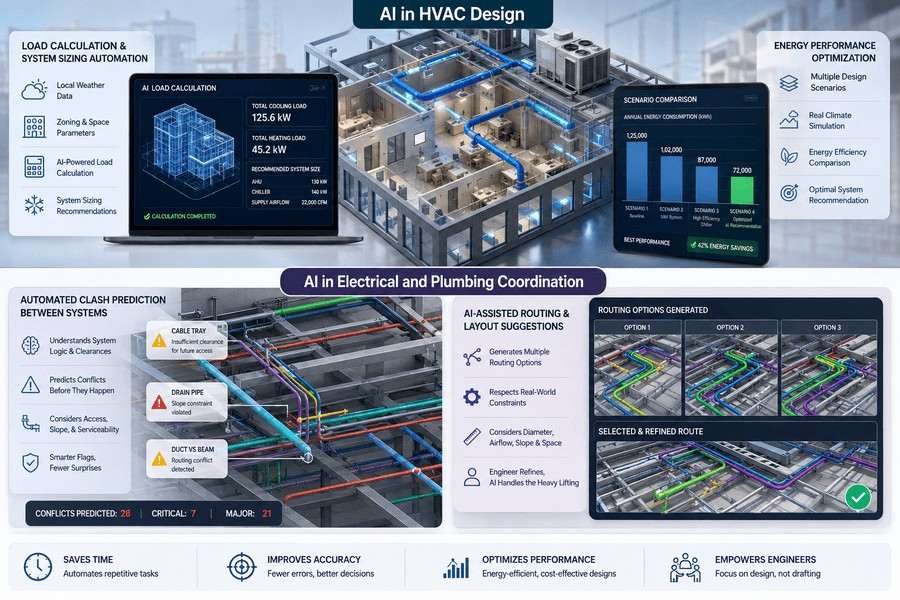
This is probably where AI has made the biggest dent so far, mostly because HVAC load calculations were always the most formulaic part of the job - lots of variables, but consistent rules. Automated tools now pull in local weather design parameters, run through the zoning math, and hand back sizing recommendations that used to take an engineer a solid afternoon. You still review it. You still catch the edge cases the tool missed. But the first-pass number isn't something you're building from scratch anymore.
Energy performance optimization tools
There's also a quieter shift happening around energy modelling. Instead of running one or two design scenarios because that's all the time allowed, engineers can now simulate a dozen HVAC configurations against real climate data and actually compare them on efficiency, not just gut feel. For India specifically, where cooling loads dominate almost every commercial project, this matters more than it sounds like it should - a genuinely optimized system can shave a meaningful chunk off lifetime energy costs, and clients notice that.
Want to actually build the skills behind this shift instead of just reading about it? Kaarwan's MEP BIM certification takes you from Revit MEP fundamentals to full coordination workflows, with real project practice built in.
AI in Electrical and Plumbing Coordination
AI is making coordination more proactive, helping engineers identify conflicts earlier and explore smarter routing options before construction begins.
Automated clash prediction between electrical, plumbing, and structural systems
Here's where it gets specifically MEP, not generic BIM. General clash detection tools tell you two objects are occupying the same space - useful, but blunt. What's changing now is prediction that's aware of system logic: an algorithm that understands a cable tray needs clearance for future access, or that a drainage pipe needs a minimum slope that a structural beam might interrupt. That's a different, more useful kind of flag than "these two solids overlap."
It doesn't eliminate the need for a coordinator who actually understands constructability. It just means the obvious conflicts get caught before a coordination meeting instead of during one - which, if you've sat through enough of those meetings, is a genuinely nice thing to have happen.
AI-assisted routing and layout suggestions
Manual routing of conduits, pipes, and ducts has always been one of those tasks that's simple in concept and brutal in execution once you're dealing with hundreds of runs across a dense ceiling void. AI-assisted routing tools now generate multiple layout options against real constraints - pipe diameter, airflow needs, existing structural obstacles - and let the engineer pick and refine rather than draft every single run by hand. We went deeper into this exact shift in our piece on AI-driven duct and pipe routing, if you want the specifics on how the routing logic actually works.
Also read: MEP BIM Engineer Salary in India 2026
What AI Still Can't Do in MEP Engineering
Okay, so let's not oversell this. AI is genuinely good at pattern recognition, running the same calculation a thousand times without getting tired, and flagging things a human might miss on the fifteenth review pass of the day.
What it's not good at - and this matters - is understanding why a client wants something a certain way, or making the judgment call on a genuinely novel building type where there's no historical dataset to learn from.
It also doesn't know your local contractor's actual on-site habits, or that the "optimal" duct route on screen runs straight through a beam that's technically clear on the model but a nightmare to install around in real life. That kind of tacit knowledge, the stuff you only get from actually being on sites and getting things wrong a few times, isn't something a tool picks up from a training dataset. AI in MEP engineering is a very good assistant. It is not, as of 2026, a substitute for an engineer who's actually walked a job site.
What This Means for MEP Careers in India
Here's the part that actually matters if you're trying to build a career out of this, not just follow the trend. The engineers getting hired faster and paid more right now aren't the ones who can do load calcs fastest by hand - that skill's getting commoditized. They're the ones who understand how to set up a model correctly, coordinate AI-assisted outputs with actual engineering judgment, and use these tools to move faster without cutting corners on quality.
If you're weighing whether this is worth investing time in, it's worth knowing that MEP BIM roles already command a real premium over traditional MEP work in India, and that gap is widening as firms adopt AI-assisted BIM workflows faster than the talent pool can keep up. We've broken down the actual numbers in our MEP BIM engineer salary in India guide, and if you want the case for why this skillset is worth prioritizing, why MEP and BIM are becoming essential career skills lays it out in more detail. There's also a solid overview of the drawing and documentation side in our guide to MEP drawing types and workflows, which pairs well with everything above.
If you're building a career here, that's the path - get comfortable with Revit MEP and BIM coordination first, then layer AI-assisted tools on top once the fundamentals are solid. Kaarwan's MEP BIM certification program is built around exactly that sequence.
Also read: MEP BIM Resume 2026: Format, Skills & Examples
Thinking about where AI-assisted design is headed for your career? A structured BIM MEP program gives you the coordination and modelling foundation these tools are built on top of - not a replacement for it.
FAQs
Is AI going to replace MEP engineers?
No. AI is automating the repetitive, formulaic parts of the job - load calcs, routing drafts, clash flags - but the judgment calls around design intent, constructability, and client needs still need a human who understands the full picture.
What AI tools are MEP engineers using in 2026?
Most fall into a few buckets: automated load calculation and sizing tools, AI-assisted clash prediction integrated with BIM platforms, and generative routing tools for ducts, pipes, and cable trays. Adoption varies a lot by firm size and project complexity.
Do I need to learn AI tools for an MEP BIM career?
You need the BIM and Revit MEP fundamentals first - AI tools sit on top of that foundation, not instead of it. Firms are increasingly expecting both, but the underlying modelling and coordination skills are still what gets you hired.
How is AI in MEP different from AI in general BIM workflows?
General BIM AI tools tend to focus on broad clash detection and generative massing. MEP-specific AI applications go deeper into trade logic - HVAC load calculations, electrical circuit balancing, plumbing slope and fixture requirements - things a generic BIM tool typically won't handle with the same precision.