
Civil engineers in India earn anywhere between ₹3 LPA and ₹35 LPA, and honestly, that gap says a lot about how differently this career can play out depending on where you land. Freshers usually start around ₹3–5 LPA. Cross the 8–10 year mark in a project management role, and ₹20–25 LPA isn't rare anymore. Add BIM or a niche specialization to the mix, and the number moves again.
That's the short version. Now let's get into where you actually fall on that spectrum , because "it depends" isn't a very satisfying answer when you're the one trying to plan your next two years.
How Much Does a Civil Engineer Earn by Experience Level?
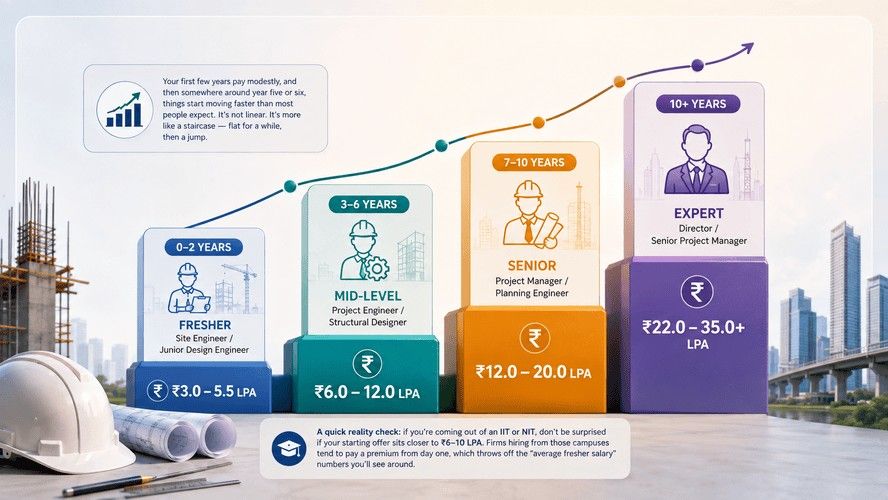
Short answer: your first few years pay modestly, and then somewhere around year five or six, things start moving faster than most people expect. It's not linear. It's more like a staircase , flat for a while, then a jump.
| Experience | Typical Role | Salary Range (LPA) |
| Fresher (0–2 yrs) | Site Engineer / Junior Design Engineer | ₹3.0 – 5.5 |
| Mid-Level (3–6 yrs) | Project Engineer / Structural Designer | ₹6.0 – 12.0 |
| Senior (7–10 yrs) | Project Manager / Planning Engineer | ₹12.0 – 20.0 |
| 10+ years | Director / Senior Project Manager | ₹22.0 – 35.0+ |
A quick reality check here: if you're coming out of an IIT or NIT, don't be surprised if your starting offer sits closer to ₹6–10 LPA. Firms hiring from those campuses tend to pay a premium from day one, which throws off the "average fresher salary" numbers you'll see floating around.
Civil Engineer Salary by City in India
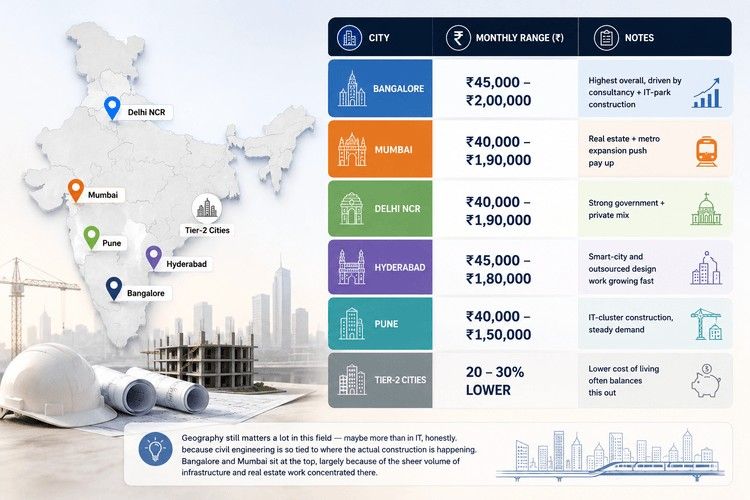
Geography still matters a lot in this field , maybe more than in IT, honestly, because civil engineering is so tied to where the actual construction is happening. Bangalore and Mumbai sit at the top, largely because of the sheer volume of infrastructure and real estate work concentrated there.
| City | Monthly Range (₹) | Notes |
| Bangalore | 45,000 – 2,00,000 | Highest overall, driven by consultancy + IT-park construction |
| Mumbai | 40,000 – 1,90,000 | Real estate + metro expansion push pay up |
| Delhi NCR | 40,000 – 1,90,000 | Strong government + private mix |
| Hyderabad | 45,000 – 1,80,000 | Smart-city and outsourced design work growing fast |
| Pune | 40,000 – 1,50,000 | IT-cluster construction, steady demand |
| Tier-2 cities | 20–30% lower | Lower cost of living often balances this out |
Worth noting , tier-2 cities pay less on paper, but the savings-to-salary ratio can genuinely be better once you factor in rent and daily expenses. Not a small thing if you're weighing a move.
If your next career move is into BIM, Kaarwan's BIM Certification Program for Civil Engineers covers Revit, Navisworks, Civil 3D, and real-world workflows employers actively look for.
Government vs Private Sector Civil Engineer Salary
This is probably the question every civil engineering student asks at some point, usually around final year when GATE prep starts eating into everyone's sleep schedule.
| Factor | Government (PSU/IES) | Private (L&T, Tata, etc.) |
| Starting Salary | ₹6–9 LPA (needs GATE rank) | ₹3.5–5.5 LPA |
| At 10 years | ₹12–18 LPA + perks | ₹15–28 LPA |
| Job Security | Very high | Moderate |
| Growth Speed | Steady, capped | Faster, less predictable |
Here's the thing people miss: government pay looks lower on paper, but HRA, DA, pension, and medical benefits close that gap more than most freshers assume. Private sector wins if you want speed and are okay with some uncertainty along the way. Government wins if stability matters more to you than a faster climb.
Neither is "wrong" , it really comes down to what kind of career stress you're willing to sign up for. If you want the fuller picture on where a civil degree can actually take you, it's worth exploring the full range of civil engineering career paths before locking into either track.
Also Explore : Does Learning BIM Increase Salary for Civil Engineers? , both go deeper into the numbers we've only summarized here.
Does Specialization Change Your Salary? (Structural, BIM, Site Engineering)
Yes. Quite a bit, actually. A generalist civil engineer and a specialized one can be at completely different pay bands by year six, even with identical years of experience on paper.
- Structural Engineering: ₹12–28 LPA for experienced professionals , one of the more consistently well-paid tracks
- Project Management: ₹15–26 LPA, especially once you're handling large-scale delivery
- Geotechnical Engineering: averages around ₹22 LPA for seasoned specialists
- BIM (Building Information Modeling): ₹12–20 LPA, and this is the one growing fastest right now
BIM deserves its own mention because it's changed the game for a lot of civil engineers who felt stuck in pure site-execution roles. Companies aren't just hiring people who know Revit anymore , they want engineers who can coordinate across teams, catch clashes before they become expensive mistakes, and manage data across a project lifecycle.
That shift in expectation is exactly how specializing in BIM changes your civil engineering salary, and it's a big enough jump that it's worth reading in full if you're on the fence about upskilling.
What Actually Increases a Civil Engineer's Salary
If you strip away all the averages and city comparisons, a few things consistently move the needle:
- Project scale. Managing a ₹500 crore highway project by year eight puts you in an entirely different salary band than someone who's only worked on residential sites.
- Software fluency. AutoCAD, STAAD.Pro, Revit, Civil 3D , these aren't nice-to-haves anymore, they're the baseline for anything beyond entry-level.
- GATE and PSU exams. Cracking GATE opens doors to PSU roles that pay significantly better than most private starting offers.
- Certifications. PMP, BIM certifications, IGBC , these can each add a real percentage bump to your negotiating position.
- Which discipline you're in. Structural, transportation, geotechnical, environmental , pay varies more across these than people expect. If you're still deciding your lane, it helps to look at the different civil engineering disciplines and their pay differences before committing to one specialization over another.
None of this is about working harder in the traditional sense. It's about being deliberate , picking the right projects, the right skills, and the right exams to chase. See how Kaarwan's BIM Certification Program for Civil Engineers can move you into the ₹12–20 LPA specialization bracket , built for engineers ready to go beyond site execution.
Also Explore : BIM Engineer Salary India 2026: Role and City-Wise Guide
Source note: City and experience-band figures cross-referenced against AmbitionBox's 2026 civil engineering salary data.
Wrapping Up
Civil engineering salaries in India aren't stagnant anymore , the infrastructure boom has genuinely shifted things upward over the last couple of years. But the range is wide enough that where you land depends almost entirely on the choices you make early: which sector, which city, which skills you bother picking up beyond the basics.
Thinking about where BIM fits into your career? Kaarwan's BIM Certification Program for Civil Engineers is built to help you move from site execution into higher-paying, coordination-focused roles.
Frequently Asked Questions
What is the starting salary for a civil engineer in India?
Most freshers start between ₹3–5.5 LPA. Graduates from top-tier institutes or those joining large EPC firms can start higher, sometimes ₹6–10 LPA.
Which sector pays civil engineers the most , government or private?
Private sector generally wins on raw numbers at senior levels, but government roles close the gap once you count in HRA, pension, and other allowances.
Does learning BIM increase a civil engineer's salary?
Yes , BIM-skilled engineers typically see a 25–40% premium over engineers doing similar work without those skills, especially in consultancy and international projects.
How much can a civil engineer earn after 10 years of experience?
Anywhere from ₹20 LPA to ₹35+ LPA, depending on sector, specialization, and whether you've moved into a project leadership role.
Is civil engineering a good-paying career in India in 2026?
It can be , especially with India's ongoing infrastructure push. The catch is that pay growth depends heavily on the skills and project exposure you actively pursue, not just years on the job.