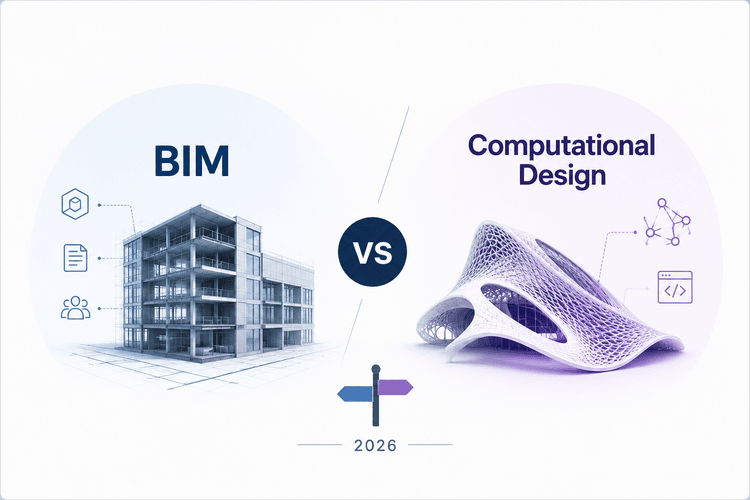
Here is a situation a lot of architecture and civil engineering students find themselves in right now. You finish your degree, you start looking at upskilling options, and you hit two paths that both sound important: BIM and Computational Design. Both are growing. Both are tech-forward. Both seem like they could unlock better jobs and better salaries.
And then you spend three weeks trying to decide which one to start with.
This guide exists to end that debate — practically, not theoretically. Both fields are genuinely valuable, and most senior AEC professionals eventually use both. But you need a starting point. And the starting point is not the same for everyone.
Let's break it down properly.
What Is BIM? What Is Computational Design?
BIM — Building Information Modeling
BIM is the digital backbone of modern construction. At its core, BIM is about creating a data-rich 3D model that carries real project information — geometry, materials, schedules, costs — in one coordinated environment. Every consultant on a project works from the same live model, which means fewer errors, fewer surprises on site, and faster documentation.
The BIM career path runs through tools like Autodesk Revit, Navisworks, and BIM 360. The work involves creating and managing 3D models, running clash detection across architectural, structural, and MEP systems, and coordinating between disciplines so that what gets built actually matches what was designed.
For a deeper look at how BIM differs from traditional CAD workflows, read: how BIM compares to traditional CAD workflows
Computational Design
Computational design is about using algorithms, parametric logic, and visual scripting to make design decisions — and to automate the tedious, repetitive work that would otherwise eat your time. Where BIM is about documenting and coordinating a building, computational design is about generating and optimizing it.
The tools are Rhino 3D with Grasshopper and Dynamo (which works inside Revit). The work involves writing scripts that adapt building geometry based on parameters, automating repetitive tasks, generating complex facades or structural forms, and running performance simulations.
The most important thing to understand about computational design: it is not just visual flair. It is systematic problem-solving. Applied badly, it produces decorative scripts nobody understands. Applied well, it saves firms weeks of manual work on a single project.
For a full picture of how this plays out in practice, read: how computational design is used in practice
BIM vs Computational Design — Side-by-Side
To help you choose the right starting point, here's a side-by-side comparison of BIM and Computational Design across skills, software, salaries, job opportunities, and long-term career growth.
| Factor | BIM | Computational Design |
| Core skill | Modeling, documentation, coordination | Algorithmic thinking, parametric modeling |
| Key software | Revit, Navisworks, BIM 360 | Rhino, Grasshopper, Dynamo |
| Best for | Detail-oriented, process-driven thinkers | Creative problem-solvers, math/logic-inclined |
| Entry salary (India) | ₹4–6 LPA | ₹4–7 LPA |
| Mid-level salary | ₹8–15 LPA | ₹8–15 LPA |
| Job availability | Very high — every firm needs BIM | Growing — concentrated in design-forward and global AEC firms |
| Career path | BIM Modeler → BIM Coordinator → BIM Manager | Computational Designer → Design Technologist → Automation Lead |
| Kaarwan course | Professional Revit & BIM Certification | Advanced Rhino & Grasshopper Certification |
The salary numbers are almost identical at entry and mid-level — which surprises a lot of people. The difference shows up later. Senior computational design roles at global delivery centres in Bengaluru, Hyderabad, and international-facing firms can command significantly higher packages because the skillset is rarer and the impact is wider. One good automation script can reduce manual work across an entire team. Firms pay for that.
For detailed salary data on each path, read: detailed BIM salary breakdown for architects and computational design salary expectations
Build industry-ready BIM skills with Kaarwan’s Revit & BIM Certification. Learn modeling, documentation, coordination, and project workflows used by leading AEC firms to accelerate your career growth in architecture, engineering, and construction.
Which Should You Start With? An Honest Decision Framework
Let's get direct about this.
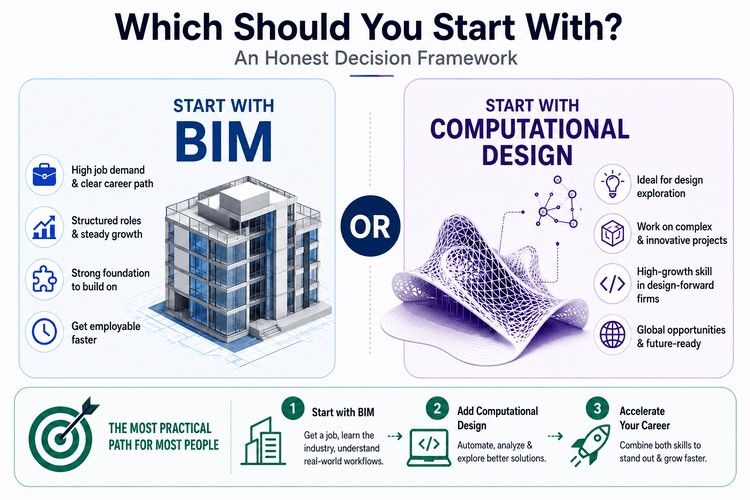
Start with BIM if:
You want a job quickly and reliably. BIM skills are required at almost every Indian AEC firm above a certain project scale, infrastructure, commercial real estate, healthcare, airports, and metro rail. The demand is consistent, and the path is structured. You know what a BIM Modeller does. You know what a BIM Coordinator does. You know what a BIM Manager does. There is a clear ladder.
Starting with BIM also gives you something that makes learning computational design significantly easier later — you already understand what you are trying to automate. You know what coordination feels like. You know why clash detection matters. When you open Dynamo and start writing scripts that automate Revit tasks, the logic clicks faster because you have been doing those tasks manually.
If you are an architecture or civil engineering graduate who needs to be employable within the next six months, BIM is the clearer starting point.
Start with Computational Design if:
You are genuinely drawn to the design exploration and form-generation side of architecture. You find yourself interested in how parametric facades work, in how algorithms can generate spatial solutions, in how the computer can test a hundred variations of a design in the time it would take you to manually model one. You care about working at design-forward firms — studios doing complex facades, infrastructure with unusual geometry, large computational design teams at international companies with Indian delivery centres.
Computational design for Indian architects is growing fastest at firms doing high-complexity work. Studios and delivery centres in Bengaluru and Hyderabad handling global projects increasingly expect computational proficiency as a baseline for senior design roles, not as a specialist skill.
The most practical answer for most people:
Start with BIM. Get employed. Learn the industry. Then layer computational design on top — because at that point you will know exactly what problems you are solving and the learning will stick.
This is not a reason to delay learning computational design indefinitely. It is a reason to sequence your learning so it compounds rather than starting from abstraction.
Start with Computational Design — Explore Kaarwan's Advanced Rhino & Grasshopper Certification
Career Growth Paths — What Each Looks Like Over Time
BIM Career Path
The BIM career in 2026 is well-documented and follows a clear progression. Entry-level roles start as BIM Modelers — creating and maintaining detailed architectural or MEP models under supervision, handling basic documentation. From there, BIM Coordinators take on cross-disciplinary responsibility — running clash detection, managing federated models, coordinating between architectural, structural, and MEP teams. BIM Managers sit at the top of the project delivery chain, setting standards, managing templates, overseeing QA, and increasingly handling client BIM requirements and government mandate compliance.
The salary at senior BIM Manager level in India — for professionals handling large commercial or infrastructure projects — reaches ₹15 LPA to ₹28 LPA at top firms. International exposure and project size both accelerate this significantly.
Computational Design Career Path
The computational design path in India is less linear but potentially more financially rewarding over time. Entry into computational roles usually happens after some BIM or architectural practice experience — as a Computational Designer or Parametric Designer developing scripts, building automated workflows, and generating geometry that project teams then document. From there, the trajectory moves toward Design Technologist roles where you define how an entire firm works — the standards, the automation tools, the parametric systems. Senior computational designers and Heads of Technology at global firms command some of the highest technical salaries in the Indian AEC market.
The shift that explains the higher compensation at senior level: you stop working on one project and start improving how an entire team or firm works. Firms pay more for that because the impact is multiplied across every project.
Is BIM a Good Starting Point for Computational Design?
Yes — and this is the question that most people do not ask but should.
Dynamo, which is one of the two primary computational design tools in AEC, runs inside Revit. It is literally built into the BIM environment. The scripts you write in Dynamo manipulate Revit elements — the same elements you model, coordinate, and document in BIM workflows. If you have spent time as a BIM professional, opening Dynamo and starting to automate Revit tasks makes intuitive sense because you already understand the underlying model logic.
Grasshopper is standalone from Revit (though Rhino Inside Revit bridges them) and requires no prior BIM background — but your ability to understand what to build with Grasshopper is still much sharper if you understand how buildings are put together from a BIM workflow perspective.
So BIM is not just an alternative to computational design. It is often the foundation that makes computational design genuinely useful rather than technically impressive but practically irrelevant.
Advance your design capabilities with Kaarwan’s Rhino & Grasshopper Certification. Master parametric design, computational workflows, and automation techniques to create smarter, innovative solutions sought by top architecture and design firms.
Conclusion
Both paths are worth building. The honest recommendation for most architecture and civil engineering students in India in 2026 is to start with BIM — get into the industry, understand how projects work, build a salary, and then layer computational design skills on top as your career progresses. That sequence compounds.
If you are someone who already has BIM skills and is wondering where to go next — computational design is exactly the right answer. The firms paying the highest technical salaries in the Indian AEC market are looking for people who can do both, and that combination is not common yet.
BIM route: Explore Kaarwan's Professional Revit & BIM Certification Program
Computational Design route: Explore Kaarwan's Advanced Rhino & Grasshopper certification.
Frequently Asked Questions
Q1: Is computational design better paid than BIM?
At entry and mid-level, the salaries are comparable — both starting in the ₹4–7 LPA range and moving to ₹8–15 LPA at mid-level in India. The significant difference appears at senior roles. Computational design professionals who move into automation lead, design technology, or Head of Technology positions at global AEC firms or delivery centres in Bengaluru and Hyderabad can command ₹18–25 LPA and above, higher than typical BIM Manager packages at the same career stage. The premium exists because the skillset is rarer and the impact on firm productivity is measurable and wide-reaching.
Q2: Can I learn both BIM and computational design?
Yes — and most senior AEC professionals eventually do. The question is in sequence. Learning BIM first gives you context that makes computational design more practical. Once you understand how Revit models are structured, learning Dynamo to automate Revit workflows is significantly more intuitive. The most valuable professionals in the AEC market right now are those who can work in both — coordinate a BIM model and write a script to automate part of that coordination. That combination is rare and well-compensated.
Q3: Which has more job openings in India right now?
BIM has considerably more total job openings. Every firm above a certain size in commercial construction, infrastructure, and real estate in India runs BIM workflows and hires BIM professionals. Computational design roles are growing but are concentrated in design-forward studios, global delivery centres, and firms handling geometrically complex projects. If you need employment quickly, BIM is the more reliable immediate path. If you are building a five-year plan that includes higher earning potential and specialisation, adding computational design skills after establishing a BIM foundation is the recommended trajectory.
Q4: Do I need a coding background for computational design?
Not for entry-level computational design. Both Grasshopper and Dynamo are visual programming environments — you connect components and nodes rather than writing lines of code. The logic is algorithmic, but the interface is graphical. That said, advancing into senior computational design roles — where you build custom plugins, write Python scripts, or develop C# automation tools — does require some text-based programming knowledge. Most professionals start with the visual tools and develop coding skills over time as the need arises. Starting from zero technical background is genuinely feasible with either Grasshopper or Dynamo.
Q5: Is BIM a good starting point for computational design?
Yes — particularly for Dynamo, which runs inside Revit and directly manipulates the BIM model elements you already understand from BIM workflows. Grasshopper is more independent, but your judgment about what to build with it is sharper when you understand project delivery from a BIM perspective. The best computational design professionals in the Indian market are typically people who came from solid BIM backgrounds — they know what problems are worth solving and build automation that teams can actually use, not just scripts that demonstrate technical capability.