If you've been scrolling job listings for Gulf-facing firms lately - AECOM, WSP, Dar Al-Handasah, that whole crowd - you've probably seen "knowledge of Dubai BIM requirements" tucked into half the job descriptions. And maybe you nodded along like you knew exactly what that meant. Fair enough, most people do the same thing.
Here's the honest version: the dubai municipality bim mandate isn't some vague industry buzzword. It's an actual regulatory requirement that's been reshaping how buildings get approved in Dubai since 2013, and it's only gotten stricter since. If you're an Indian BIM engineer, architect, or MEP professional eyeing a Gulf role, this is one of those things you genuinely need to understand - not just for interviews, but because it tells you exactly what skills are worth building right now.
So let's actually get into it.
What Is the Dubai Municipality BIM Mandate?
Dubai Municipality first made BIM compulsory for large-scale projects back in 2013 through Circular 196, and it expanded the scope in 2015 with Circular 207. Since then, the rules have kept moving - most recently tightening again around 2023–2024 to tie BIM submission directly to the building permit process itself.
The short version of what this actually means on the ground: for defined categories of buildings, you can't get your permit approved without submitting a proper BIM model alongside your drawings. Not a Revit file that just looks nice. A model with real, checkable data attached to it - fire ratings, room classifications, structural information, the works.
And here's the bit that trips a lot of people up: Dubai isn't one single authority. Dubai Municipality (DM) covers mainland Dubai and runs the main BIM e-Submission platform. But Trakhees handles Palm Jumeirah and JAFZA zones, DDA covers TECOM and Dubai Internet City, and DIFC runs its own separate rulebook entirely. A model built to satisfy DM won't automatically satisfy Trakhees. Worth knowing before you assume "Dubai BIM" means one uniform standard everywhere.
Which Projects Actually Require BIM?
This is where the mandate gets specific, and honestly, a lot of firms get this part wrong.
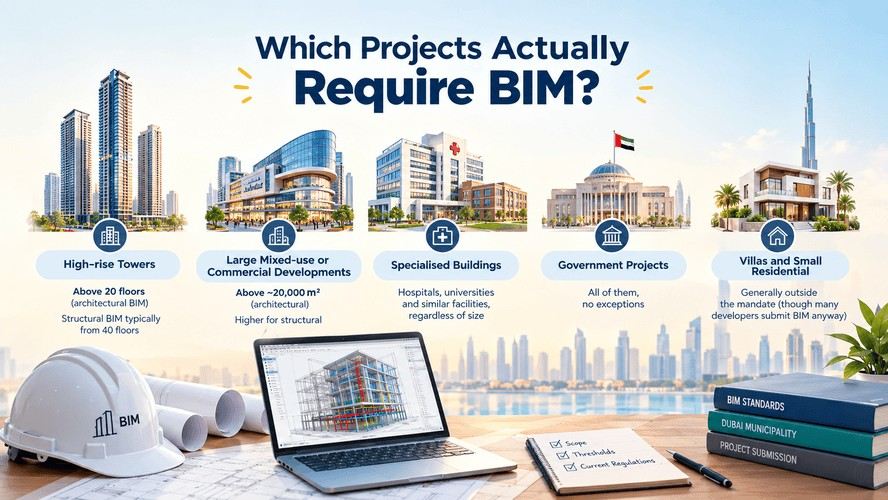
Broadly, here's how the thresholds tend to break down:
- High-rise towers - required above roughly 20 floors for architectural BIM, though structural BIM typically kicks in higher, around 40 floors
- Large mixed-use or commercial developments - anything above the published gross floor area threshold (commonly cited around 20,000 m² for architectural, higher for structural)
- Specialised buildings - hospitals, universities, and similar facilities, regardless of size
- Government projects - all of them, no exceptions
- Villas and small residential - generally sit outside the mandate, though plenty of developers submit BIM anyway for the coordination benefits
One detail that catches people off guard: the architectural threshold is lower than the structural one. So a 25-storey tower might need a full architectural BIM submission but not necessarily a structural one. Teams either over-deliver and burn weeks on unnecessary modelling, or under-deliver and get bounced back. Neither is a great way to spend a project timeline.
And thresholds move. What applied under Circular 196 in 2013 isn't quite what applies now. If you're working on a submission, confirming current scope with your reviewing authority isn't optional - it's step one, before the BEP even gets written.
Want to turn Dubai’s BIM requirements into a career advantage? Kaarwan’s Professional Revit & BIM Certification Program focuses on practical BIM workflows, project coordination, and industry-ready skills.
Dubai Building Code and Dubai BIM Standards: How They Connect to ISO 19650
Here's where it stops being about geometry and starts being about information management, which is honestly the part most people underestimate.
Dubai's BIM workflow runs on openBIM principles - meaning your native Revit or ArchiCAD file isn't actually the deliverable. The IFC (Industry Foundation Classes) export is what gets submitted, checked against automated rules, and either passed or flagged. Alongside IFC, you'll also hear about IDS (a machine-readable way of stating exactly what data needs to sit on which object) and BCF, which is how violations come back to you so you can fix them inside your own modelling software.
Underneath all of that sits ISO 19650, the international framework for managing information across a project's entire life - how it's requested, planned, produced, checked, and delivered. Dubai's BIM standards are built on this same backbone, and if you want to actually understand the ISO 19650 framework properly rather than just recognising the acronym in an interview, that's worth a proper read on its own.
In practice, a compliant Dubai submission layers three things together: ISO 19650 as the process spine, the client's own information requirements, and whichever local authority is reviewing your project - DM, Trakhees, or DDA. Getting all three aligned at the BEP stage, before anyone starts modelling, is genuinely the single highest-leverage thing a team can do here.
Is COBie Data Mandatory Yet? Where Dubai Is Heading
Not universally, no - not as of right now. But the direction is pretty obvious if you're paying attention.
Dubai Municipality has signalled fairly clearly that it's moving toward requiring COBie data (that's the structured format used to hand over facility management information) on government and larger private projects. It fits with a bigger pattern too: Dubai passed a law in early 2026 requiring Quality and Safety Certificates for buildings once they pass 20 years old, and that same law directs the Municipality to build a unified digital building database for the entire emirate. Read between the lines and it's clear - the permit model isn't a throwaway document anymore. It's meant to become the first record in a much longer digital life for that building.
Practically, this means firms building COBie-ready workflows now, even where it isn't strictly required yet, are the ones who'll be ahead when the scope eventually widens. If you're job-hunting, being able to say you understand COBie handover data is a genuinely useful line on a CV right now, before it becomes table stakes for everyone.
How This Compares to Other Gulf and Global Mandates
Dubai was early to this, but it's not alone anymore. Saudi Arabia made BIM compulsory for all new construction managed by MOMRAH from January 2024, driven heavily by the Vision 2030 giga-projects - NEOM, Qiddiya, Red Sea Global, that whole pipeline. It's a similar story: too big and too fast to run on drawings alone.
Qatar hasn't gone the full mandatory-law route yet, but Ashghal, its public works authority, uses BIM extensively on major infrastructure regardless. And further afield, Singapore has run mature BIM mandates for years, often cited as one of the more established regulatory models globally.
None of this is meant to overwhelm you - the point is simply that "BIM-ready" is fast becoming a baseline expectation across the whole Gulf, not a Dubai-specific quirk.
Why This Matters If You're Applying for BIM Jobs in the Gulf
Alright, here's the part you're probably actually here for.
Every one of these mandate requirements - the IFC exports, the ISO 19650 alignment, the COBie direction - translates directly into hiring criteria. Firms working on DM submissions need people who can populate parameters correctly, not just draw walls. They need engineers who understand why a wall exported as a generic proxy object fails an automated check. They need coordinators who know that a room schedule has to reconcile with the area statement, every single time.
If you've followed how this mandate is shaping BIM hiring across the Gulf, you'll notice the pattern pretty quickly: consultancies aren't paying premiums for software knowledge anymore. They're paying for information discipline. Someone who understands ISO 19650 workflows and CDE structures is worth more than someone who just knows Revit shortcuts, and Gulf salaries reflect that gap clearly - what Indian architects are actually earning on Gulf-facing projects tends to run noticeably higher for people who can speak this language fluently.
Also Explore: BIM Salaries in India 2026: Role-Based Guide and BIM Civil Engineer Salary India 2026 for a side-by-side sense of how domestic and Gulf pay actually compare.
Common Submission Mistakes Firms Make
A few patterns show up again and again in rejected Dubai submissions, and honestly, most of them are avoidable:
- Missing fire rating parameters - walls modelled correctly but the actual parameter left blank, so the automated check finds nothing there
- Poor IFC mapping - elements exported as generic proxies instead of proper classes, so a wall that should read as IfcWall doesn't get checked as one at all
- Incomplete or unbounded rooms - spatial data that looks fine in Revit but falls apart the moment the compliance checker looks at it
- Coordinates that don't reconcile - base points and levels not locked down early, so federated models drift apart across disciplines
- Treating the compliance check as a last-minute step - when Dubai actually publishes a free checker you can (and should) run from week one
None of these are exotic problems. They're mostly discipline issues - treating a submission model like a design sandbox instead of a regulated dataset with a pass-or-fail gate.
If you're building toward MEP-specific BIM roles, a day in the life of an MEP BIM engineer actually walks through how much of this coordination discipline plays out day to day, well before anyone's near a Gulf submission.
Ready to build the BIM skills Dubai employers are looking for? Kaarwan’s Professional Revit & BIM Certification Program goes beyond software basics to cover real-world BIM workflows, coordination, and project delivery.
FAQs
Is BIM mandatory for all buildings in Dubai?
No. It applies to defined categories - high-rise towers above certain floor or area thresholds, specialised buildings like hospitals and universities, and all government projects. Villas and small residential generally fall outside current scope.
Does Dubai Municipality require ISO 19650 compliance?
Dubai has aligned its BIM framework with ISO 19650 alongside IFC and other openBIM standards. Government and larger private projects are expected to follow ISO 19650 information management practices.
Do renovation projects need BIM models too?
Generally yes, if the renovation scope crosses the same thresholds that would apply to new construction. Dubai increasingly expects existing-conditions models for major retrofit work.
What happens if a submission doesn't meet the mandate?
The model gets flagged through the automated compliance check and sent back for correction before it reaches a human reviewer - meaning a resubmission cycle and a delayed permit.