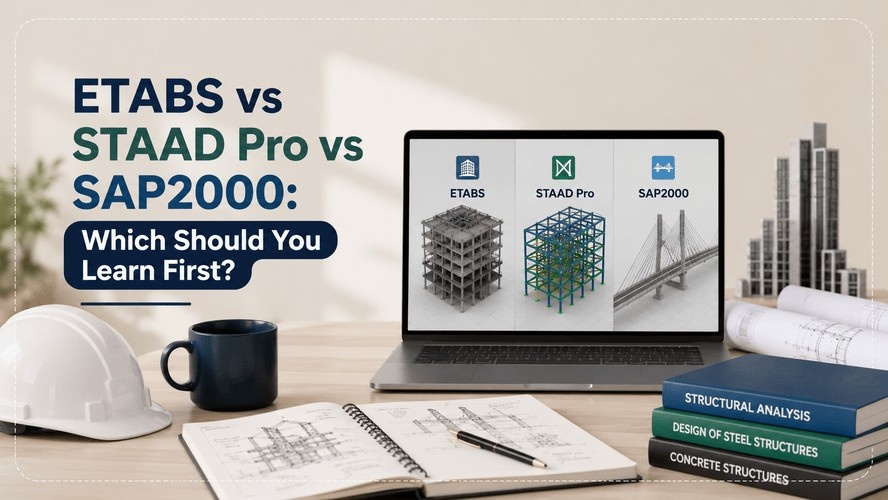
Every structural engineering student hits this wall around final year. You've done your mechanics, your RCC design theory, maybe even a bit of AutoCAD detailing, and then someone in your batch mentions ETABS, another swears by STAAD Pro, and a professor casually name-drops SAP2000 like you should already know it. Nobody actually sits you down and explains the difference. So you end up watching three different YouTube tutorials and getting three different opinions.
Let's fix that. Straight answer first, reasoning after.
Also Exlore : BIM Course in India 2026 guide if you want to see what that next step actually looks like in practice.
The Quick Answer
If you're picking one to start with: learn ETABS first if you want to design buildings, learn STAAD Pro first if industrial or steel structures interest you, and treat SAP2000 as the tool you pick up later for specialised or irregular geometry, bridges, stadiums, cable structures, that sort of thing. Your first choice should follow the kind of firm you want to work at, not the other way round.
That's it. That's the verdict. Now here's why.
What Each Tool Actually Does
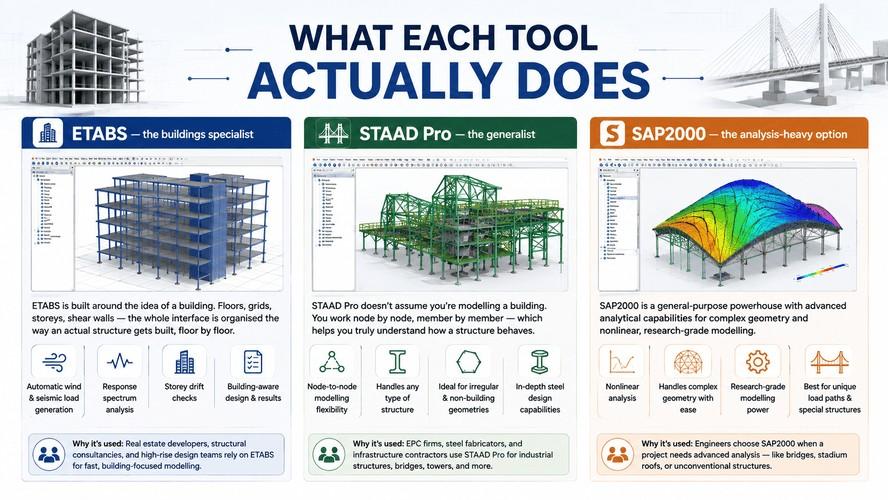
ETABS — the buildings specialist
ETABS is built around the idea of a building. Floors, grids, storeys, shear walls, the whole interface is organised the way an actual structure gets built, floor by floor. That makes it genuinely quick to pick up if you're working on multi-storey RCC or steel buildings, because the software mirrors the drawing set sitting in front of you. Automatic wind and seismic load generation, storey drift checks, response spectrum analysis, all of it is baked in and building-aware. This is why real estate developers, structural consultancies, and high-rise design teams lean on it so heavily.
STAAD Pro — the generalist
STAAD Pro, from Bentley Systems, doesn't assume you're modelling a building at all. You work node by node, member by member, which sounds tedious at first, but it forces you to actually understand how a structure is put together mathematically, instead of relying on the software's assumptions. That's exactly why it's the tool of choice for industrial sheds, pipe racks, transmission towers, bridges, and anything with an irregular or non-building geometry. EPC firms, steel fabricators, and infrastructure contractors run on STAAD.
SAP2000 — the analysis-heavy option
SAP2000 is CSI's general-purpose engine, and it's arguably the most powerful of the three when it comes to raw analytical capability, nonlinear analysis, complex geometry, research-grade modelling. But it doesn't hold your hand the way ETABS does for a typical building, and it doesn't have STAAD's steel-design depth for industrial work either. Most engineers pick it up after they've already got one of the other two under their belt, when a project genuinely needs that extra analytical muscle , think bridges, stadium roofs, or anything with unconventional load paths.
Picked your structural software? The next real salary jump comes from BIM coordination. Kaarwan's BIM Civil Programme builds exactly that skill set for working structural engineers.
Side-by-Side Comparison Table
| ETABS | STAAD Pro | SAP2000 | |
| Best for | Multi-storey buildings | Industrial, steel, irregular structures | Complex/special geometry, bridges |
| Learning curve | Gentle — building-oriented | Moderate to steep — node/member based | Steepest — general FEM engine |
| IS code support | IS 456, IS 1893, IS 800 | IS 800, IS 875, IS 1893 | IS codes supported, less building-native |
| India industry adoption | Very high — real estate, consultancies | Very high — EPC, infra, government | Moderate — specialist/research firms |
| Typical project type | Residential towers, commercial buildings | Bridges, towers, industrial sheds | Stadiums, cable structures, custom FEA |
| BIM (Revit) integration | Strong, storey-based workflows | Good, via CAD interoperability | Available but less building-workflow native |
If you're the kind of person who wants a scannable answer over a scroll of paragraphs — that table basically is the article.
What Indian Structural Firms Actually Ask For
Here's the bit most comparison articles skip. Software choice isn't academic, it's tied directly to who's hiring and what they're hiring for.
Building design consultancies and real estate developers, especially in metros seeing high-rise growth, are almost always looking for ETABS proficiency first. Seismic design, RCC detailing, storey drift, these are day-one skills in that world. On the other side, EPC companies, steel fabrication units, and infrastructure firms working with agencies like NHAI want STAAD Pro competence, particularly around steel design codes and industrial load cases.
Kaarwan's own breakdown of the best structural design courses for civil engineers goes deeper into which combination of skills actually moves the needle on salary, and it's worth a read if you're still mapping out your first two years.
Also read: Top Structural Engineering Companies in India — it's a decent way to see, firm by firm, which software shows up in job descriptions the most.
Do You Need to Learn All Three?
Honestly? Not right away, and definitely not simultaneously, that's a fast way to half-learn all three instead of properly learning one.
Site engineers and freshers targeting building design firms, start with ETABS. It gets you productive fastest and it's what most entry-level structural roles at consultancies actually screen for.
Anyone eyeing EPC, industrial, or infrastructure roles , STAAD Pro is your entry point. The node-based modelling teaches you structural behaviour in a way that pays off even when you move to other tools later.
Academic or research-leaning paths, or anyone who ends up on genuinely unconventional geometry, SAP2000 becomes relevant, usually a year or two in, once you've got fundamentals down on one of the other two.
Most senior structural engineers do end up knowing two, sometimes all three. But that's a "learn in sequence over a few years" thing, not a "cram all three before your first job" thing.
If you're still deciding your broader specialisation before narrowing down software, Kaarwan's Civil Engineering Courses List is a useful map of where different paths actually lead.
Where This Leads — From Analysis Software to BIM
Here's the part nobody tells you early enough: knowing ETABS or STAAD Pro gets you the design. It doesn't get you the coordination roles — the ones where the real pay jump tends to sit.
Once you're comfortable running analysis and design in one of these tools, the natural next step is BIM — Revit Structure for modelling, Navisworks for clash detection, structured workflows for multi-disciplinary coordination. Firms doing international project delivery or working with BIM execution plans want engineers who can take a structurally sound model and actually coordinate it against architecture and MEP, not just produce a design report.
Also explore: BIM Certifications & Training for Civil & Structural Engineers
Structural analysis gets you the design. BIM gets you the coordination roles and the pay bump. Explore Kaarwan's BIM Civil Programme to see what comes after ETABS or STAAD.
Conclusion
ETABS for buildings, STAAD Pro for industrial and steel, SAP2000 once you need the extra analytical horsepower, that's really the whole decision tree. Pick based on where you want to work, not which tool looks more impressive on a resume. And once you've got one of these down, keep BIM on your radar, it's where the coordination roles, and the better pay, tend to live.
FAQ
Which is better, ETABS or STAAD Pro?
Neither is universally "better" — ETABS is stronger for multi-storey building design because its workflow mirrors floor-by-floor construction, while STAAD Pro is more flexible for industrial, steel, and irregular structures. The right one depends on the project type, not a fixed hierarchy.
Can STAAD Pro replace ETABS for building design?
STAAD Pro can analyse and design buildings, but it lacks ETABS's storey-based automation for repetitive floor plans, seismic load generation, and drift checks. For regular multi-storey RCC buildings, ETABS is typically faster and more purpose-built.
Is ETABS only used for buildings?
Mostly, yes. ETABS is optimised for building geometry, storeys, grids, diaphragms, and while it can technically model other structures, it isn't the efficient choice outside building-type projects.
Which software do most structural firms in India use?
It splits by sector. Real estate and building consultancies lean heavily on ETABS, while EPC firms, steel fabricators, and infrastructure contractors rely on STAAD Pro. Larger firms often use both depending on the project.
Do I need to learn both ETABS and STAAD Pro to get hired?
Not for an entry-level role — one is enough to start. Many senior engineers eventually learn both because it widens the kind of projects and firms they can work with, but that typically happens over the first few years of a career, not before the first job.
Does learning ETABS or STAAD Pro help with a BIM career?
Yes, and it's actually a strong foundation. Understanding structural analysis and design logic makes it easier to move into BIM coordination roles using Revit Structure and Navisworks, since you already understand what the model needs to represent structurally.