If you've spent even ten minutes Googling "5D BIM course," you've probably noticed something odd — every result promises a dedicated certificate, but the syllabus underneath reads suspiciously like a generic BIM course with a "5D" sticker slapped on the title. You're not imagining it. Let's actually talk about what's going on.
Direct Answer: 5D BIM Isn't Usually Sold as a Standalone Course
Here's the honest version, no sugar-coating: there isn't really a standalone "5D BIM Certification" that exists as its own industry-recognized product — not at Kaarwan, and, if you look closely, not really anywhere reputable either. What you'll find instead is 5D BIM taught as a specialized module within a broader BIM or civil engineering certification program. Cost estimation, quantity takeoff, BOQ generation — these are real, learnable, hireable skills. They're just not packaged as a solo course the way, say, a "Revit Architecture course" might be.
That's not us dodging the question. It's just how the skill actually sits inside the BIM workflow. 5D BIM builds directly on top of 3D modeling and 4D scheduling — you can't really teach it in isolation without teaching the layers underneath it first. So when you see ads for a "complete 5D BIM course" running for a few weeks with zero prerequisites, that's usually a red flag worth noticing.
Also read: What 5D BIM actually means
What You Actually Need to Learn for 5D BIM
So if it's not one course, what are you actually supposed to learn? In practice, 5D BIM skills break down into a handful of concrete, practicable things:
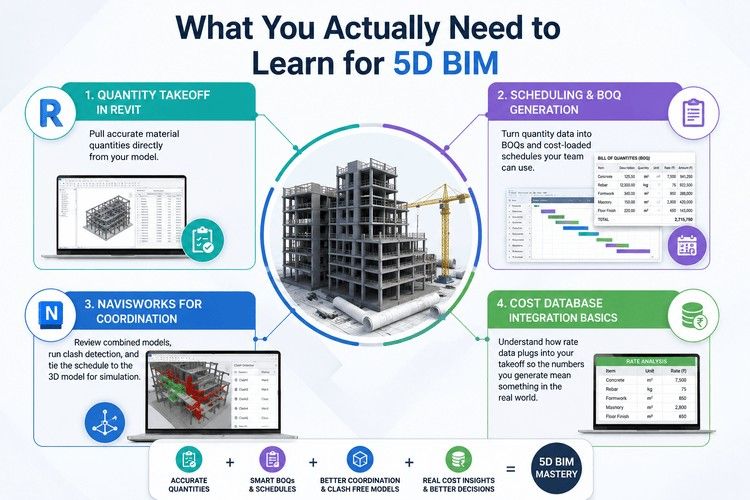
- Quantity takeoff in Revit — pulling accurate material quantities directly from your model instead of manually counting from drawings
- Scheduling and BOQ generation — turning that quantity data into bills of quantities and cost-loaded schedules that a site team or client can actually use
- Navisworks for coordination — reviewing combined models, running clash detection, and tying the schedule to the 3D model for simulation
- Cost database integration basics — understanding how rate data plugs into your takeoff so the numbers you generate mean something in the real world
None of these are exotic. They're the practical, day-to-day skills a BIM cost manager or planner is expected to walk in already knowing.
Also explore: Quantity takeoff in Revit if you want to see the software side up close.
Learn BOQ generation, scheduling, and cost documentation hands-on in Kaarwan's Professional BIM Certification Program for Civil Engineers — a 6-month live program, next batch starts 28th July 2026.
What to Look for in a Course If You Want 5D Skills
If you're evaluating training options — and there are a lot out there — here's a quick mental checklist:
- Does it actually cover BOQ generation, not just "cost theory"?
- Is there a clearly named scheduling or documentation module, not a vague mention buried in the syllabus?
- Are the mentors people who've actually scheduled or costed real projects, not just software trainers reading off slides?
- Do you walk away with project-based outputs — an actual BOQ, an actual schedule — rather than just quiz scores?
If a program can't answer those clearly, it's worth being a little skeptical of the "5D BIM Certified" badge it's dangling in front of you.
Also Read: how 5D BIM reduces budget overruns.
Where 5D BIM Fits in Kaarwan's BIM Certification Program for Civil Engineers
At Kaarwan, we don't sell a separate "5D BIM Certificate" either — for the same reason nobody honest does. Instead, 5D BIM skills live inside Module 5: Scheduling, BOQs & Documentation, part of our 6-month BIM Certification Program for Civil Engineers. You build up to it — modeling first, then scheduling, then costing — so by the time you're generating a BOQ, you actually understand where the numbers are coming from.
The certificates you actually walk away with are Revit Proficiency, Official Navisworks, ReCap Pro, and Course Completion — real, named, checkable credentials rather than a made-up "5D" badge. And the program includes mentorship from BIM professionals with hands-on scheduling and simulation experience on live infrastructure projects, so the module isn't just theory dressed up as practice. (Note: mentor name and bio to be pulled directly from the live mentor page before publishing — flagging here rather than inventing one.)
Also Read: How BIM improves cost estimation
Learn BOQ generation, scheduling, and cost documentation hands-on in Kaarwan's Professional BIM Certification Program for Civil Engineers — a 6-month live program, next batch starts 28th July 2026.
Two Quick Reasons to Consider the Program
Want to actually generate BOQs and schedules instead of just reading about them? Kaarwan's BIM Certification Program for Civil Engineers builds these skills module by module, with mentors who've worked on real infrastructure projects.
If cost estimation and scheduling keep showing up in job listings you want, this is the program built specifically to get you there — hands-on, structured, and Autodesk-recognized.
The Real Answer
So — is there a 5D BIM course? Not in the way the ads make it sound. What actually exists is a specific, learnable set of skills — takeoff, scheduling, BOQs, cost data — taught as part of a proper BIM program, not sold as a shortcut. If you're serious about it, look past the flashy course titles and check what's actually in the syllabus. That's the only thing that matters once you're sitting in front of a real project.
Frequently Asked Questions
Is 5D BIM a certification on its own?
Not really, no — not as an industry-standard, standalone product. It's taught as a specialized module within a full BIM certification, like Module 5 in Kaarwan's BIM Certification Program for Civil Engineers, rather than sold separately.
How long does it take to learn 5D BIM?
Since it builds on 3D modeling and 4D scheduling knowledge, most learners pick up solid 5D BIM skills over several weeks within a structured program — faster if you already know Revit, slower if you're starting from scratch.
Do I need to know Revit before learning 5D BIM?
Pretty much, yes. Quantity takeoff and BOQ generation both depend on a model that's built and organized correctly in Revit, so a working knowledge of it isn't optional — it's the foundation everything else sits on.