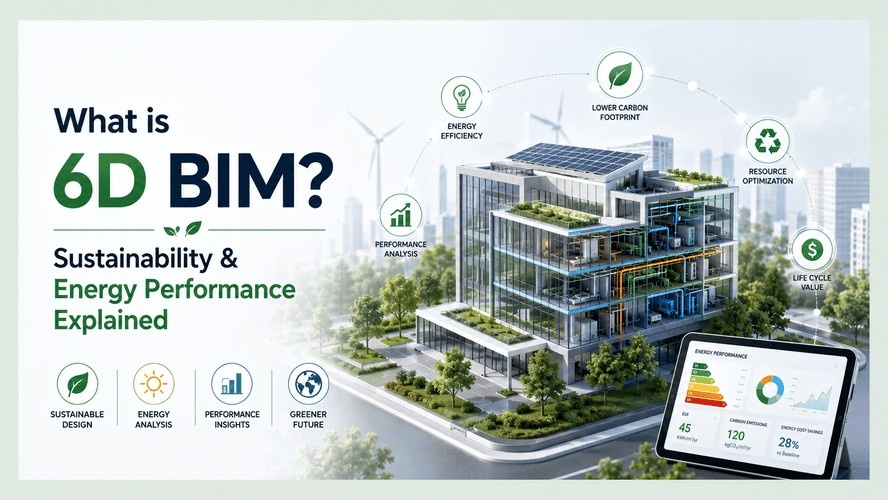
Somewhere around the fifth dimension of BIM, most people start feeling pretty confident. Cost data, budgets, quantity takeoffs , that's tangible, easy to picture. Then 6D shows up, and it gets murkier fast, because a lot of the content out there mixes it up with facility management, which is really more of a 7D thing. Let's untangle it properly.
What Does 6D BIM Mean?
Short version: 6D BIM is your model enriched with sustainability and energy-performance data , used to cut down a building's environmental impact across its entire lifecycle, not just while it's being built.
Position-wise, it sits right between 5D and 7D. Think of it as the "performance" layer. 5D told you what the building costs. 7D will later tell you how to maintain it. 6D sits in between and asks a different question entirely , how efficiently does this thing actually run? How much energy does it eat up, how much carbon does it carry, and could smarter choices at the design stage change that math significantly?
Curious where this fits with the rest of the BIM dimensions? Explore all BIM dimensions from 2D to 10D for the full map before going deeper here.
Also read: BIM's Future in MEP Engineering
How 6D BIM Builds on 5D BIM
| 5D BIM | 6D BIM | |
| What it adds | Cost data , estimating, budgeting, quantity takeoffs | Sustainability and energy-performance data |
| Primary use | Financial forecasting, budget tracking through design changes | Energy simulation, carbon impact analysis, material sustainability |
| Primary stakeholder | Cost estimators, project managers | Sustainability consultants, energy analysts, architects |
| When it's used | Throughout design and construction planning | Primarily at design stage, feeding into operations |
| Data source | Cost databases, quantity schedules | Energy models, material carbon data, simulation software |
Here's the thing worth remembering , cost and sustainability aren't really separate conversations anymore. A cheaper HVAC system upfront might cost triple in energy bills over twenty years, and 6D is exactly the tool that surfaces that trade-off before it's locked in. If you haven't already looked at how 5D BIM adds cost data, it's worth reading alongside this one , the two dimensions genuinely talk to each other.
Thinking about where sustainability-adjacent BIM skills fit into your career? Kaarwan's certification programs build the modeling foundation this entire dimension system depends on, dimension by dimension.
What 6D BIM Actually Tracks
Let's get specific, because this is where a lot of explainers stay frustratingly vague.
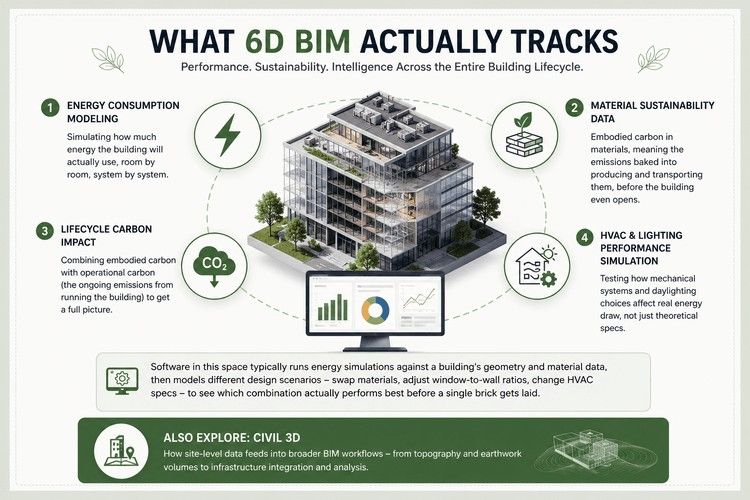
- Energy consumption modeling , simulating how much energy the building will actually use, room by room, system by system
- Material sustainability data , embodied carbon in materials, meaning the emissions baked into producing and transporting them, before the building even opens
- Lifecycle carbon impact , combining embodied carbon with operational carbon (the ongoing emissions from running the building) to get a full picture
- HVAC and lighting performance simulation , testing how mechanical systems and daylighting choices affect real energy draw, not just theoretical specs
Software in this space typically runs energy simulations against a building's geometry and material data, then models different design scenarios , swap materials, adjust window-to-wall ratios, change HVAC specs , to see which combination actually performs best before a single brick gets laid.
Also explore: Civil 3D , how site-level data feeds into broader BIM workflows
Why 6D BIM Matters for Sustainable Design
A few genuinely useful buildings have shown what's possible when energy modeling gets taken seriously from day one , sustainability-focused office projects that pushed embodied and operational carbon analysis early into design have reported dramatically lower energy use than comparable buildings in their category. That's not a fluke; it's what happens when the model actually informs the decisions instead of documenting them after the fact.
The practical upside breaks down into a few things:
- Energy optimization happens early, when changes are cheap, not after handover when they're expensive
- Long-term operating costs drop, sometimes substantially, over a building's lifespan
- The data supports the documentation needed for green building certification processes , LEED, IGBC-type frameworks, and similar systems , though it's worth being honest here: 6D BIM supports that certification journey, it doesn't guarantee an outcome. The actual certification still depends on independent assessment.
Also explore: Shop Drawings vs. IFC Drawings , the practical side of BIM documentation
Who Uses 6D BIM?
- Sustainability consultants , running the actual energy and carbon simulations
- Energy analysts , interpreting simulation output and recommending design adjustments
- Architects focused on green design , making material and system choices informed by that data
- BIM coordinators , the ones making sure this data is clean enough to flow downstream into facility management later
That last point matters more than it sounds , how 6D BIM connects to facility management in 7D BIM is worth reading if you want the full picture of where this data ends up living once the building's actually occupied.
If you're prepping for interviews or just want to sound sharp discussing BIM dimensions with a hiring manager, how BIM dimensions come up in interviews covers exactly where 6D tends to trip candidates up.
Wondering how BIM careers actually branch out after the basics? Kaarwan's Professional Revit & BIM Certification Program gives you the core modeling skills every advanced BIM dimension, including this one, is built on top of.
Wrapping Up
3D gives shape, 4D gives time, 5D gives cost , and 6D is where sustainability actually gets teeth instead of staying a slide in a pitch deck. It's the dimension that asks the uncomfortable question early: is this building actually going to perform the way we're claiming it will?
If you're building toward a BIM career and want the practical foundation underneath all of this, start your BIM career with Kaarwan's certification program , it's where every one of these dimensions eventually traces back to.
Frequently Asked Questions
What is the difference between 5D and 6D BIM?
5D BIM handles cost , estimating, budgeting, tracking quantities. 6D BIM shifts focus to sustainability and energy performance, simulating how efficiently the building will actually run.
Is 6D BIM required for green building certification?
Not strictly required, but it's a strong supporting tool. It generates the energy and carbon data that certification processes like LEED or IGBC-type frameworks typically ask for , though the certification itself still needs independent assessment.
What software is used for 6D BIM energy analysis?
Energy analysis in 6D BIM usually pairs a BIM authoring tool with a dedicated energy simulation engine, translating the model's geometry and materials into an energy analysis model that can be tested against different design scenarios.
How does 6D BIM connect to 7D BIM?
6D generates performance and sustainability data during design. Once the building is handed over, that same data , plus maintenance and asset information , carries forward into 7D BIM for facility management.