So you've heard people throw around "IGBC AP" in college placements or on some architect's LinkedIn bio, and you're wondering if it's one of those credentials worth chasing or just another acronym cluttering up someone's resume. Fair question. Let's actually get into it.
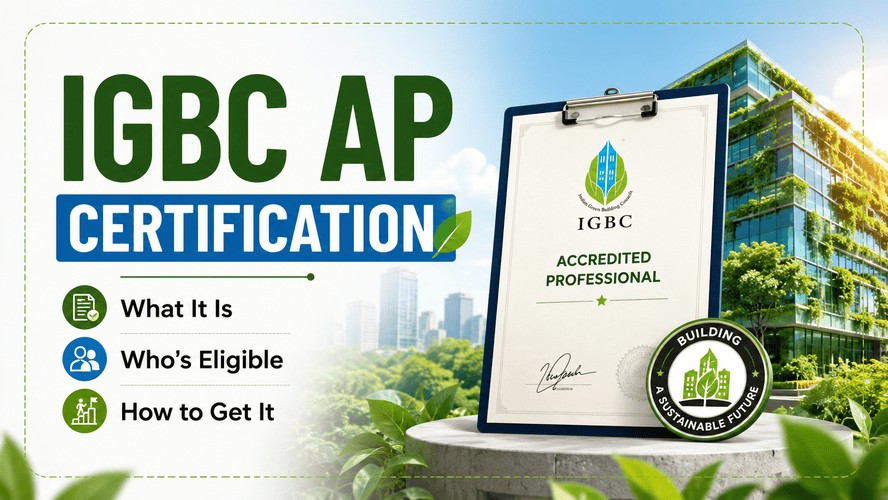
IGBC AP stands for Indian Green Building Council Accredited Professional. In plain terms, it's a credential that tells the industry you understand green building design, construction, and operations well enough to work on IGBC-rated projects.
It's not tied to one specific rating system - it tests your overall grasp of sustainable building practices, codes, and how the certification process actually works on the ground. Think of it less like a degree and more like a proof-of-competence stamp, similar in spirit to how green building certification and design standards work across the broader sustainable design world.
Here's the thing that actually makes this relevant if you're a student or early-career professional: India's green building market isn't small anymore. It's projected to run into tens of billions of dollars by 2030, and there just aren't enough qualified accredited professionals to match that growth. That gap is exactly where this certification becomes useful - not as a vanity credential, but as a genuine differentiator.
Also Read : The Future of Indian Architecture: Embracing BIM for Sustainable Design
What Is IGBC AP Certification, Really?
Let's strip away the jargon for a second. IGBC AP is an exam-based credential offered by the Indian Green Building Council, which itself operates under the Confederation of Indian Industry (CII). It was set up to build a pool of professionals capable of steering green building projects - from design intent all the way through documentation and compliance.
A few things worth knowing upfront:
- It's not rating-system specific. Unlike some credentials tied to one particular framework, IGBC AP tests general green building knowledge - design strategies, codes, materials, water and energy systems, the works.
- If an IGBC AP holder is part of a project team, that project actually earns a bonus credit point under the Innovation and Design category. So companies genuinely want people with this on their team, not just on paper.
- The exam is entirely multiple-choice, conducted online through remote proctoring, and administered by MeritTrac - the same folks who run a huge chunk of India's high-stakes assessment exams.
If you've ever read about how BIM documentation supports certification compliance, you'll notice a pattern here - a lot of green certification work these days runs through digital documentation and modeling tools, and having both skill sets (BIM know-how plus a credential like IGBC AP) makes your resume genuinely harder to overlook.
CTA 2: Pairing IGBC AP with hands-on modeling skills makes you far more hireable. Explore Kaarwan's Advanced BIM Revit Certification Course and build both sides of your green career.
IGBC AP vs IGBC AP-Associate: Which One Should You Actually Take?
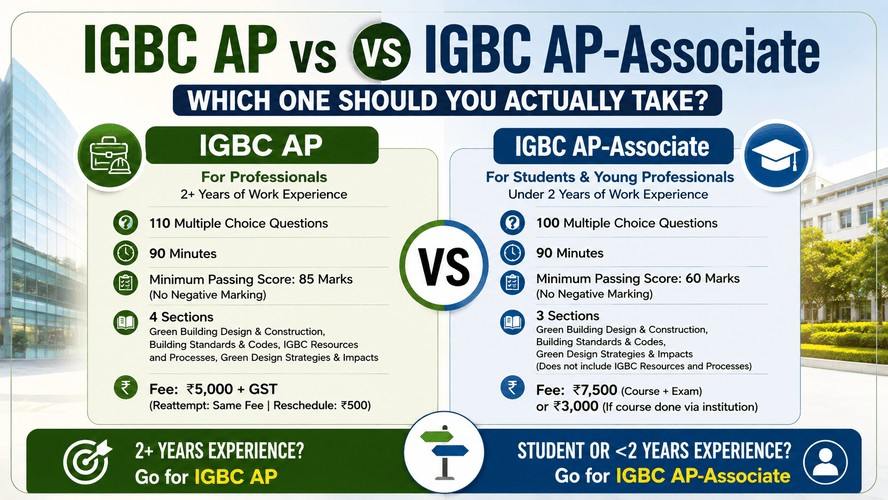
This is where a lot of students get stuck, and honestly, it trips people up because the eligibility line is drawn purely on work experience - not qualification, not college, just years on the job.
IGBC AP (the standard track) This one's meant for professionals who already have at least two years of experience in the building industry. There's no requirement to have taken a prior course - you can walk in and register directly if you meet the experience bar.
- 110 multiple-choice questions
- 90 minutes
- Minimum passing score: 85 marks (no negative marking)
- Covers four sections: Green Building Design & Construction, Building Standards & Codes, IGBC Resources and Processes, and Green Design Strategies & Impacts
- Fee: ₹5,000 plus GST (reattempt costs the same; rescheduling is ₹500 extra)
IGBC AP-Associate (the student track) This is built for students and young professionals with under two years of experience. But here's the catch a lot of people miss - you can't just show up for this one. You need to have completed IGBC's Certification Course on Green Built Environment first, either through IGBC directly or through an institution that's adopted their green education programme.
- 100 multiple-choice questions
- 90 minutes
- Minimum passing score: 60 marks (no negative marking)
- Covers three sections (skips the "IGBC Resources and Processes" section that the professional exam includes)
- Fee: ₹7,500 (course + exam combined) or ₹3,000 if you've already done the course through an institution
So really, the decision isn't "which one sounds more impressive." It's dictated by where you are right now. Still studying or fresh out of college with barely any work experience? AP-Associate is your lane, and you'll need to knock out the course first. Already grinding through two-plus years on real projects? Skip straight to the AP exam.
Eligibility: Do You Actually Qualify?
Let's make this dead simple.
- IGBC AP: Any professional with 2+ years of experience in the building industry - architecture, civil engineering, MEP, construction management, sustainability consulting, all of it counts.
- IGBC AP-Associate: Students and professionals with less than 2 years of experience, provided they've completed the required IGBC Certification Course beforehand.
There's no formal degree requirement baked in, which honestly surprises a lot of people. It's experience-and-course-based, not qualification-gated. That's a fairly rare structure compared to how most Indian certifications work.
Exam Format: What You're Actually Walking Into
I'll be honest, this part reads a bit clinical on IGBC's own site, so here's the breakdown that actually matters:
- Fully online, remote-proctored - you can sit for it from your own laptop or desktop, no test center commute
- Held twice a month, on the 1st and 3rd Saturday
- Login credentials and instructions only land in your inbox 5 days before the exam date (so don't panic if you don't see anything the week before)
- Results are shared immediately after you finish, and a formal scorecard follows within 3 working days
- If you clear it, your name gets listed on IGBC's official website as an Accredited Professional
One thing worth flagging - the exam isn't purely definitional. You'll get scenario-style questions. Something like being asked what oil grit separators are used for, or what connected load threshold triggers ECBC (Energy Conservation Building Code) applicability. It rewards people who've actually engaged with green building concepts, not just memorized a glossary.
How to Prepare for the IGBC AP Exam
There's no shortcut here, but there is a sane path.
- Start with IGBC's own reference material. The IGBC Green New Buildings Abridged Reference Guide is the baseline text most prep resources point back to.
- Understand the four (or three, for AP-Associate) sections cold. Don't just skim - know why rainwater harvesting mandates exist, what ECBC actually regulates, how credit appeals work within IGBC's process.
- Practice with sample questions relentlessly. The format rewards familiarity with question style more than raw memorization.
- Register on the official IGBC portal, create your account, pick your preferred exam date, and pay the applicable fee. Confirmation lands in your registered email automatically.
- Don't cram the codes and standards section. This tends to be where people lose the most marks because it's less intuitive than the design strategy questions.
If you're someone who leans more visual or hands-on when studying, pairing this with practical exposure - like working through actual BIM automation workflows - tends to make the abstract concepts stick a lot better than pure reading ever does.
Career Value: What Does This Actually Get You?
Fair question, and one worth answering honestly rather than with recruitment-brochure energy.
- It's a resume differentiator, not a guarantee. Firms working on IGBC-registered projects actively look for people who understand the compliance process, because it saves them documentation headaches down the line.
- It earns your project points. Literally - having an IGBC AP on the team contributes toward the Innovation and Design credit category. That's a tangible, quantifiable reason employers value it.
- It opens doors across roles, not just architecture - engineers, project managers, sustainability consultants, and facility managers all use this credential to signal green building fluency.
- It compounds well with other skills. On its own, it's a knowledge credential. Paired with something practical like Revit or BIM modeling, it becomes a lot more employable, since so much of real-world green certification work runs through digital documentation now.
Also Read: Sustainable Design with BIM: Earning Green Certifications
IGBC vs LEED: A Quick Word
People ask this constantly, so let's settle it briefly. LEED (Leadership in Energy and Environmental Design) is the globally recognized U.S.-origin framework, administered by GBCI, and its AP credentials come with specialty tracks. IGBC AP is India-specific, tied to IGBC's own rating systems and building codes like ECBC.
If you're planning to work primarily on Indian projects, IGBC AP is the more immediately relevant credential. If your ambitions stretch toward international or MNC-driven projects, LEED AP carries more global recognition. Plenty of professionals in India end up pursuing both over time - they're not mutually exclusive.
Ready to back up your green building knowledge with real technical skill? Kaarwan's BIM and Revit certification course helps you turn sustainability concepts into project-ready documentation.
FAQs
Is IGBC AP worth it for architecture students?
If you're still a student, you'd actually pursue the IGBC AP-Associate track rather than the standard AP exam, and yes - it's genuinely worth it if you're heading into a career involving sustainable design, since it signals real fluency in green building codes and processes to future employers.
What's the difference between IGBC AP and IGBC AP-Associate?
IGBC AP is for professionals with 2+ years of experience and requires no prior course. IGBC AP-Associate is for students and professionals with under 2 years of experience, and it requires completing IGBC's Certification Course on Green Built Environment before you're eligible to sit for the exam.
How long is the IGBC AP certification valid?
IGBC doesn't publish a fixed expiry date for the AP credential itself the way it does for project certifications (which need renewal every 3 years). Once you clear the exam, your name stays listed as an Accredited Professional on IGBC's official records.
Can I take the IGBC AP exam without work experience?
No - the standard IGBC AP exam requires at least 2 years of building-industry experience. If you don't have that yet, the AP-Associate exam is your route, provided you complete the required certification course first.