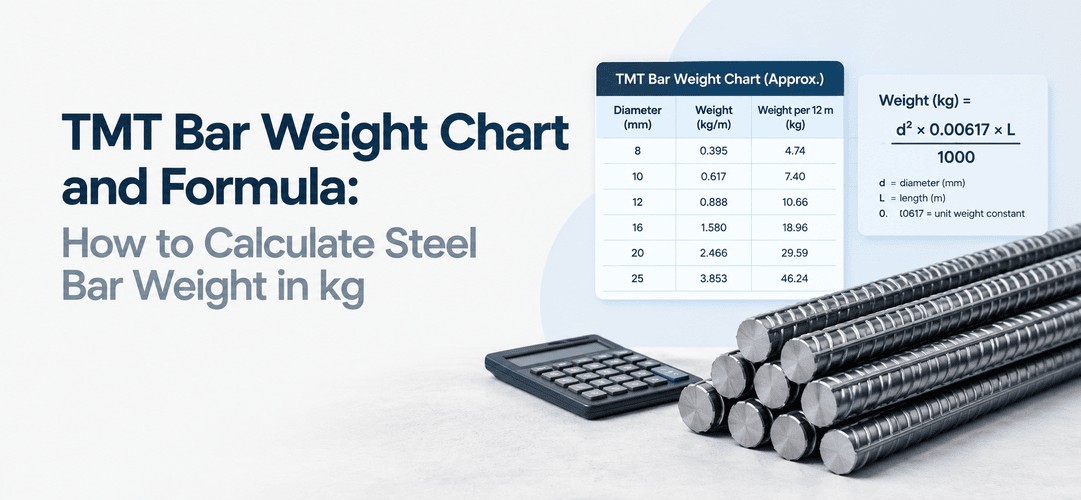
The weight of a TMT bar per metre is D²/162 kg, where D is the bar diameter in mm. A 10 mm bar comes to about 0.617 kg per metre, so a standard 12 m bar weighs around 7.4 kg. That one line is behind almost every steel quantity you'll ever put in a BOQ. Below you'll find the full TMT bar weight chart, where 162 actually comes from, and worked examples you can copy straight into your own sheets.
Also Read : Essential RCC Construction Terminology
TMT bar weight formula (D²/162) and where it comes from
Here's the formula once more, cleanly:
Weight per metre (kg/m) = D² ÷ 162 Weight of a bar (kg) = D² × L ÷ 162 (D in mm, L in metres)
Why 162? It isn't magic. A round bar's cross-section is π/4 × D². Multiply by one metre of length and steel's density of 7,850 kg/m³, and you get D² × 0.006165 kg per metre. Flip that around and 1 ÷ 0.006165 is roughly 162.2. Engineers rounded it to 162, and that's what the whole country uses.
Got lengths in feet? Convert to metres first (divide by 3.281). Don't mix units. That's the mistake that quietly ruins quantity sheets.
TMT bar weight chart: kg per metre, kg per 12 m bar, bars per tonne
These are nominal values in line with IS 1786:2008, the standard for high-strength deformed steel bars. Bars per tonne are rounded, so treat them as thumb-rules.
| Diameter (mm) | Weight (kg/m) | Weight of one 12 m bar (kg) | Approx. bars per tonne |
| 6 | 0.222 | 2.66 | 375 |
| 8 | 0.395 | 4.74 | 211 |
| 10 | 0.617 | 7.40 | 135 |
| 12 | 0.888 | 10.66 | 94 |
| 16 | 1.580 | 18.96 | 53 |
| 20 | 2.470 | 29.64 | 34 |
| 25 | 3.850 | 46.20 | 22 |
| 28 | 4.830 | 57.96 | 17 |
| 32 | 6.310 | 75.72 | 13 |
Sticking this chart on the site office wall isn't a bad idea. People will thank you.
10 mm TMT bar weight
A 10 mm TMT bar weighs 0.617 kg per metre. A 12 m bar is about 7.40 kg, and one tonne holds roughly 135 bars. Most slab work in Indian housing runs on this size, so it's the number you'll reach for first.
8 mm TMT bar weight
0.395 kg/m, or 4.74 kg per 12 m bar. This is the stirrup and slab-distribution size, so it shows up in huge quantities even though each bar is light.
12 mm TMT bar weight
0.888 kg/m, or 10.66 kg per 12 m bar. A very common size for slab main bars and beam reinforcement.
16 mm TMT bar weight
1.580 kg/m, or 18.96 kg per 12 m bar. Typical in beams and columns of regular buildings.
20 mm TMT bar weight
2.470 kg/m, or 29.64 kg per 12 m bar. Think heavier columns and footings.
Turning bar lengths into BOQ quantities by hand is a skill. Learn to do it properly, with schedules and take-offs, in Kaarwan's civil BIM program.
TMT bar, rod, saria: are they the same thing?
Mostly, yes. On an Indian site, saria, sariya, rod and rebar all point at reinforcement steel. TMT just tells you how the bar was made, with a hard outer layer from quenching and a softer core. The D²/162 formula works on the weight of round steel, and the chart above is for ribbed TMT bars. Plain mild steel rounds are sold differently, so don't assume the same nominal values apply to them.
How to calculate the weight of a bar of any length
Three steps. Square the diameter. Multiply by the length in metres. Divide by 162.
Example 1: one 12 mm bar, 8 m long 12 × 12 = 144. 144 × 8 = 1,152. 1,152 ÷ 162 = 7.11 kg.
Example 2: sixty 20 mm bars, each 6.5 m 20² = 400. 400 × 6.5 ÷ 162 = 16.05 kg per bar. 16.05 × 60 = about 963 kg, almost a tonne from one bar type.
Example 3: 8 mm stirrups, 250 pieces at 1.9 m cutting length each Total length = 250 × 1.9 = 475 m. 475 × 0.395 = about 188 kg.
Notice the third one. Small bars, big count, real weight. Stirrups get under-estimated on site more often than anything else.
Standard bar length, bundle weight and bars per tonne
In India most mills supply TMT in 12 m lengths. That's why the chart carries a 12 m column. If your supplier cuts to a different length, scale it. Weight is per metre, always.
Bundles are trickier. The number of bars in a bundle changes from mill to mill, so there's no single "standard bundle weight". Count the bars, multiply by the per-bar weight from the chart, done. For instance, a bundle of five 16 mm bars at 12 m is 5 × 18.96 = 94.8 kg. For bars per tonne, divide 1,000 by the weight of one bar. 1,000 ÷ 10.66 gives about 94 bars of 12 mm.
TMT bar sizes and where each is used
- 8 mm: stirrups, ties, slab distribution steel
- 10 mm: slabs, stirrups in larger members, lintels
- 12 mm: slab and beam reinforcement
- 16 mm: beams and columns
- 20 mm and above: heavy columns, footings, raft foundations, bridge work
- 25 to 32 mm: high-rise columns and infrastructure
The exact size is always the structural engineer's call from the drawings. This list is a rough map, nothing more.
Nominal vs actual weight: the IS 1786 tolerance
A bar from the mill won't weigh exactly the chart value. IS 1786:2008 allows a small tolerance on nominal mass, and published min–max charts show it tightening as bars get thicker: roughly ±7% for bars up to 10 mm, ±5% for 12 to 16 mm, and ±3% above that. This is why you weigh a sample bar on delivery. If a 12 mm, 12 m bar comes in well under 10.1 kg, ask questions before you sign the challan.
For reference, India is the world's second-largest crude steel producer. The Ministry of Steel reports crude steel output of about 170 million tonnes in 2025-26, up from about 152 million tonnes in 2024-25. With that much steel moving, even a 3% error on a big project adds up fast.
Also Read : IS Codes for Civil Engineering
Want your steel quantities to match the model every time? Learn how to create accurate schedules, BOQs, and construction documentation with Kaarwan’s Professional BIM Certification Program for Civil Engineers.
From weight to steel quantity: BBS to BOQ
Here's where this stops being theory. A bar bending schedule gives you bar lengths and counts. Your weight chart turns those lengths into kilograms. Those kilograms land in the BOQ. And if you work in Revit, the same numbers feed into a quantity take-off, so it's worth knowing the hand calculation well enough to sanity-check what the software gives you.
Honestly, this is the habit that separates a quick estimator from a careful one. Always cross-check the model against the manual number.
If you want that workflow end to end, the Professional BIM Certification Program for Civil Engineers covers scheduling, BOQs and documentation in Weeks 8 to 9.
FAQs
How do you calculate the weight of an 8 mm steel bar?
Use D² × L ÷ 162. For a 12 m bar, 8 × 8 × 12 ÷ 162 = 4.74 kg. Per metre, it's 0.395 kg.
What is the weight of a 12 mm steel bar?
0.888 kg per metre. A 12 m bar weighs about 10.66 kg.
What is the weight of a 6 mm steel bar?
About 0.222 kg per metre, so roughly 2.66 kg for a 12 m length.
How many steel bars are there in one tonne?
Divide 1,000 by the weight of one bar. For 12 m bars that's roughly 135 bars of 10 mm, 94 of 12 mm and 53 of 16 mm.
How many pieces of rebar come in a bundle?
It depends on the mill and the diameter. Count the pieces and multiply by the per-bar weight to get the bundle weight.
How do you calculate steel bar weight in kg?
Square the diameter in mm, multiply by the length in metres, then divide by 162.
Why is the formula D²/162?
Cross-sectional area (π/4 × D²) multiplied by steel density (7,850 kg/m³) works out to D² ÷ 162.2, rounded to 162.