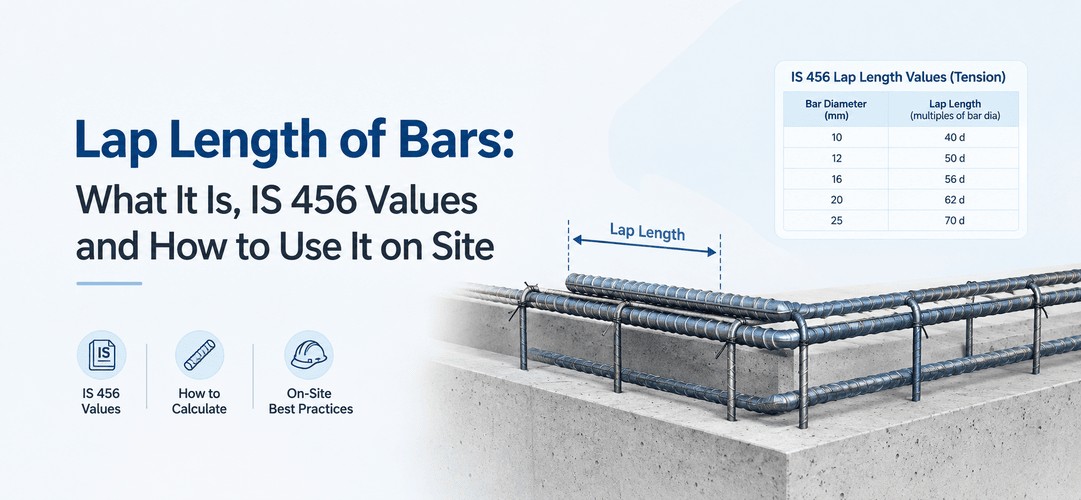
Lap length is the distance two reinforcement bars overlap so that force can pass from one bar to the next through the concrete around them. In India, IS 456:2000 sets that distance from the development length (Ld). The answer changes depending on whether the bar is being pulled (tension) or squeezed (compression).
This guide covers lap length vs development length, the IS 456 values, a ready table for 8 mm to 32 mm Fe500 bars, and where laps should and shouldn't go in a column, beam, slab or footing.
Why does this matter? Because steel never arrives in the length your building needs. Rebar usually comes in 12 m pieces, and India uses a lot of it. The Ministry of Steel reported finished steel consumption of about 164 million tonnes in FY 2025-26, up roughly 7-8%, with infrastructure and construction among the drivers.
Every one of those bars gets cut, bent and spliced somewhere. And a bad splice is invisible once the concrete is poured. That's the scary part.
What is lap length?
Lap length is the length over which two bars run side by side so one can hand its force over to the other. Force doesn't jump from steel to steel. It moves from bar A into the concrete through bond, then from the concrete into bar B. The overlap is the stretch where that handover happens.
Make it too short and the bond runs out before the load has fully shifted. You get slip, cracking and, in the worst case, a failure that gives very little warning.
You lap when the bar you need is longer than the bar you have, at construction joints, and at every floor where column bars carry on upwards. A single RCC building can have hundreds of laps.
Lap length vs development length
Development length (Ld) is how far one bar must be embedded in concrete to develop its full design stress. Lap length is how far two bars must overlap to pass that stress between them. Lap length is built from Ld, and that's exactly where people mix them up.
| Development length (Ld) | Lap length | |
| Question it answers | How much embedment does one bar need? | How much overlap do two bars need? |
| IS 456 clause | 26.2.1 | 26.2.5 |
| Depends on | Bar diameter, bar stress, bond stress | Ld, plus a minimum floor (30φ or 24φ), tension or compression |
| Where you see it | Bar ends, anchorage at supports | Splices |
Want to turn lap lengths into real rebar models? Join Kaarwan's Professional BIM Certification Program for Civil Engineers and learn rebar, steel and fabrication hands-on.
Development length formula (Ld = φσs / 4τbd)
IS 456 Clause 26.2.1 gives the formula:
Ld = (φ × σs) / (4 × τbd)
Here φ is the nominal bar diameter, σs is the stress in the bar at design load (0.87 fy), and τbd is the design bond stress for the concrete grade. IS 456 gives τbd for plain bars in tension. For deformed bars like the TMT you actually buy in India, increase it by 60%. For bars in compression, add another 25%.
| Concrete | Plain bar, tension (N/mm²) | Deformed, tension (×1.6) | Deformed, compression (×1.6 ×1.25) |
| M20 | 1.2 | 1.92 | 2.40 |
| M25 | 1.4 | 2.24 | 2.80 |
| M30 | 1.5 | 2.40 | 3.00 |
| M35 | 1.7 | 2.72 | 3.40 |
| M40 | 1.9 | 3.04 | 3.80 |
Try one by hand. Take a 16 mm Fe500 bar in M25. Stress is 0.87 × 500 = 435 N/mm². Then Ld = 16 × 435 / (4 × 2.24) = about 777 mm, or roughly 48.5 times the bar diameter.
Forget the 1.6 factor and you'll use the plain-bar value, so your Ld comes out 60% longer than needed. That's safe, but it wastes steel across a whole project.
Lap length values as per IS 456:2000
Here's what Clause 26.2.5.1 asks for:
- Flexural tension (beams, slabs): lap = Ld, but not less than 30φ.
- Direct tension (ties, hangers, tank walls): lap = 2Ld, but not less than 30φ.
- Compression (columns): lap = Ld in compression, but not less than 24φ.
- Straight portion of a tension lap: at least 15φ or 200 mm, whichever is more. Hooks help with anchorage but can't replace this.
- Different diameters: work out the lap from the smaller bar.
- Bars larger than 32 mm: don't lap them. Use welding or mechanical couplers.
- Some tension laps get bumped up: the code asks for a 1.4 multiplier in certain cases, such as top-cast bars with thin cover, corner bars, and laps packed close together. It goes to 2.0 when two conditions combine. Check Clause 26.2.5.1(c) and your drawing.
About that 32 mm: older printed copies of IS 456 and plenty of online notes still say 36 mm. Amendment No. 3 brought it down to 32 mm. If your site copy of the code is old, this is exactly the kind of thing it gets wrong.
Now the thumb rules you hear on every site: 40d to 45d for columns, 50d to 60d for beams and slabs. They're handy for a quick check. But run the numbers. For Fe500 in M20, the tension lap works out to about 56.6d, so a blanket "50d" is short. In M25 it's about 48.5d, in M30 about 45.3d. The multiple moves with the concrete grade, so the thumb rule is a sanity check, not a design.
Lap length in column, beam, slab and footing
Use this table as a starting point. The approved structural drawing always wins.
| Member | Bar condition | Where laps usually go | Watch out for |
| Lap length in column | Mostly compression | Away from the beam-column joint; central part of column height in seismic detailing | Don't lap every bar at one level. Keep steel within the 4% limit at laps |
| Lap length for beam | Flexural tension | Bottom bars near supports, top bars toward mid-span | Keep clear of sections where bending moment exceeds 50% of moment of resistance |
| Lapping length for slab | Flexural tension | Same logic as beams: bottom bars over supports, top bars toward mid-span | Distribution bars need laps too. Stagger them |
| Footing and starter bars | Anchorage plus splice | Starters lap above the footing | Don't call every embedded tail a "lap". Confirm what the drawing intends |
Also Read : Beam Reinforcement Details in RCC
Staggering laps and where not to lap
- No more than half the bars at one section. If you must lap more, increase the lap length and/or add closely spaced stirrups or spirals around the splice.
- Stagger properly. IS 456 treats laps as staggered when their centres are at least 1.3 times the lap length apart. "Not on one line" isn't measurable. 1.3 × lap is.
- Stay out of maximum-stress zones, and out of congested beam-column joints.
- Bundled bars: lap one bar at a time and stagger them. Never end a whole bundle at one section.
This gets stricter in seismic zones. NDMA's commonly quoted figure is that roughly 59% of India's land area is exposed to moderate to severe earthquake shaking. For ductile detailing, IS 13920:2016 generally keeps laps out of the joint and out of the zone within 2d of the column face, and out of regions where yielding is expected. Read it alongside IS 456 for any building in Zones III to V.
Lap length table for 8 mm to 32 mm bars
These are calculated values for Fe500 deformed bars at 0.87 fy, in M20 and M25, using the formula above. In every case Ld is larger than the 30φ and 24φ minimums, so Ld governs. They're base values, before any 1.4 or 2.0 multiplier and before your project's rounding rules.
| Bar dia (mm) | M20 tension lap (mm) | M25 tension lap (mm) | M20 compression lap (mm) | M25 compression lap (mm) |
| 8 | 453 | 388 | 363 | 311 |
| 10 | 566 | 485 | 453 | 388 |
| 12 | 680 | 583 | 544 | 466 |
| 16 | 906 | 777 | 725 | 621 |
| 20 | 1,133 | 971 | 906 | 777 |
| 25 | 1,416 | 1,214 | 1,133 | 971 |
| 28 | 1,586 | 1,359 | 1,269 | 1,088 |
| 32 | 1,813 | 1,554 | 1,450 | 1,243 |
So the lap length for a 16 mm bar in M25 is about 777 mm in flexural tension and about 621 mm in compression. Direct tension doubles the tension figure to roughly 1,554 mm.
How lap length affects cutting length in a BBS
Lap length isn't only a detailing number. It's steel you pay for. When a bar is cut storey by storey, the lap is extra length added on top of what the member needs structurally.
Picture a 3 m storey with 16 mm column bars lapped about 620 mm in compression. That lap adds roughly a fifth to the bar's length before wastage. Multiply that across every column bar in a G+4 building and you can see why quantity surveyors and bar benders care about it. Your bar bending schedule has to carry the right lap in every cutting length, or the site ends up cutting bars short or wasting steel. If you're pricing work, the same numbers feed your quantity surveying take-off.
The same discipline carries into modelling. In precast and fabrication detailing, laps and couplers are modelled bar by bar, which is also what the Rebar, Steel and Fabrication module in Kaarwan's Professional BIM Certification Program for Civil Engineers trains you to do.
CTA 2: Tired of copying lap tables from random PDFs? Kaarwan's Professional BIM Certification Program for Civil Engineers shows you how to detail bars and laps properly.
Common site mistakes
- Using "50d" for every bar without checking the concrete grade
- Lapping all bars at one section of a column or beam
- Putting laps in beam-column joints or near maximum-moment zones
- Using the old 36 mm limit instead of 32 mm
- Reusing a flexural-tension lap where the member is in direct tension
- Taking the lap from the larger bar when two diameters meet
- Forgetting that hooks don't replace the 15φ / 200 mm straight overlap
- Changing lap locations on site after the BBS is approved
FAQs
What is the difference between lap length and development length?
Development length is how far one bar must be embedded to develop its full stress. Lap length is how far two bars must overlap to pass that stress between them. Under IS 456, lap length is calculated from Ld, with minimums of 30φ in tension and 24φ in compression.
What is the lap length for 12 mm and 16 mm Fe500 bar in M25 concrete?
For deformed Fe500 bars in M25, the flexural tension lap is about 583 mm for 12 mm and about 777 mm for 16 mm. In compression, it's about 466 mm and 621 mm. Check your drawing for any multipliers and rounding.
Why should laps be staggered?
If all bars lap at one section, the bond force and congestion pile up in one place. That raises the risk of splitting and honeycombing. IS 456 limits lapping to no more than half the bars at a section and treats laps as staggered when their centres are at least 1.3 times the lap length apart.
What is lap length in a column?
Column bars are mostly in compression, so the lap is the compression development length, but never less than 24φ. Laps should sit away from beam-column joints, and in seismic buildings follow IS 13920 for the permitted zone.
Can bars larger than 32 mm be lapped?
No. As per the amended IS 456 text, bars larger than 32 mm should be welded or joined with mechanical couplers instead.
Is lap length the same for beams and slabs?
The rule is the same, since both are in flexural tension. Your numbers will still differ by bar size, concrete grade, cover and spacing, so always follow the approved drawing.