Introduction:
Landscape planning is an integral part of architectural design that bridges the gap between built environments and nature. A thoughtfully designed landscape not only enhances the visual appeal of a space but also influences how people experience and interact with their surroundings. Whether it’s a residential backyard or a large public plaza, certain core elements consistently define the character and functionality of landscape architecture. This article explores four essential components of landscape planning—vegetation, hardscape, water bodies, and outdoor furniture—and their architectural relevance.
1. Vegetation:
Vegetation forms the backbone of most landscape designs, serving both functional and aesthetic purposes. In architectural planning, vegetation is more than just greenery—it acts as a buffer for privacy, a shade provider, a visual connector, and an ecological contributor. Trees, shrubs, ground covers, and climbers can define zones, direct movement, improve air quality, and reduce heat island effects in urban environments.
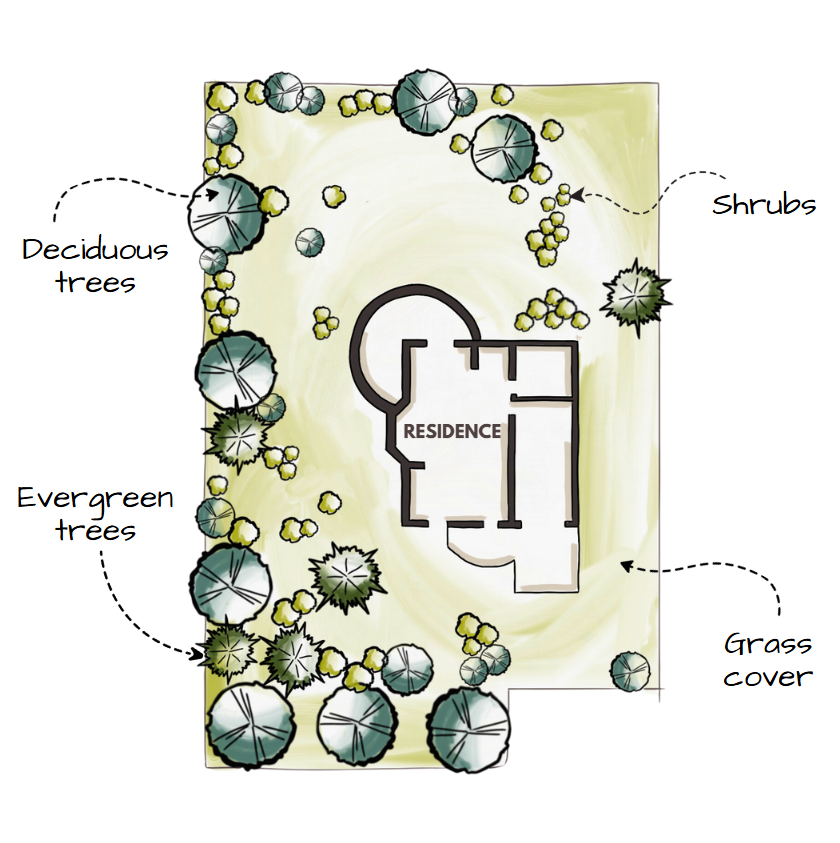
Illustration by Shivani Chougula @Kaarwan
Architecturally, vegetation enhances spatial quality by framing views or screening unwanted visuals. It contributes to microclimate control and biodiversity. Types of vegetation commonly used include deciduous trees for seasonal change, evergreen hedges for year-round screening, and flowering plants for visual variety. The choice of plants must consider maintenance, local climate, and ecological compatibility.
Plant Selection Criteria
Choosing a plant isn't really about what looks good in the nursery - it's about what's still alive and doing its job three summers from now. Climate zone matters more than almost anything else here. In hot-dry regions (think Rajasthan, Gujarat), natives like Neem, Khejri, and Babool tolerate water stress that ornamental imports just won't survive. Warm-humid coastal zones lean toward Coconut, Areca, and Bamboo. Composite-climate belts across the North Indian plains do well with Gulmohar, Amaltas, and Peepal.
Spacing depends on canopy spread, not just trunk size - large-canopy trees like Gulmohar or Rain Tree need 6–8m of breathing room, medium-canopy trees like Neem sit closer to 3–4m, and shrubs or ground cover can go tighter, around 0.5–1m depending on species. Maintenance load varies just as much: native and drought-tolerant species need minimal upkeep once established, while ornamental flowering plants often demand regular pruning, feeding, and pest management. Get this wrong and you're either overcrowding a site in five years or signing up for a maintenance bill nobody budgeted for.
2. Hardscape:
Hardscape elements are the non-living, structural features of a landscape. This includes pathways, pavements, walls, steps, decks, and built features like pergolas or gazebos. From an architectural standpoint, hardscape defines spatial layout and circulation, creates boundaries, and adds form and rhythm to outdoor areas. Materials used in hardscaping—stone, concrete, wood, or brick—should harmonize with the architectural palette of adjacent buildings.
This is where hardscape stops being just "the paved bits" and starts doing architectural work. Pergolas and trellises give you filtered shade and a framework for climbers without fully enclosing a space. Gazebos and pavilions act as destination points within a larger landscape - somewhere to actually sit and look back at the garden.
Retaining walls solve a grading problem and create usable flat terraces on sloped land at the same time, which matters a lot more on Indian sites than flat-lot Western landscaping guides tend to admit. Shade structures - whether a simple shade sail or a built canopy - extend how long outdoor spaces stay usable through the hotter months. None of these are decorative afterthoughts; they're structural decisions that shape circulation and comfort just as much as a pathway does.
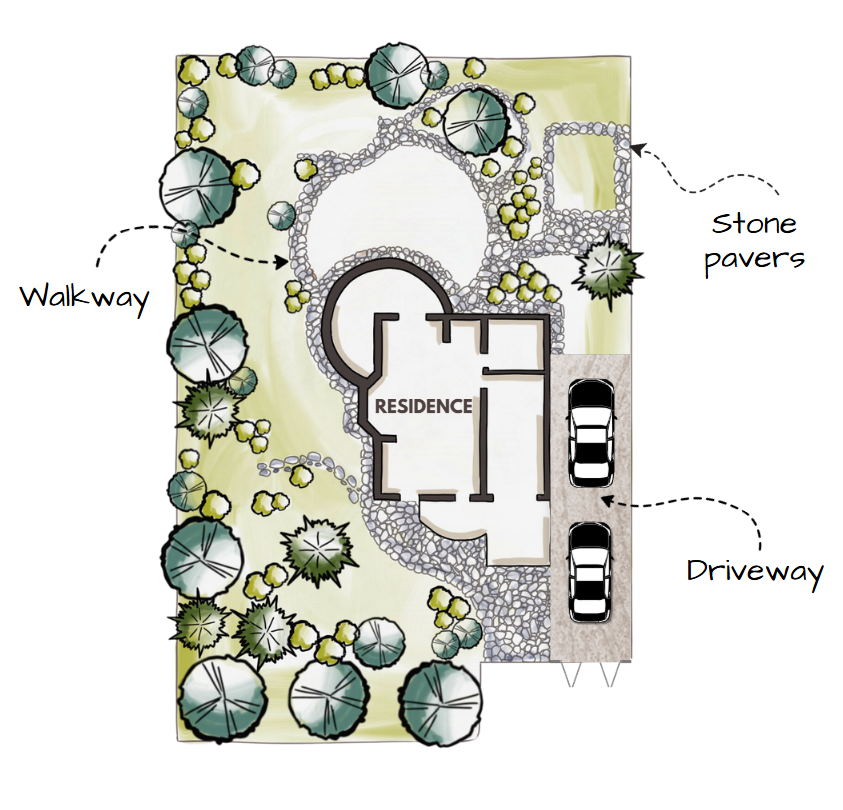
Illustration by Shivani Chougula @Kaarwan
Hardscape not only supports user movement and access but also affects stormwater drainage and accessibility. Different textures and finishes can influence safety and usability. For instance, permeable pavers contribute to sustainable site design, while gravel pathways evoke a more rustic aesthetic. Effective hardscape planning balances durability, maintenance, and visual integration.
Beyond the material palette, hardscape has to actually work as infrastructure. Ramps should generally stay under a 1:12 gradient to remain wheelchair-accessible; anything steeper starts excluding people, full stop. Walkways need a cross-slope of roughly 1–2% - enough to shed water without feeling like you're walking on a tilt.
Surface choice affects slip resistance directly: textured stone or brushed concrete perform far better in wet conditions than polished finishes, which look sharp in renders and turn dangerous the first monsoon. Get the gradient and drainage math wrong at this stage and you're retrofitting expensive fixes later - this is the one section where the numbers genuinely matter more than the aesthetics.
3. Water Bodies:
Water features like ponds, fountains, streams, and reflecting pools add dynamism and serenity to landscapes. In architectural contexts, they serve both symbolic and climatic roles. Water can cool microclimates through evaporation, offer acoustic masking in noisy environments, and serve as focal elements in public spaces.
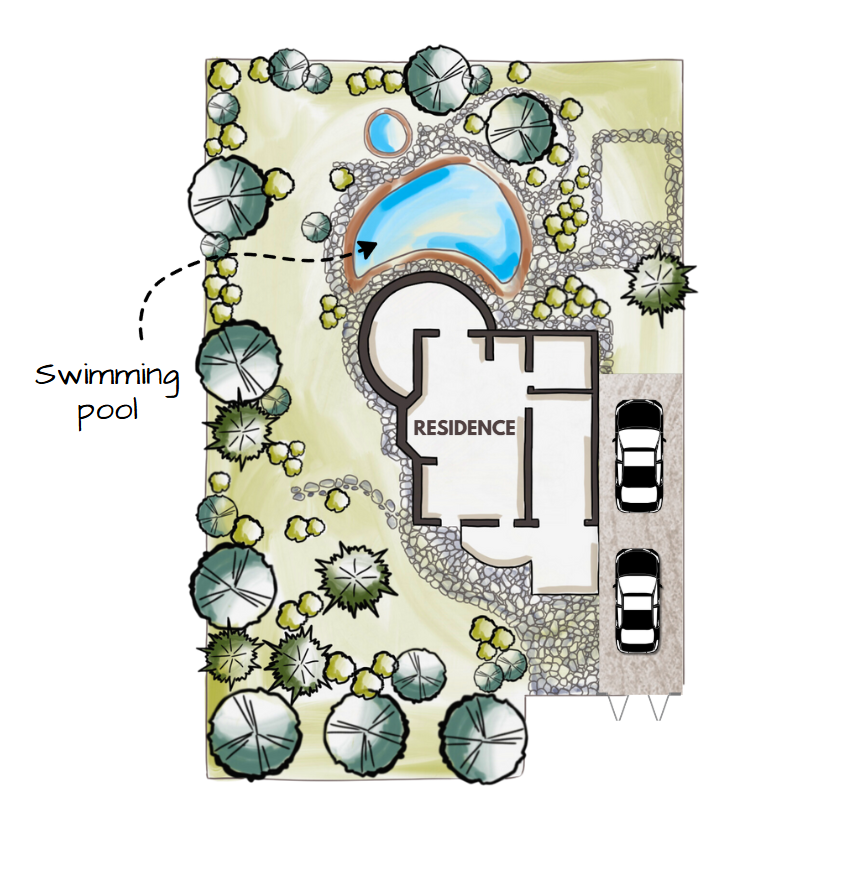
Illustration by Shivani Chougula @Kaarwan
Types range from still pools used in meditative settings to kinetic fountains in urban plazas. Their design must account for safety, water conservation, and maintenance. Architecturally, integrating water into landscape design encourages a multisensory experience—sound, reflection, movement—that elevates the ambience and emotional connection to space.
Depth is the first safety question, always - features accessible to children generally need to stay under 45cm, or be fenced/guarded if deeper. Beyond that, recirculation systems matter more than people expect: standing water without proper circulation turns stagnant and becomes a mosquito problem fast, especially in Indian humidity.
Evaporation is a real cost too, not just an aesthetic concern - open water features in Indian summers can lose 5–8mm of depth per day, which adds up over a season and needs to be factored into water budgeting, not discovered after the fact. Maintenance realistically means regular filtration checks, algae control, and topping up levels - this isn't a set-it-and-forget-it element, whatever the brochure renders suggest.
4. Outdoor Furniture:
Furniture in landscape design is more than just functional seating—it shapes social interaction and supports a range of activities. Benches, tables, loungers, planters, bike racks, and lighting fixtures contribute to the usability and character of open spaces. In architectural planning, outdoor furniture must be strategically placed to serve pedestrian needs without disrupting circulation.
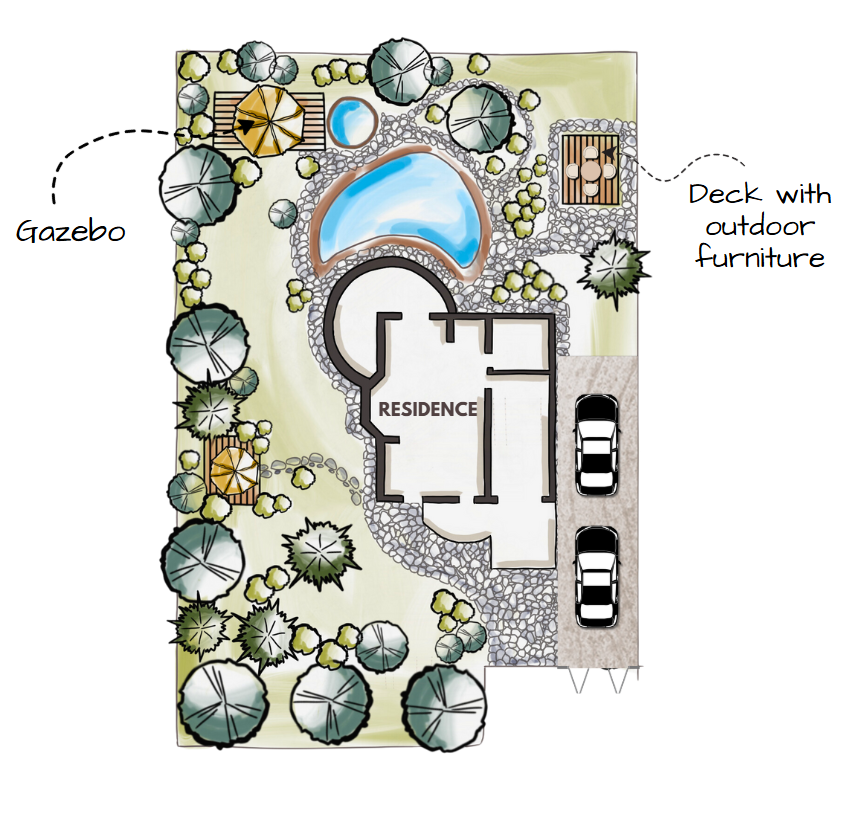
Illustration by Shivani Chougula @Kaarwan
Designers must consider material durability, ergonomics, and user comfort. For example, weather-resistant wood or powder-coated steel ensures longevity in different climates. Custom or modular furniture can complement the architectural language of adjacent structures.
The numbers here aren't arbitrary - they're the difference between furniture people actually use and furniture that just sits there looking correct in photographs. Seat height typically runs 400–450mm. Bench spacing for two people to sit comfortably needs around 1.2m of length; go tighter and it reads as a single-person perch, not seating.
Table clearance for knees and movement wants roughly 750mm. Between separate seating clusters, leave 1.5–2m if you want people to actually have a conversation rather than eavesdrop on the next group over. Weathering matters as much as comfort: teak and select hardwoods handle humid climates well, powder-coated steel resists corrosion better in coastal, salt-heavy air, and untreated softwoods will let you down fast in either. Placement decisions made without this math tend to produce landscapes that photograph beautifully and get used by nobody.
Thoughtfully chosen furniture transforms underutilized outdoor areas into active, engaging spaces.
How These Four Elements Work Together
Here's the thing nobody's definitional summary tells you: these four elements aren't independent choices you make in parallel. They're a sequence, and the order matters. Site planning generally moves survey → grading → hardscape circulation → vegetation zoning → water features → furniture - and each stage genuinely constrains the one after it.
Grading decides where water goes, which decides where hardscape can safely sit - you don't put a walkway at the bottom of a slope without solving drainage first, unless you enjoy pooled water on your paving every monsoon. Hardscape circulation, in turn, dictates where vegetation zones make sense - a canopy tree planted too close to a path means dealing with root heave and low branches within a few years. Canopy spread also constrains furniture placement; put a bench where a tree's mature spread will eventually shade or crowd it, and you're relocating furniture in year four. Water features need to sit where drainage and grading already cooperate, not fight against them.
Take a small residential plot as an example. Survey and grading come first - sorting out slope and natural water flow. Hardscape circulation follows, laying the driveway and main walkway along the flattest, most direct route. Vegetation zoning comes next: large canopy trees go where they won't conflict with the driveway's root zone, hedging goes along boundaries for privacy. A small water feature, if included, sits in a spot the grading already drains toward - never against it. Furniture goes in last, responding to whatever shade pattern the now-mature planting plan will eventually create.
Skip this sequence - say, decide furniture placement before vegetation zoning - and you spend years fighting decisions you made too early.
Landscape Elements in the Indian Context
Generic landscape guidance - the kind AI summaries hand out by default - mostly assumes a climate and a municipal context that doesn't map onto India. That gap is exactly where this section earns its keep.
Climate zone should drive vegetation choice before aesthetics do. Hot-dry regions call for drought-tolerant natives; warm-humid coastal zones need species that handle humidity and salt air without rotting; composite-climate zones across the northern plains need plants that survive both punishing summers and cold winters. Choosing based on a Pinterest board instead of a climate map is how landscapes fail within two seasons.
Monsoon dictates hardscape and drainage decisions in ways temperate-climate guides simply don't cover. Permeable paving reduces surface runoff during heavy rain. Swales - shallow, vegetated channels - redirect water away from structures instead of letting it pool. Plinth levels need to sit high enough above expected flood lines for the site and region, not just meet a generic building code minimum.
Water features come with real constraints here too - municipal water restrictions in many Indian cities make large, constantly-topped-up water bodies a genuine liability, not just an expense. Recirculating, low-evaporation designs are the more defensible choice, both for cost and for not being the landscape everyone side-eyes during a water shortage.
Material choice is often decided by what's actually available regionally, and at what cost - Kota stone, IPS (Indian Patent Stone) flooring, local quarried stone, and brick paving dominate Indian landscape work for a reason: they're regionally sourced, cost-effective, and proven in Indian conditions, unlike imported materials that look identical in a catalogue but perform differently in Indian heat and monsoon cycles.
Conclusion:
Landscape planning is a layered process that demands an understanding of both natural systems and architectural intent. The integration of vegetation, hardscape, water bodies, and outdoor furniture creates functional, sustainable, and visually cohesive environments. For architects, mastering these elements enables the design of landscapes that not only complement built forms but also elevate the human experience.
Frequently Asked Questions
What are the 4 elements of a landscape?
The four core elements of landscape architecture are vegetation (trees, shrubs, ground cover, and climbers), hardscape (paving, pathways, walls, steps, and built features), water bodies (ponds, fountains, streams, and reflecting pools), and outdoor furniture (seating, planters, lighting, and fixtures) - together, they define how any outdoor space looks, moves, and functions.
What is the difference between landscape design and landscape architecture?
Landscape design focuses on the aesthetic layout and planting of outdoor spaces, usually at a residential or small-site scale. Landscape architecture is the licensed professional discipline that goes further - covering grading, drainage, ecology, structural elements, and large-scale master planning for public and institutional projects.
What is the difference between hardscape and softscape?
Hardscape covers the non-living structural components - paving, walls, steps, decks, pergolas. Softscape covers the living material - trees, shrubs, lawns, ground cover, soil. Good landscape planning balances the two, since they handle circulation, drainage, and visual character together, not separately.
Which element should be planned first in landscape architecture?
Site grading and hardscape circulation come first, since they determine levels, drainage paths, and access. Vegetation zoning follows, then water features, with outdoor furniture placed last - it responds to whatever circulation and shade pattern the earlier decisions have already created.
What are the most common materials used in hardscape design?
Stone, concrete, brick, timber, and permeable pavers see the most use. Which one wins out depends on load, drainage needs, slip resistance, local availability, and how well it sits alongside the adjacent building's material palette.