


In the world of Building Information Modelling (BIM), understanding the roles within a firm can be overwhelming, especially for those entering the AECO industry (Architecture, Engineering, Construction, and Operations) or transitioning from traditional design practices. Whether you’re an aspiring BIM Coordinator, a curious architect, or an industry veteran navigating new technologies, knowing who does what in a BIM environment is crucial. From clash detection to digital twin creation, each role carries a unique responsibility that contributes to the overall delivery of a coordinated and efficient building model.
This guide breaks down every key position inside a BIM firm, what each role is responsible for, which software they use, and where each person sits in the BIM team structure — so you can understand the full picture, whether you are exploring a BIM career or joining a BIM team for the first time.
What Is a BIM Firm?
A BIM firm leverages digital design, documentation, and simulation tools to manage data-rich 3D models throughout the building lifecycle—from design to demolition. Such firms often specialise in design coordination, model authoring, clash detection, or offer end-to-end digital delivery solutions.
Their teams typically include experts from multiple disciplines, including architects, engineers, software specialists, and project managers, each playing a critical part in realising a building project through BIM workflows.
A typical BIM firm follows a clear team hierarchy that flows from strategy at the top down to execution at the ground level:
BIM Manager → BIM Coordinator → BIM Specialist → BIM Modeller → BIM Technician
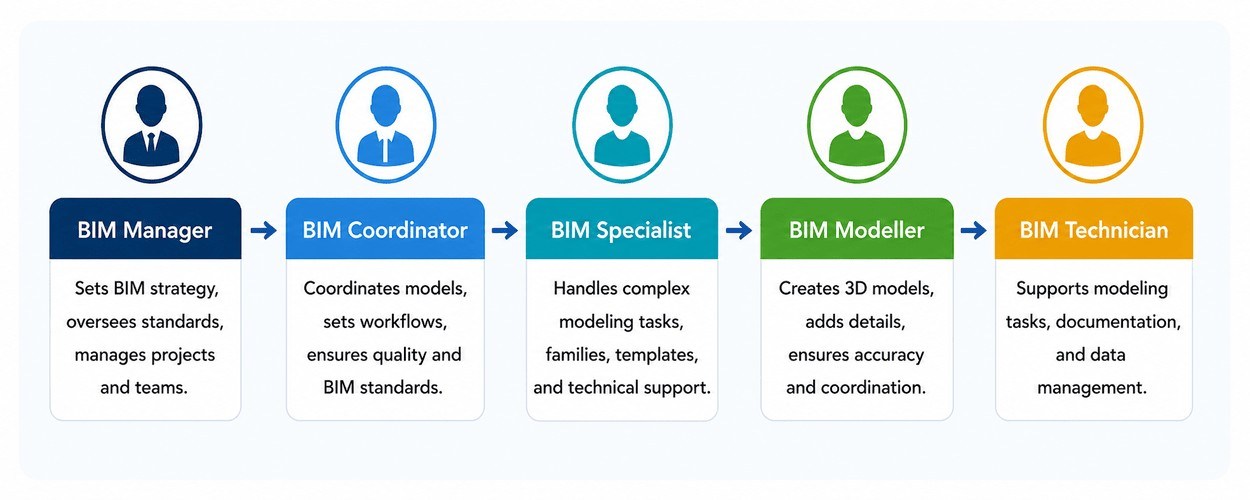
Supporting this core delivery team are the Information Manager and BIM Consultant, who operate across the project at an organisational and advisory level. Understanding where each role sits in this hierarchy is the key to understanding what each person actually does.
One thing worth flagging before we go role by role: some firms use the title "BIM Engineer" for a position that sits somewhere between Modeller and Specialist - part hands-on modelling, part light coordination. It's not wrong, it's just a different naming convention some firms lean on, and it trips people up more than it probably should. If you want to know what a BIM Engineer actually does and how the role stacks up against a BIM Manager's, we've broken it down separately in our BIM Engineer vs BIM Manager comparison.
How BIM Teams Are Structured - Small Firm vs. Large Firm
Here's the thing nobody tells you when you're trying to figure out where you'd fit in a BIM team: the org chart above is basically the textbook version. Five neat boxes, five separate people, each doing exactly one job. In real firms, that structure bends hard depending on size.
At a small or mid-sized practice - under 50 people, say - you'll rarely find five different humans in five different roles. More often, one person is wearing two or three hats. A "BIM Coordinator" at a 20-person office might also be doing half the Modeller's work themselves, simply because there's no headcount to split it further. The BIM Manager might just be the senior architect who happens to understand Revit standards better than anyone else, with BIM oversight eating maybe 30% of their actual week.
Larger firms - your L&Ts, AECOMs, WSPs - run it closer to the textbook. A dedicated BIM Manager oversees multiple project teams. Several Coordinators each own a different project or discipline. A pool of Modellers reports up through them. And there's often a standalone Information Manager sitting at the organisational level, managing the CDE across dozens of live projects at once. At that scale, the roles genuinely separate out, because the volume of work justifies it.
Practically, this means: don't take a job title at face value. A "BIM Coordinator" posting at a 15-person firm might quietly expect you to model as well. Read the actual responsibilities in the listing, not just the label on top of it.
Key BIM Roles and Their Responsibilities

1. BIM Manager – The Strategic Brain
The BIM Manager sits at the top of the hierarchy in terms of digital oversight. They define the BIM Execution Plan (BEP), coordinate between departments, manage software standards, and ensure that teams are trained to follow firm-wide protocols.
Key Responsibilities:
- Developing and maintaining BIM Standards and Protocols
- Ensuring compliance with ISO 19650 or other region-specific BIM standards
- Evaluating and integrating new technologies
- Overseeing BIM implementation across multiple projects
- Acting as the primary liaison for client-side BIM requirements
Common Google queries:
- What does a BIM Manager do daily?
- How much does a BIM Manager earn in the UK/India?
- Is BIM Management a good career option?
The BIM Manager does not model. They govern. If the project's BIM Execution Plan is the rulebook, the BIM Manager wrote it. Day-to-day, a BIM Manager spends time reviewing compliance, coordinating between departments, evaluating new tools, and responding to client-side BIM requirements. On larger projects, they may manage multiple coordinators simultaneously.
Typical tools: Revit, ProjectWise, Excel, CDE platforms
Salary in India: ₹18 LPA and above

2. BIM Coordinator – The Workflow Enforcer
Think of the BIM Coordinator as the technical executor of the BIM Manager’s vision. They translate the BEP into action, coordinate between different disciplines, and perform model validation to ensure accuracy.
Key Responsibilities:
- Interdisciplinary coordination between architectural, structural, and MEP models
- Running clash detection in software like Navisworks
- Coordinating model updates and submissions
- Maintaining federated models
- Providing support to model authors
Tools Used: Revit, Navisworks, Solibri, BIM Track, Revit, BIM 360
Common Google queries:
- What is the difference between a BIM Coordinator and a BIM Manager?
- Which software do BIM Coordinators use?
The most common question about this role is: what does a BIM Coordinator do differently from a BIM Manager? The answer is simple — the Manager sets the rules, the Coordinator enforces them on a live project every single day.
A BIM Coordinator's week typically involves merging discipline models, running clash detection in Navisworks, preparing clash reports, tracking revisions, and keeping the Common Data Environment updated for the whole team.
Curious what a week actually looks like in this seat, day to day? We've mapped it out in our full BIM Coordinator career guide.
Salary in India: ₹10 LPA – ₹18 LPA

3. BIM Modeller – The Digital Draughtsperson
Often the starting point for many professionals entering the BIM ecosystem, the BIM Modeller is responsible for 3D model creation. This role demands precision and a deep understanding of construction detailing.
Key Responsibilities:
- Authoring models in Revit, ArchiCAD, or Vectorworks
- Developing families, templates, and components
- Annotating sheets, detailing sections, and creating parametric elements
- Updating models based on redline comments or site changes
- Ensuring models are LOD-compliant (Level of Development)
Common Google queries:
- What does a BIM Modeller do in Revit?
- Is BIM Modelling a good career for architects?
For most freshers entering the BIM industry in India, the BIM Modeller role is the clearest and most accessible starting point. It does not require years of experience, it requires precision, patience, and strong Revit fundamentals.
The progression from BIM Modeller is well defined: Modeller → Specialist → Coordinator → Manager. Each step adds coordination responsibility on top of modelling skill.
Typical tools: Revit, ArchiCAD, Vectorworks, Twinmotion, Enscape
Salary in India: ₹4 LPA – ₹7 LPA fresher, ₹6 LPA – ₹10 LPA mid-level
Want to know the full BIM career path from Modeller to Manager? Read our complete guide: How to Become a BIM Specialist
If you're weighing whether this is the right entry point for you, our complete BIM Modeller career guide goes deeper into the day-to-day and the path out of it.
4. Computational BIM Specialist – The Automation Expert
This role merges coding with design. A Computational BIM Specialist uses tools like Dynamo, Grasshopper, and Python to create custom scripts that automate repetitive tasks and optimise performance.
Key Responsibilities:
- Creating visual scripts for automation
- Developing custom tools to simplify complex modelling tasks
- Assisting with data extraction and management
- Integrating GIS or IoT data into BIM models
- Supporting generative design and parametric workflows
Common Google queries:
- What is Dynamo in BIM?
- How do I become a Computational BIM Specialist?
This is the most future-proof role in any BIM firm right now. As firms push toward automation and data-driven delivery, the demand for professionals who can write Dynamo scripts and build custom workflows is growing faster than the supply.
Most Computational BIM Specialists start as modellers or architects and develop scripting skills on top of their design background — making it an ideal progression for technically curious professionals.
Typical tools: Dynamo, Grasshopper, Python, Rhino, Revit
Explore your high-tech niches, take our affordable masterclasses, clear your doubts, and understand the field before you fully invest your commitment into a niche career.
5. BIM Technician – The On-Ground Support
Supporting both coordinators and modellers, BIM Technicians are responsible for managing drawing sets, running quality control checks, and formatting sheets for submission.
Key Responsibilities:
- Printing and exporting models into 2D deliverables
- Supporting redline and mark-up reviews
- Applying templates and standards
- Assisting with data entry and COBie integration
For professionals who are new to BIM without a strong modelling background, the BIM Technician role offers real project exposure without the pressure of full model authoring. It is a practical foot in the door.
Typical tools: Revit, AutoCAD, Excel, COBie tools

6. Information Manager – The Data Gatekeeper
Operating at a project or organisational level, the Information Manager oversees the proper use, naming, storage, and classification of data according to ISO 19650.
Key Responsibilities:
- Managing the Common Data Environment (CDE)
- Implementing naming conventions
- Creating data drops and audits
- Ensuring metadata consistency
- Coordinating asset information requirements for handover
Common Google queries:
- Who is responsible for the CDE in BIM?
- What is the role of Information Management in BIM?
Who is responsible for the Common Data Environment in a BIM project? In most firms, that responsibility sits squarely with the Information Manager. As BIM mandates grow especially on government and international projects in India, this role is becoming non-negotiable rather than optional.
Typical tools: Asite, Viewpoint, BIM 360, Excel, COBie tools
7. BIM Consultant – The External Advisor
For clients unfamiliar with BIM workflows, BIM Consultants act as a bridge, offering onboarding services, training, audits, and implementation plans.
Key Responsibilities:
- Advising clients on BIM adoption and maturity
- Delivering training for internal teams
- Creating firm-specific templates and protocols
- Conducting model audits
- Assisting with digital twin implementation
For experienced BIM professionals with strong communication skills, the consulting path offers the highest earning potential in the BIM industry and the variety of working across multiple organisations and project types simultaneously.
Typical tools: Revit, Excel, PowerPoint, CDE platforms, Asite
BIM Software Skills by Role
| BIM Role | Primary Software | Secondary Tools |
|---|---|---|
| BIM Manager | Revit, Excel | ProjectWise, CDE platforms |
| BIM Coordinator | Navisworks, Solibri | BIM 360, BIM Track, Revit |
| BIM Modeller | Revit, ArchiCAD | Twinmotion, Enscape, Vectorworks |
| Computational BIM | Dynamo, Grasshopper | Python, Rhino, Revit |
| BIM Technician | Revit, AutoCAD | Excel, COBie tools |
| Information Manager | Asite, Viewpoint | Excel, COBie, BIM 360 |
| BIM Consultant | Revit, Excel | PowerPoint, CDE tools, Asite |
BIM Role Hierarchy and Salary in India (2026)
India's BIM industry is expanding rapidly driven by government infrastructure mandates, global AEC outsourcing, and adoption of ISO 19650 by major firms like L&T, Shapoorji Pallonji, and Tata Projects. Here is how the BIM role hierarchy maps to salary in the Indian market today.
| BIM Role | Experience | Salary Range (India) |
|---|---|---|
| BIM Technician | 0–1 year | ₹3 LPA – ₹5 LPA |
| BIM Modeller | 1–2 years | ₹4 LPA – ₹7 LPA |
| BIM Specialist | 2–4 years | ₹6 LPA – ₹10 LPA |
| BIM Coordinator | 4–7 years | ₹10 LPA – ₹18 LPA |
| BIM Manager | 7+ years | ₹18 LPA and above |
| Computational BIM | 3–6 years | ₹12 LPA – ₹22 LPA |
BIM professionals in India earn 20–40% more than non-BIM counterparts at the same experience level. MEP BIM and Computational BIM command the highest salaries, while civil and infrastructure BIM is the fastest-growing segment.
For the full salary breakdown by city and experience level, read our guide: BIM Salaries and Career Paths Role-Based Guide
Upskilling for BIM Roles
Interested professionals can upskill through structured training in tools like Revit, Navisworks, and Dynamo. Additionally, ISO 19650 certification, hands-on experience with CDE platforms, and BIM for Facilities Management are emerging areas that open doors to higher-paying roles.
Kaarwan's Free BIM Masterclass Course is one such platform helping young professionals bridge the knowledge gap by offering practical, affordable BIM education grounded in real-life industry workflows.
The BIM industry in India is growing faster than the talent pipeline can fill. Every role in this guide from BIM Technician to BIM Manager — is actively being hired for right now, and professionals with structured BIM training consistently earn 20–40% more than their non-BIM peers.
Understanding the roles is step one.
Building the skills is step two.
Start your BIM journey with Kaarwan's Professional BIM Certification Program
Which BIM Role Is Right for You?
Most people start from the BIM Modeller role if they step in as a fresher in the BIM Industry (computational designer role not included). Choosing a BIM role depends on your background, interests, and aptitude. :
- Prefer structure and rules? Information Management might suit you.
- Love problem-solving and scripting? Explore Computational BIM.
- Enjoy visuals and detail? Consider becoming a BIM Modeller or Visualisation Specialist.
- Want to lead teams? Aim for a BIM Manager with experience and certifications.
Each role in a BIM team is critical—not just for project delivery, but for creating a digitally resilient construction ecosystem. The industry is evolving fast, and by understanding these roles, you can better prepare for your next career move in digital construction.
Still not sure which BIM role matches your background and goals? Our detailed career guide walks you through every step — from choosing your first BIM tool to landing your first BIM job.
Read: How to Become a BIM Specialist — Full Career Guide
Frequently Asked Questions About BIM Roles and Responsibilities
1. What is the difference between a BIM Manager and a BIM Coordinator?
A BIM Manager sets the overall digital strategy — writing the BIM Execution Plan, defining standards, and managing compliance at the firm level. A BIM Coordinator executes that strategy on a live project — running clash detection, managing the federated model, and coordinating between disciplines every day. The Manager thinks firm-wide; the Coordinator operates project-wide.
2. What does a BIM Coordinator do on a day-to-day basis?
A BIM Coordinator merges discipline models into a federated model, runs clash detection using Navisworks or Solibri, prepares clash reports, tracks model revisions, and manages CDE workflows. It is the most active technical role in a live BIM project team.
3. What is the BIM role hierarchy inside a firm?
The standard BIM hierarchy runs: BIM Manager → BIM Coordinator → BIM Specialist → BIM Modeller → BIM Technician. Information Managers and BIM Consultants operate across this hierarchy at an organisational or advisory level.
4. Which BIM role is best for freshers in India?
The BIM Modeller role is the most accessible entry point for architecture and engineering freshers. It requires Revit proficiency and basic construction documentation knowledge. With 2–3 years of experience, a BIM Modeller typically progresses to BIM Specialist and then BIM Coordinator.
5. What is the salary of a BIM Manager in India?
A BIM Manager in India earns ₹18 LPA and above depending on firm, city, and project type. The role typically requires 7+ years of BIM experience and strong knowledge of ISO 19650 and digital delivery standards.
6. What is a BIM Specialist and how is it different from a BIM Modeller?
A BIM Modeller creates and builds the 3D model. A BIM Specialist has moved beyond modelling into coordination — understanding clash detection, BIM standards compliance, and cross-discipline workflows. The Specialist role sits between Modeller and Coordinator in the BIM hierarchy.
7. Who is responsible for the Common Data Environment in a BIM project?
The Information Manager is responsible for managing the CDE — controlling file workflows, naming conventions, revision management, and information drops across all project stages in line with ISO 19650.




.png)