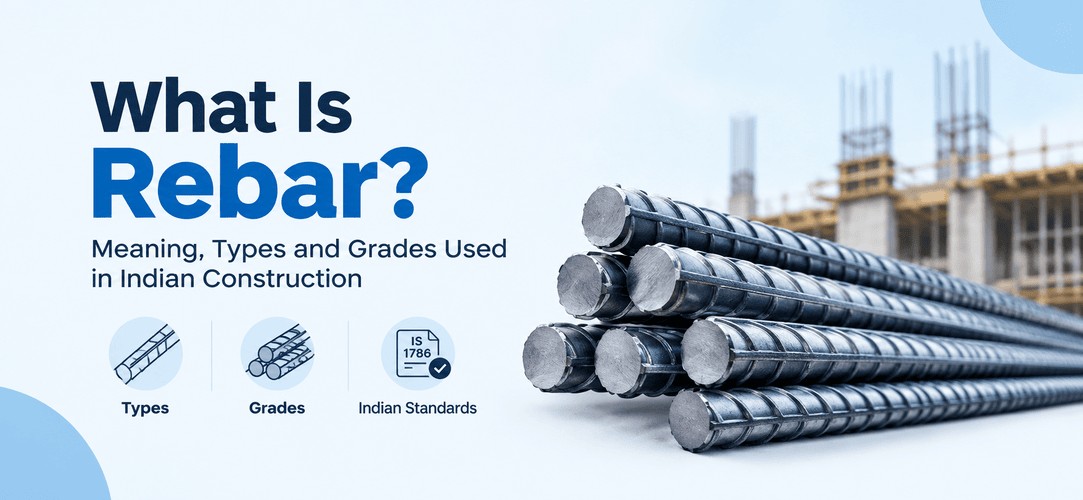
Rebar, short for reinforcing bar, is a steel bar placed inside concrete to carry the tension that concrete cannot. Concrete is strong when squeezed and weak when pulled, so beams, slabs, columns and footings in RCC buildings all carry rebar.
In India, most of it is TMT (thermo-mechanically treated) ribbed bar made to IS 1786:2008, in grades such as Fe 500 and Fe 500D. This guide covers the rebar meaning, the main types, how to read a grade like Fe 500D, and where each one gets used.
It's a big material, too. India's finished steel consumption in FY 2025-26 was about 163.7 million tonnes, per provisional JPC data, with construction and infrastructure among the demand drivers the Ministry of Steel named. A lot of that ends up hidden inside concrete, doing a job nobody sees.
What Is Rebar?
Rebar is a steel bar, ribbed or plain, placed inside concrete to take the pulling and bending forces concrete can't handle alone. The name is short for reinforcing bar. In India you'll also hear it called reinforcement steel, TMT bar or saria. Steel and concrete together make RCC (reinforced cement concrete), the backbone of most buildings here.
Rebar Meaning: Why Concrete Needs It
Squeeze a concrete block and it takes a huge load. Pull it or bend it and it cracks early. That's the whole reason rebar exists.
Take a simple beam resting on two walls. Load comes down, the top of the beam gets squeezed (compression) and the bottom gets stretched (tension). Concrete handles the top just fine. The bottom is where the main bars sit, quietly doing the pulling work.
Two things make the partnership click. Steel and concrete expand and contract by almost the same amount when temperature changes, so they don't tear apart from each other. And concrete is alkaline, which keeps steel from rusting as long as there's enough cover (the layer of concrete between the bar and the outer surface). If cover or other site terms feel fuzzy, these RCC terms explained will help.
Rebar vs Reinforcement vs TMT Bar vs Saria: Are They the Same?
Mostly yes. Same thing, different words. TMT bar vs rebar is the one people trip on, because TMT is a type of rebar, not a synonym.
| Term | What it means | Where you'll hear it |
| Rebar | General term for steel bars placed in concrete | Textbooks, online, drawings |
| Reinforcement | The whole steel system: bars, stirrups, mesh | Structural drawings, IS codes |
| TMT bar | A rebar made by thermo-mechanical treatment | Most Indian sites today |
| Saria / sariya | Everyday Hindi word for rebar, usually TMT | Dealers, contractors, bills |
So every TMT bar is rebar, but not every rebar is TMT.
Model rebar in Revit instead of drawing every bar by hand. Rebar, Steel and Fabrication is part of Kaarwan's BIM Certification Program for Civil Engineers.
Types of Rebar Used in India
Here's the list most Indian engineers will actually run into. Your structural engineer decides which one a project gets.
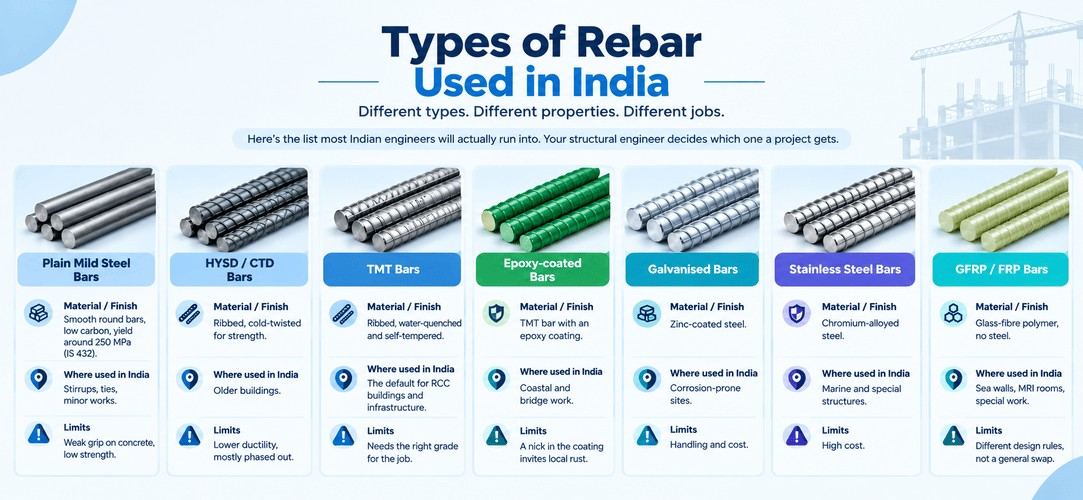
| Type | Material or finish | Where used in India | Limits |
| Plain mild steel bars | Smooth round bars, low carbon, yield around 250 MPa (IS 432) | Stirrups, ties, minor works | Weak grip on concrete, low strength |
| HYSD / CTD bars | Ribbed, cold-twisted for strength | Older buildings | Lower ductility, mostly phased out |
| TMT bars | Ribbed, water-quenched and self-tempered | The default for RCC buildings and infrastructure | Needs the right grade for the job |
| Epoxy-coated bars | TMT bar with an epoxy coating | Coastal and bridge work | A nick in the coating invites local rust |
| Galvanised bars | Zinc-coated steel | Corrosion-prone sites | Handling and cost |
| Stainless steel bars | Chromium-alloyed steel | Marine and special structures | High cost |
| GFRP / FRP bars | Glass-fibre polymer, no steel | Sea walls, MRI rooms, special work | Different design rules, not a general swap |
TMT deserves a quick explanation. At the mill, the hot bar is sprayed with water, so the outer skin hardens fast while the core stays hot and tempers itself as it cools. You end up with a tough outer layer (martensite) around a softer, more ductile core (ferrite-pearlite). Strong outside, forgiving inside. That mix is why TMT took over from the older cold-twisted bars.
Plain vs Deformed (Ribbed) Bars: Why the Ribs Matter
A plain bar holds on to concrete mostly through friction and end hooks. A ribbed bar gets mechanically locked in by its ribs, so force passes from steel to concrete much more reliably. That's why main tension bars in Indian RCC are ribbed. Plain bars survive mostly as stirrups and ties in smaller jobs, and only where the design allows.
Also Read: Beam Reinforcement Details in RCC
Rebar Grades as per IS 1786:2008: How to Read Fe 415, Fe 500, Fe 500D and More
IS 1786:2008 is the Indian standard for these bars, and the IS 1786 grades follow one simple code. "Fe" stands for iron (ferrum) and the number is the minimum yield strength in N/mm² (MPa). A "D" at the end means the same yield strength but tougher ductility requirements.
Values below are from Table 3 of the standard as amended by BIS:
| Grade | Min yield (MPa) | Min TS/YS ratio (and min tensile strength) | Min elongation | Typical use |
| Fe 415 | 415 | 1.10 (485 MPa) | 14.5% | Older designs, still specified sometimes |
| Fe 415D | 415 | 1.12 (500 MPa) | 18.0% | Where a lower grade with high ductility is called for |
| Fe 500 | 500 | 1.08 (545 MPa) | 12.0% | General residential and commercial RCC |
| Fe 500D | 500 | 1.10 (565 MPa) | 16.0% | Seismic zones, ductile frames |
| Fe 550 | 550 | 1.06 (585 MPa) | 10.0% | Heavier loads, congested bar layouts |
| Fe 550D | 550 | 1.08 (600 MPa) | 14.5% | Heavy structures that also need ductility |
| Fe 600 | 600 | 1.06 (660 MPa) | 10.0% | Heavy infrastructure, specialist use |
Heads up: if you've seen Fe 500D quoted at 18% elongation on some page online, that's the Fe 415D number leaking across. The standard gives 16.0% for Fe 500D.
A higher number isn't automatically better. Stronger steel can mean less bar, but elongation drops and anchorage needs go up, which is why lap length changes when the grade changes. The engineer picks the grade. The IS codes for reinforcement tell them how.
Fe 500 vs Fe 500D: What the D Means
Both have the same 500 MPa yield. The D grade just stretches further before it snaps: at least 16% elongation against 12%, a higher tensile-to-yield ratio (1.10 against 1.08), and tighter chemistry. Fe 500D caps carbon at 0.25% and sulphur and phosphorus at 0.040% each. Plain Fe 500 allows 0.30% carbon and 0.055% each.
Why care? In an earthquake, a beam or column is expected to bend and deform without breaking suddenly. Steel that can stretch gives the frame time. Around 59% of India's land area falls in Seismic Zones III to V, so this isn't a niche worry.
Picture a G+8 apartment block in Guwahati, which sits in Zone V. The drawings say Fe 500D for all main bars, and the dealer offers cheaper Fe 500, "same strength." Same yield, yes. But IS 13920:2016 (ductile detailing) wants reinforcement with elongation of at least about 14.5%, and plain Fe 500 only guarantees 12%. Swapping it isn't saving money. It's changing the design without telling the engineer.
Rebar Sizes in One Table
Sizes run from 6 mm to 40 mm for most building work. Treat this as a rough guide, not a design.
| Bar size | Commonly used for |
| 6, 8 mm | Stirrups, ties, distribution bars |
| 10 mm | Stirrups, slab bars, secondary steel |
| 12, 16, 20 mm | Beams, columns, lintels |
| 25, 32, 40 mm | Heavy columns, footings, high-rise, bridges |
For weights per metre and per bar, use the TMT bar weight chart.
Where Rebar Goes in a Building
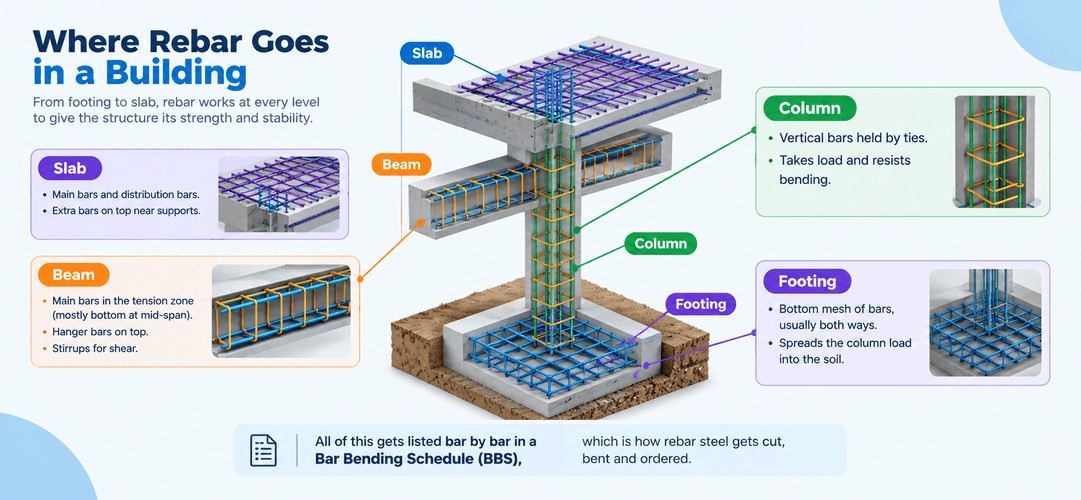
- Footing: a bottom mesh of bars, usually both ways, spreading the column load into the soil.
- Column: vertical bars held by ties, taking load and resisting bending.
- Beam: main bars in the tension zone (mostly the bottom at mid-span), hanger bars on top, stirrups for shear. See how rebar is placed in a beam.
- Slab: main bars and distribution bars, with extra bars on top near supports. See how rebar is placed in a slab.
All of this gets listed bar by bar in a bar bending schedule, which is how rebar steel gets cut, bent and ordered.
Know your Fe 500 from your Fe 500D? Take it into Structural Modelling (RCC), part of Kaarwan's BIM Certification Program for Civil Engineers.
How to Check Rebar on Site
You don't need a lab to catch the obvious problems.
- Mill test certificate: check grade, heat number, yield and elongation for the lot actually delivered.
- Markings: the rolled-in marks on the ribs should match the paperwork.
- Weight: weigh a cut length and compare it with the chart. A big shortfall means a bar thinner than its label.
- Rust: light surface rust is usually fine. Flaking scale or deep pitting is not.
- Bend test: bend a sample bar around the right mandrel. Cracks on the outer curve mean rejection.
- Storage: keep bars off the ground, away from mud and standing water.
That's rebar in construction, start to finish: a bar, a grade and a placement, all matching the drawing. And if you'd rather model rebar in Revit than draw every bar by hand, there's the Professional BIM Certification Program for Civil Engineers.
FAQs
What is the meaning of rebar?
Rebar is short for reinforcing bar, a steel bar placed inside concrete to carry tension and bending forces. It's what turns plain concrete into RCC.
What is the difference between rebar and TMT bar?
Rebar is the general term for any steel reinforcement in concrete. A TMT bar is one type, made by water-quenching and self-tempering at the mill. It's the most common rebar steel in Indian construction.
What are the types of rebar used in construction?
Plain mild steel bars, HYSD/CTD bars, TMT bars, epoxy-coated, galvanised, stainless steel and GFRP bars. In India, TMT is the default for buildings, and the coated or special types show up where corrosion is a concern.
What does Fe 500D mean?
Fe stands for iron, 500 is the minimum yield strength in MPa, and D means enhanced ductility. IS 1786 requires at least 16% elongation for Fe 500D, against 12% for plain Fe 500.
What is the difference between plain and deformed bars?
Plain bars are smooth and grip concrete mainly through friction and hooks. Deformed bars have ribs that lock into the concrete, so they bond far better and carry the main tension in RCC.
Which rebar grade is used in India for houses?
Whatever the structural drawing specifies, most often Fe 500 or Fe 500D. In seismic zones the engineer will usually call for a D grade, so don't switch grades on price alone.
Why is rebar used in concrete?
Concrete is strong in compression but weak in tension. Rebar takes the tension, which helps beams, slabs and columns carry load without cracking and failing early.